
Ionic and Covalent Bonding
Students use valence electrons and electronegativity patterns to explain how ionic and covalent bonds form and how bonding influences material properties.

Illustrations are auto-generated and may be placeholders. They can be refreshed to match the narration.
Valence Electrons and Stability
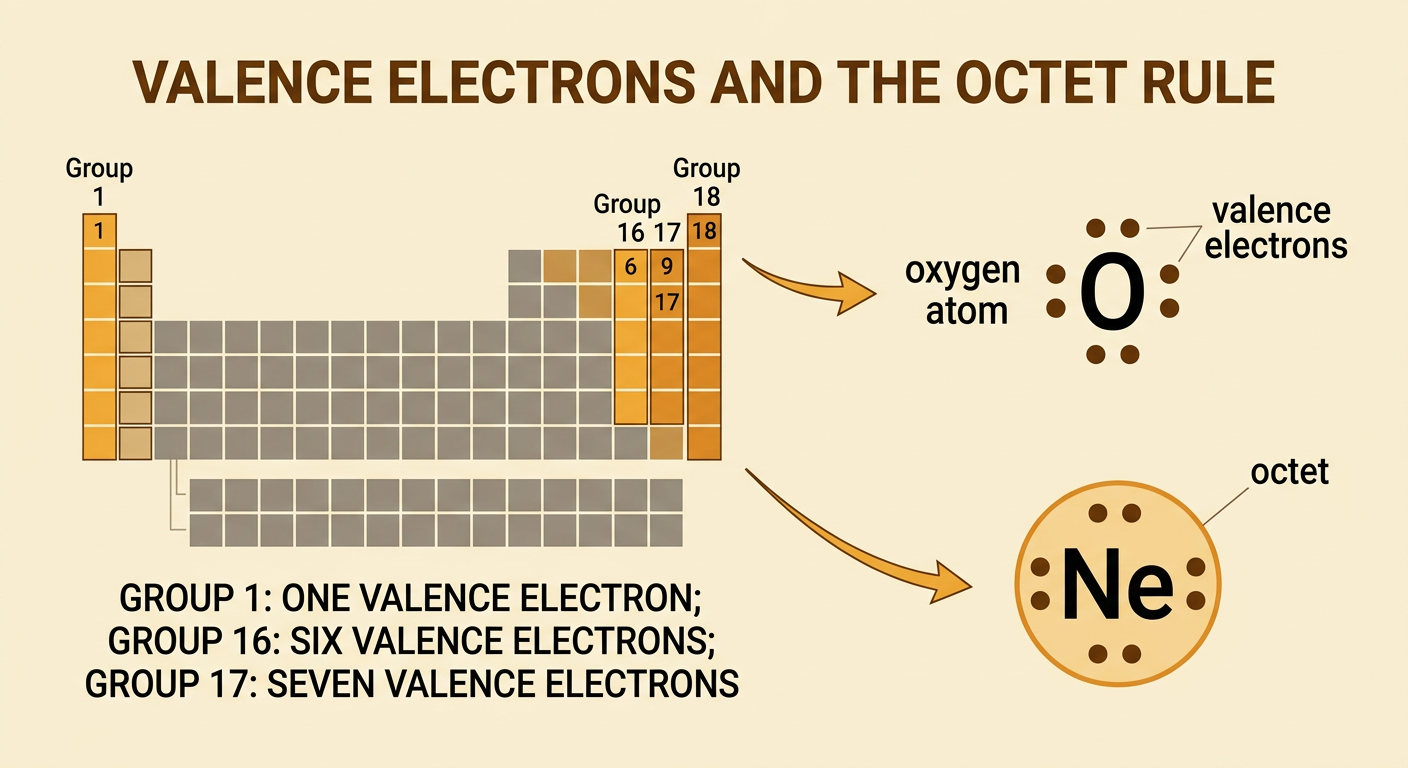
Valence electrons are the electrons in an atom’s outermost occupied energy level. They are the electrons most involved in chemical bonding. For many main-group elements, atoms are especially stable when their outer level contains eight electrons, called an octet. Hydrogen and helium are stable with two. The periodic table helps predict valence electrons: elements in Group 1 have one, Group 16 have six, and Group 17 have seven. For example, an oxygen atom has six valence electrons. It can reach an octet by gaining two electrons or by sharing two pairs of electrons with other atoms. Lewis dot diagrams represent valence electrons as dots around an element symbol. These diagrams help explain and predict how atoms combine, although the octet rule is a useful pattern rather than a rule that applies to every element and compound.
Electron Transfer in Ionic Bonds
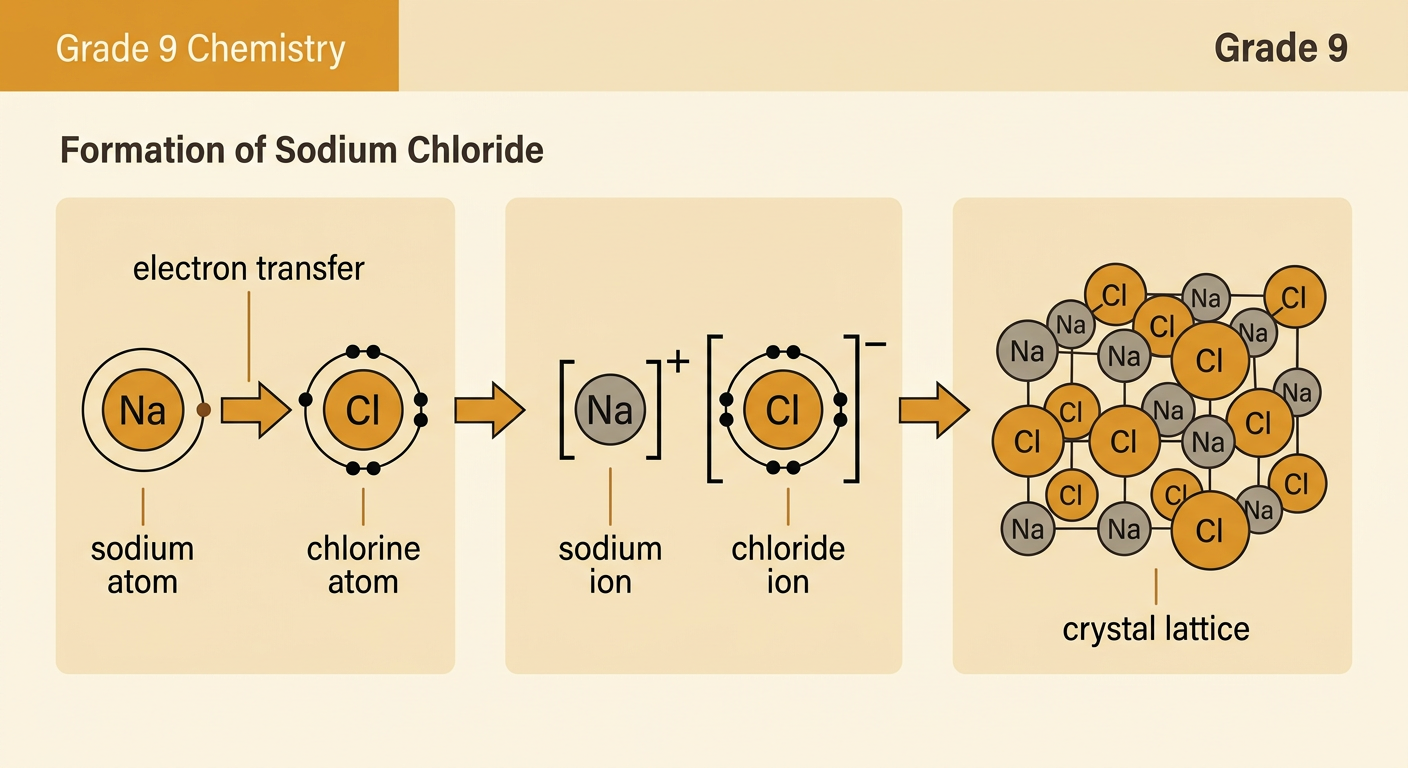
An ionic bond forms when electrons are transferred from one atom to another, producing oppositely charged ions. Metals tend to lose valence electrons and become positive cations, while nonmetals tend to gain electrons and become negative anions. For example, a sodium atom has one valence electron, and a chlorine atom has seven. Sodium transfers its outer electron to chlorine. Sodium then becomes Na positive, and chlorine becomes Cl negative; each has a more stable outer electron arrangement. The electrical attraction between these opposite charges holds the ions together. In solid sodium chloride, the ions form a repeating three-dimensional crystal lattice rather than separate NaCl molecules. The formula NaCl shows a one-to-one ratio of sodium ions to chloride ions, making the compound electrically neutral overall.
Electron Sharing in Covalent Bonds
A covalent bond forms when atoms share one or more pairs of valence electrons. Covalent bonding usually occurs between nonmetal atoms. Each shared pair is attracted to both positively charged nuclei, holding the atoms together. In a water molecule, oxygen has six valence electrons, and each hydrogen has one. Oxygen shares one electron pair with each hydrogen, forming two single covalent bonds. Each hydrogen then has access to two electrons, while oxygen has access to eight electrons when its two lone pairs are included. The electrons are not shared equally because oxygen attracts them more strongly than hydrogen does. This makes each oxygen-hydrogen bond polar: oxygen has a partial negative charge, and the hydrogen atoms have partial positive charges. Unlike an ionic lattice, water consists of individual molecules.

Using Electronegativity to Classify Bonds
Electronegativity measures how strongly an atom attracts shared or transferred bonding electrons. It generally increases from left to right across a period and increases upward within a group on the periodic table. The difference between the electronegativities of two bonded atoms helps classify the bond. A very small difference usually indicates a nonpolar covalent bond, as in Cl2, where both atoms attract electrons equally. A moderate difference usually indicates a polar covalent bond, as in HCl, where chlorine attracts the shared electrons more strongly. A large difference often indicates ionic bonding, as in NaCl, where the electron distribution is best described as transfer to form ions. Approximate classroom boundaries are 0.0 to 0.4 for nonpolar covalent, 0.5 to 1.7 for polar covalent, and above 1.7 for ionic. These boundaries are guidelines because bonding exists along a continuum.

Bonding and Material Properties
Bonding and particle structure influence measurable properties such as melting point, brittleness, solubility, and electrical conductivity. Ionic solids such as sodium chloride contain a lattice of charged ions held by strong electrical attractions. They often have high melting points and are brittle. Solid sodium chloride does not conduct electricity because its ions cannot move, but melted or dissolved sodium chloride conducts because the ions are mobile. Many molecular covalent substances, such as sugar, have lower melting points than ionic solids and do not conduct electricity because they lack mobile charged particles. However, network covalent solids such as diamond are important exceptions and can have very high melting points. Students can compare equal samples by testing solubility, conductivity before and after dissolving, and melting behavior using safe procedures. Recorded observations provide evidence for inferring particle structure and the relative strength of electrical forces. A strong explanation should cite specific results and connect them logically to a bonding model.
