
Ionic and Covalent Bonding: Predicting Lewis Structures
Students use valence electrons and periodic table patterns to distinguish ionic from covalent bonding and construct Lewis structures for common compounds.

Illustrations are auto-generated and may be placeholders. They can be refreshed to match the narration.
Valence Electrons and Stable Configurations
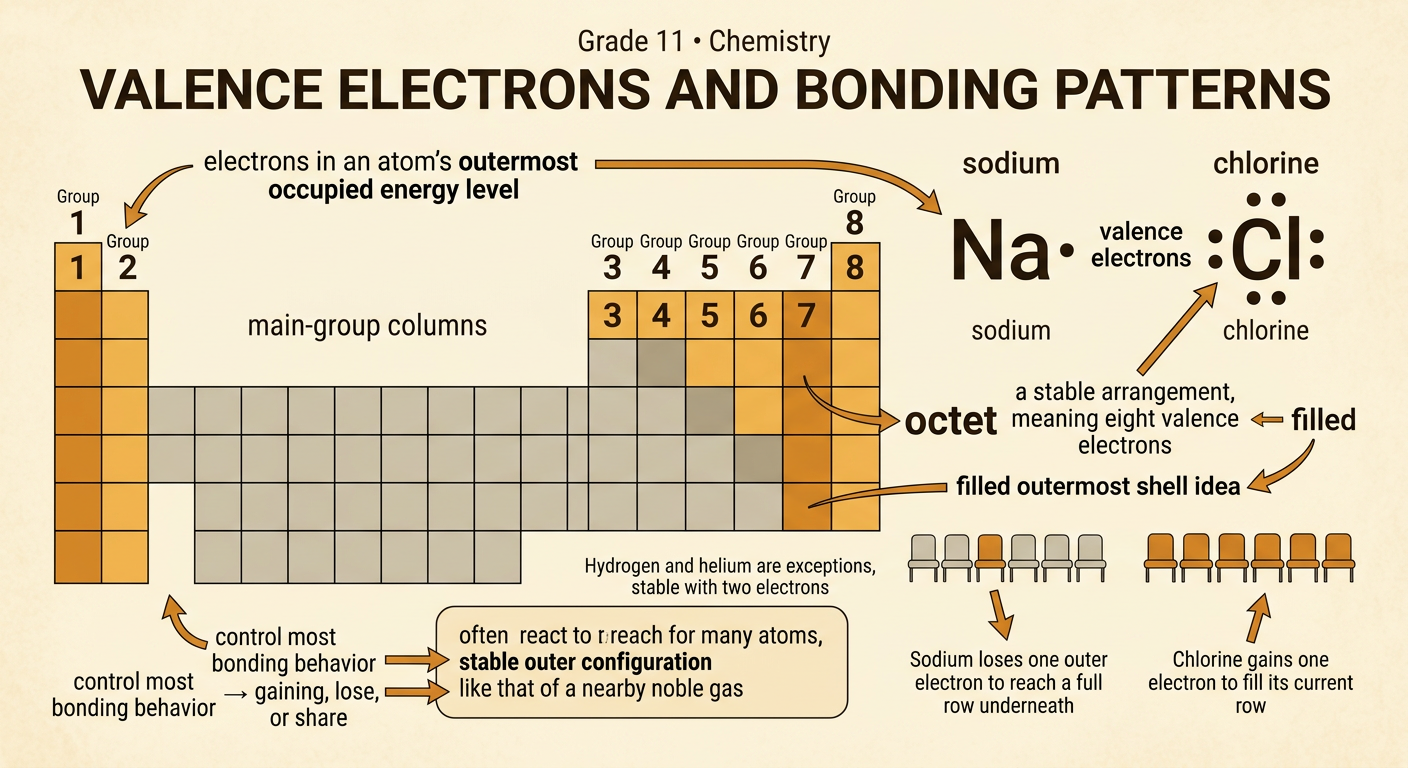
Valence electrons are the electrons in an atom’s outermost occupied energy level. They control how the atom usually bonds. For main-group elements, the group number helps identify the number of valence electrons. Sodium, in Group 1, has one valence electron, while chlorine, in Group 17, has seven. Atoms often gain, lose, or share electrons to reach a stable configuration like that of a nearby noble gas. For many atoms, this means having eight valence electrons, called an octet. Hydrogen and helium are stable with two electrons instead. Sodium can become stable by losing one electron, and chlorine can become stable by gaining one. Periodic table patterns therefore provide evidence for predicting which elements will react and what kinds of bonds they are likely to form.
Electron Transfer in Ionic Bonds
An ionic bond forms when electrons are transferred from one atom to another, producing oppositely charged ions that attract each other. This usually occurs between a metal and a nonmetal. Magnesium has two valence electrons and tends to lose both, forming Mg²⁺. Each chlorine atom has seven valence electrons and tends to gain one, forming Cl⁻. Therefore, one magnesium atom transfers one electron to each of two chlorine atoms. The resulting formula is MgCl₂ because two chloride ions are needed to balance the charge of one magnesium ion. In a Lewis model of the ions, Mg²⁺ has no dots, while each bracketed Cl⁻ has a complete octet. The compound is electrically neutral because the total positive charge and total negative charge are equal.

Electron Sharing in Covalent Bonds
A covalent bond forms when atoms share one or more pairs of valence electrons. Covalent bonding usually occurs between nonmetals because neither atom readily loses enough electrons to form a stable ion. In a water molecule, oxygen has six valence electrons, and each hydrogen has one. Oxygen shares one electron pair with each hydrogen, producing two single covalent bonds. Each shared pair counts for both bonded atoms. As a result, oxygen has access to eight electrons around it, while each hydrogen has access to two. Oxygen also retains two lone pairs, which are pairs of valence electrons not used in bonding. The Lewis structure H–O–H represents the bonding pairs with lines and the lone pairs with dots. Unlike an ionic compound, water consists of distinct molecules.

Constructing Lewis Structures
To construct a Lewis structure, first count all valence electrons. Next, choose a central atom, usually the least electronegative element other than hydrogen, and connect the surrounding atoms with single bonds. Subtract the bonding electrons from the total, then place the remaining electrons around outer atoms before completing the central atom’s octet. For carbon dioxide, CO₂, carbon contributes four valence electrons and the two oxygen atoms contribute twelve, giving sixteen total. A first arrangement of O–C–O uses four electrons in two single bonds. Completing both oxygen octets leaves carbon without an octet. Converting one lone pair from each oxygen into a bonding pair creates O=C=O. The final structure has two double bonds, two lone pairs on each oxygen, no formal charges, and sixteen electrons represented overall.

Using Bonding Models to Predict Compound Formation
Bonding models help predict whether elements will form a compound and what formula is most reasonable. Begin with periodic table evidence: metals generally lose electrons, while nonmetals gain or share them. Calcium, a Group 2 metal, tends to form Ca²⁺. Fluorine, a Group 17 nonmetal, tends to form F⁻. Charge balance requires two fluoride ions for every calcium ion, so the predicted ionic formula is CaF₂. In contrast, carbon and chlorine are both nonmetals, so they are more likely to share electrons. Carbon needs four additional electrons for an octet, and each chlorine typically forms one covalent bond. The model therefore predicts CCl₄, with four C–Cl single bonds. A strong explanation connects the observed valence-electron patterns to electron transfer or sharing and then checks that the model gives stable outer configurations and, for ionic compounds, a neutral total charge.
