
Ionic and Covalent Bonding: Structure and Properties
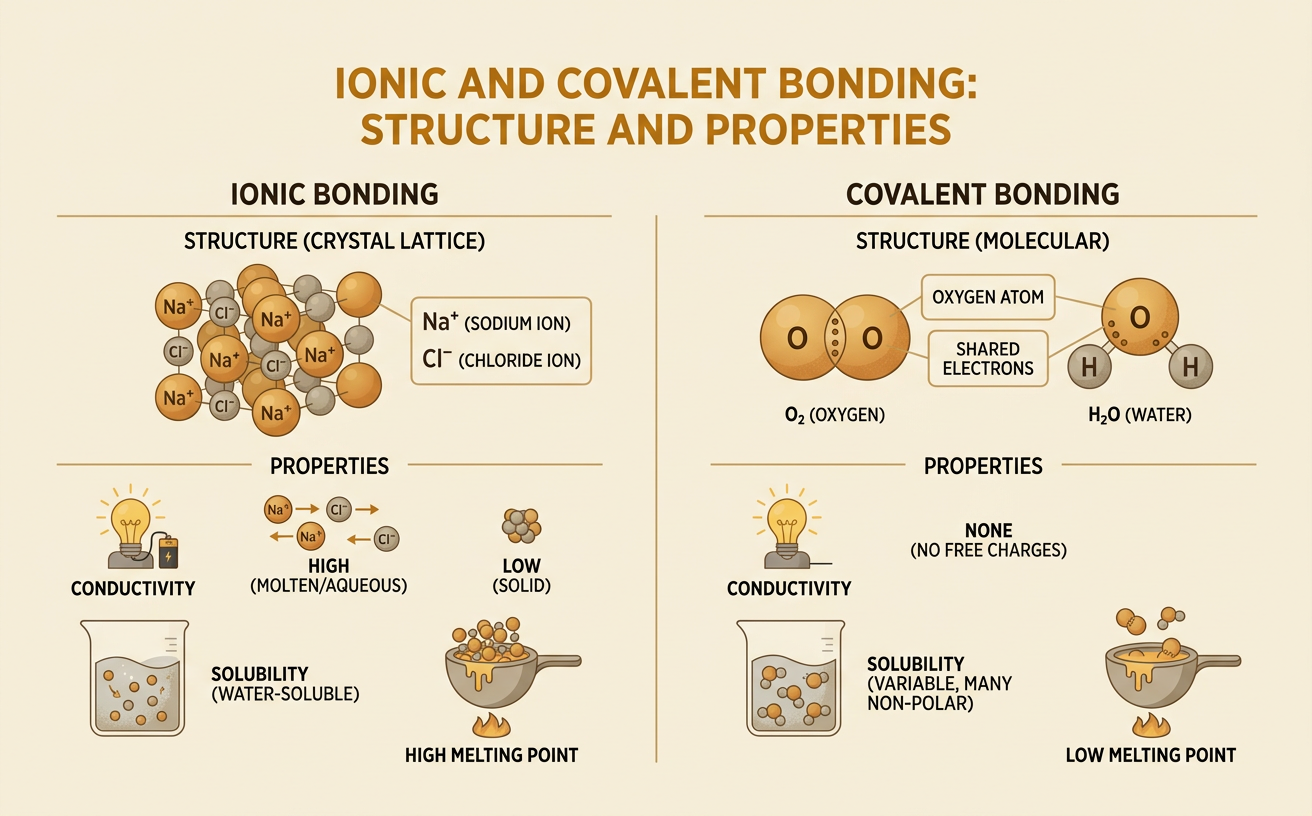
Students use particle models and property data to distinguish ionic from covalent bonding and explain how bond type affects conductivity, solubility, and melting point.
Illustrations are auto-generated and may be placeholders. They can be refreshed to match the narration.
Valence Electrons and Bond Formation
Valence electrons are the electrons in an atom’s outermost occupied energy level. They largely determine how that atom bonds with other atoms. Atoms may transfer or share valence electrons to reach a lower-energy, more stable arrangement. For many main-group elements, this arrangement has eight valence electrons, although hydrogen is stable with two. Bond formation involves electrical attractions: negatively charged electrons are attracted to positively charged nuclei, and oppositely charged ions attract one another. Lewis electron-dot models represent valence electrons as dots around an element’s symbol. For example, magnesium has two valence electrons, while oxygen has six. Their electron arrangements suggest that magnesium can lose two electrons and oxygen can gain two, producing stable ions that attract each other. Models help predict bonding, but they simplify the actual three-dimensional distribution of electrons.

Electron Transfer in Ionic Bonds
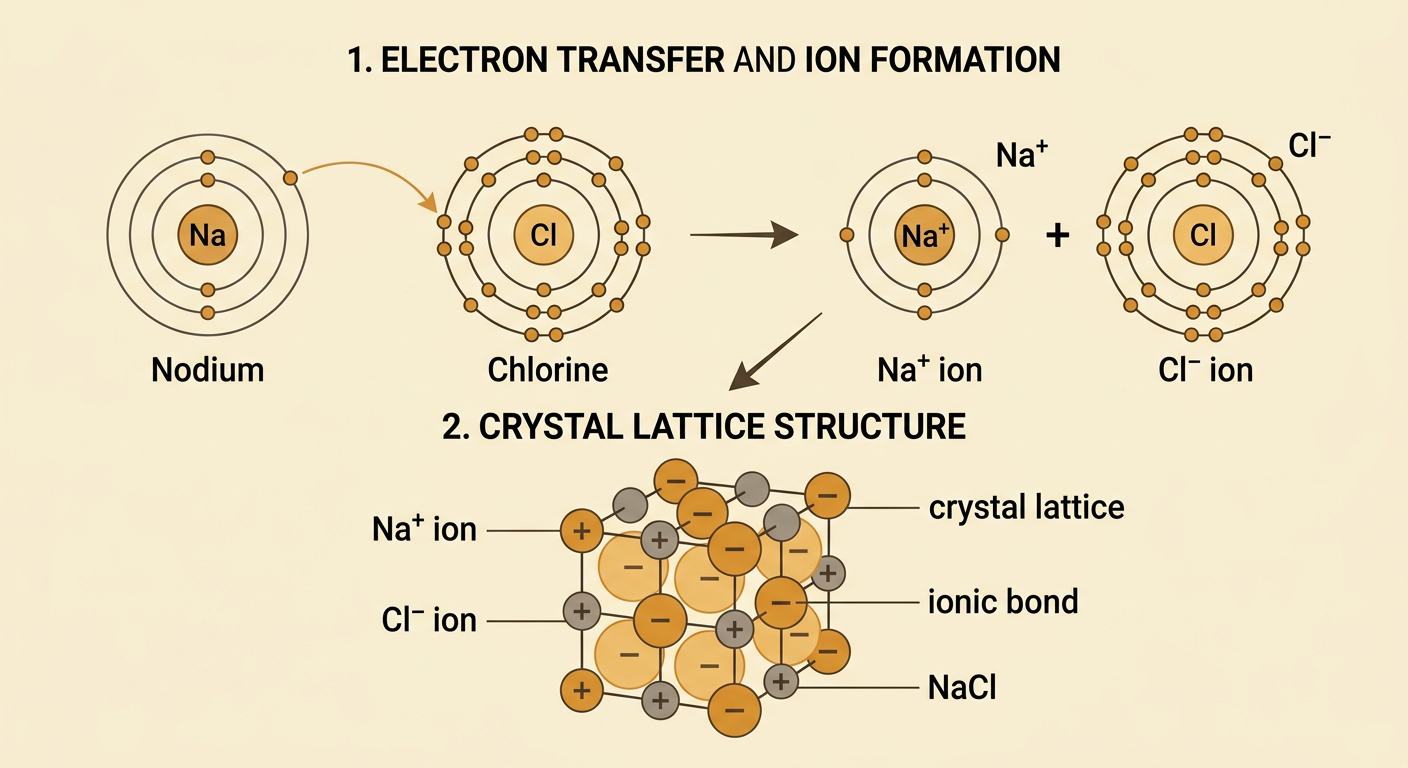
An ionic bond forms when electrons are transferred and the resulting positive and negative ions attract each other. Sodium has one valence electron and chlorine has seven. When sodium transfers its electron to chlorine, sodium becomes a Na+ ion and chlorine becomes a Cl− ion. Each ion then has a more stable outer electron arrangement. The attraction between opposite charges holds the ions together. In solid sodium chloride, the ions do not exist as separate NaCl molecules. Instead, they repeat in a three-dimensional crystal lattice, with each ion surrounded by ions of opposite charge. The chemical formula NaCl gives the simplest whole-number ratio of sodium ions to chloride ions. Strong electrical attractions throughout the lattice help explain why sodium chloride is a hard solid with a high melting point.
Electron Sharing in Covalent Bonds
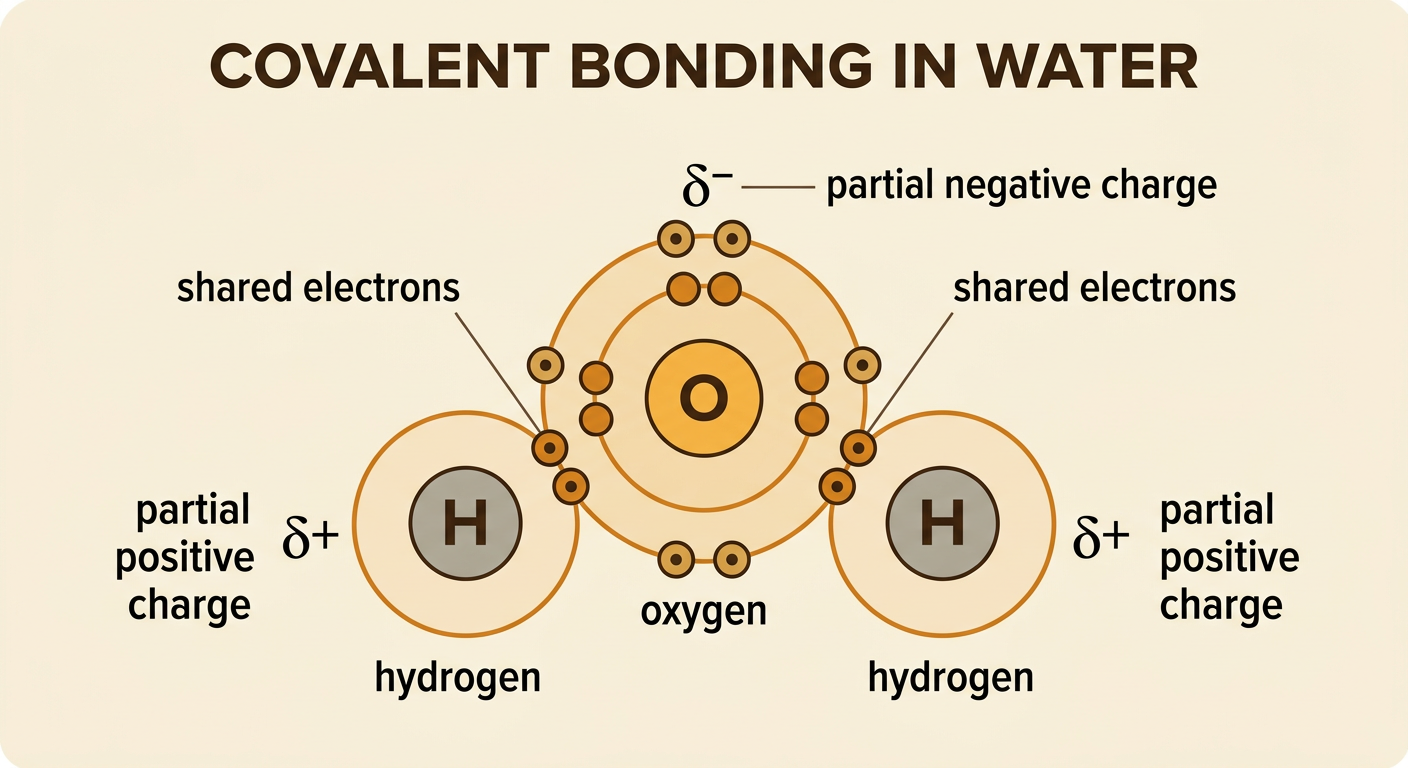
A covalent bond forms when atoms share one or more pairs of valence electrons. This type of bonding usually occurs between nonmetal atoms. In a water molecule, oxygen shares one pair of electrons with each of two hydrogen atoms. Each hydrogen gains access to two electrons, while oxygen gains access to eight valence electrons. The shared electrons are attracted to both bonded nuclei, holding the atoms together. However, oxygen attracts the shared electrons more strongly than hydrogen does. This unequal sharing makes each O–H bond polar, giving oxygen a partial negative charge and hydrogen a partial positive charge. Covalent substances may consist of separate molecules, such as water and carbon dioxide, or continuous networks, such as diamond. Their properties depend on both the covalent bonds and the attractions between particles.
Modeling Compound Structures
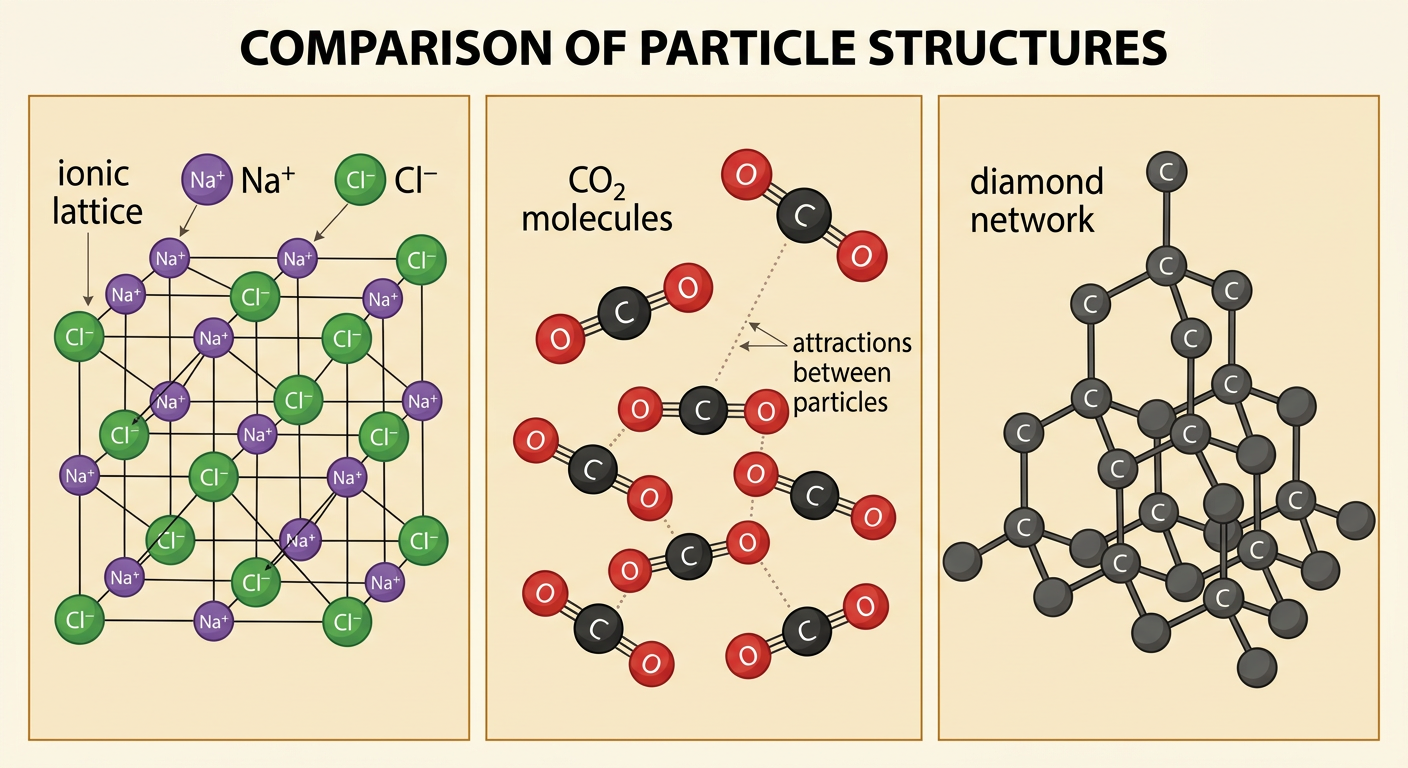
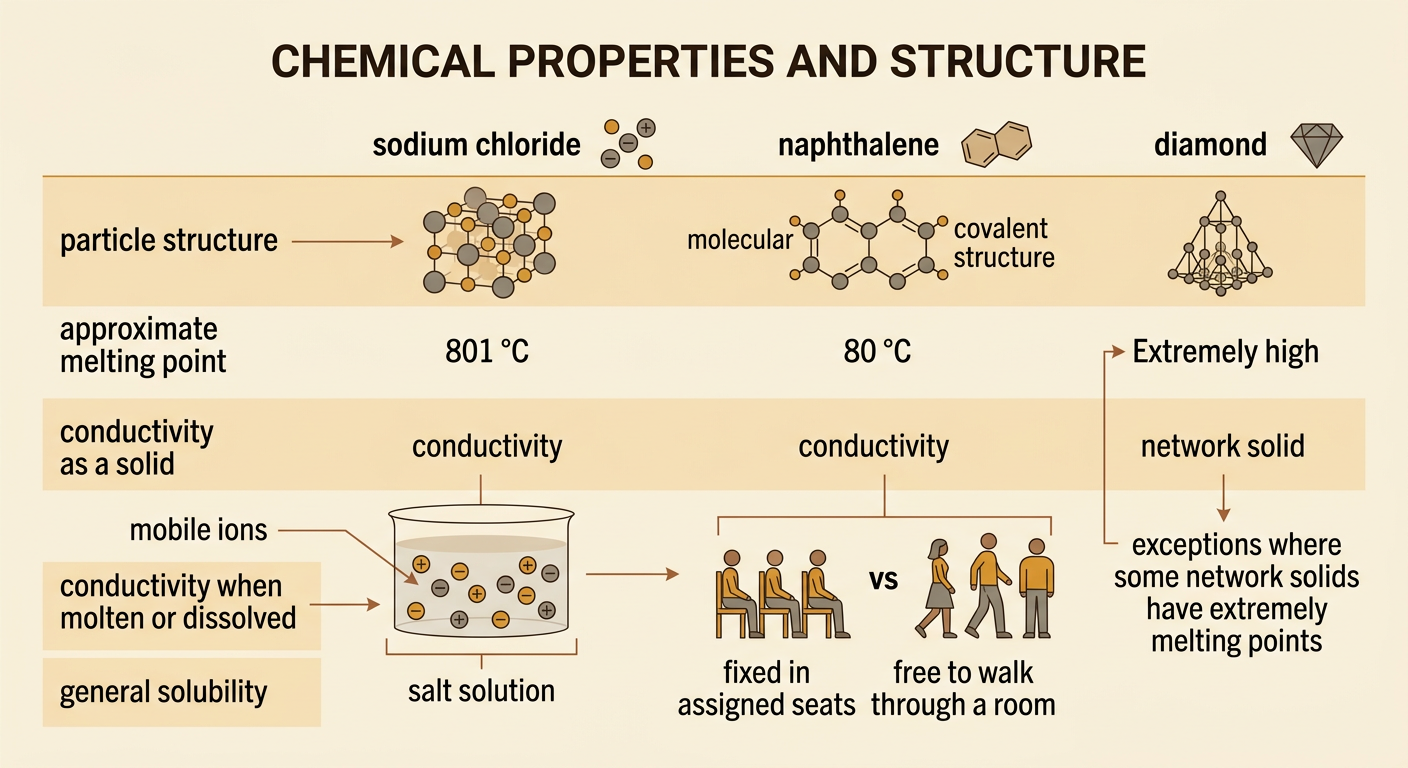
Particle models connect microscopic structure to observable properties. An ionic model should show a repeating array of positive and negative ions rather than separate molecule units. A molecular covalent model should show distinct groups of bonded atoms with space between molecules. A network covalent model should show atoms joined by covalent bonds throughout one continuous structure. For example, solid sodium chloride forms an ionic lattice, solid carbon dioxide consists of separate CO2 molecules, and diamond is a network of bonded carbon atoms. These structural differences affect how much energy is needed to separate particles. When reading a model, identify the particles, their charges, the bonds within each particle, and the attractions between particles. Translating a particle diagram into a written explanation provides evidence for predicting melting point, solubility, and electrical conductivity.
Comparing Physical Properties
Property data can provide evidence about bond type and particle structure. Sodium chloride, an ionic compound, melts at about 801°C because many strong attractions in its lattice must be overcome. It does not conduct electricity as a solid because its ions cannot move, but it conducts when molten or dissolved in water because the ions become mobile. Naphthalene, a molecular covalent substance, melts near 80°C and does not conduct electricity because it has no mobile charged particles. Many ionic compounds dissolve in water, while many nonpolar molecular substances do not, but solubility is not a perfect test. Some ionic compounds are insoluble, and some covalent molecules dissolve readily. Network covalent solids such as diamond often have extremely high melting points. Therefore, students should use several properties together rather than relying on one observation.
Choosing Materials for Practical Uses
Bonding and property data can support practical and economic decisions. Consider choosing a road deicer. Sodium chloride is ionic, dissolves in water, and separates into mobile ions that lower water’s freezing point. It is widely available and relatively inexpensive, so applying an additional amount may produce the marginal benefit of preventing more ice and reducing crash risk. However, the marginal costs can include extra purchases, vehicle and bridge corrosion, damage to roadside plants, and salty runoff entering waterways. Urea is a molecular covalent alternative that also dissolves, but it is often more expensive and nitrogen-rich runoff can promote unwanted plant or algae growth. A decision should compare the added benefit and added cost of each additional unit used, not merely identify the cheapest bag. Bonding explains useful properties, while economic and environmental evidence helps determine the best material and application rate.
