
Judicial Review and the Limits of Government Power
Students examine how judicial review enables the Supreme Court to interpret the Constitution and resolve disputes over government power and individual rights.
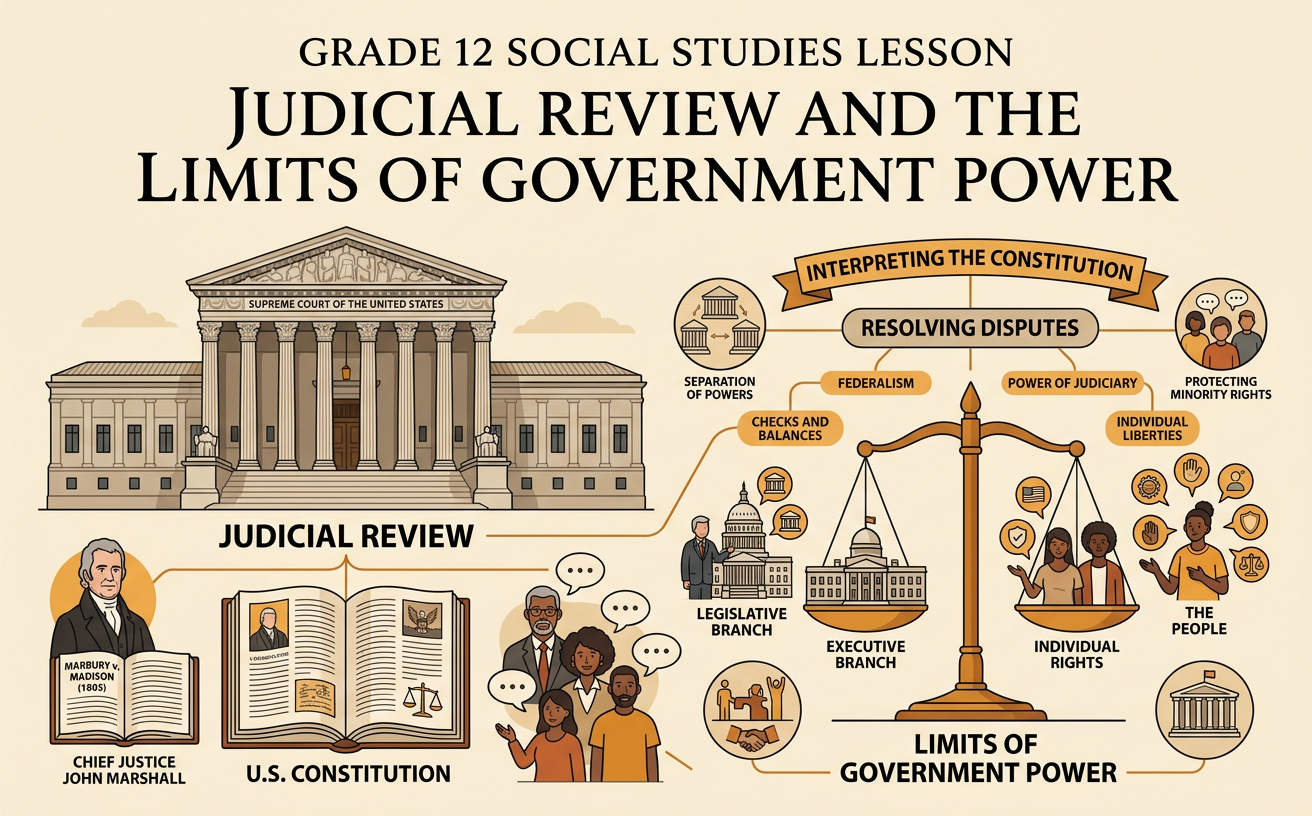
Illustrations are auto-generated and may be placeholders. They can be refreshed to match the narration.
Origins of Judicial Review
Judicial review is the power of courts to determine whether government actions are consistent with the Constitution. The Constitution does not use the phrase “judicial review,” but Article III gives federal courts authority to decide cases arising under the Constitution. The Supremacy Clause identifies the Constitution as the nation’s highest law, suggesting that conflicting laws cannot stand. Before 1803, state courts had already declined to enforce some laws they considered unconstitutional. In Federalist No. 78, Alexander Hamilton argued that judges should follow the Constitution when it conflicts with an ordinary law. For example, if Congress passed a law prohibiting criticism of the president, a court could compare that law with the First Amendment. Judicial review developed from constitutional structure, legal precedent, and the principle that government officials must obey a higher law.

Marbury v. Madison in Context
Marbury v. Madison arose from a political transition after the election of 1800. President John Adams appointed several judges near the end of his term, and William Marbury’s signed commission was not delivered before Thomas Jefferson became president. Jefferson ordered Secretary of State James Madison not to deliver it. Marbury asked the Supreme Court to issue a writ of mandamus requiring Madison to act. In 1803, Chief Justice John Marshall concluded that Marbury had a legal right to the commission and that Madison had violated that right. However, the Court ruled that it lacked constitutional authority to provide the requested remedy because the relevant provision of the Judiciary Act of 1789 improperly expanded the Court’s original jurisdiction. The decision declared part of a federal statute unconstitutional and firmly established judicial review at the national level.

Constitutional Powers and Limits
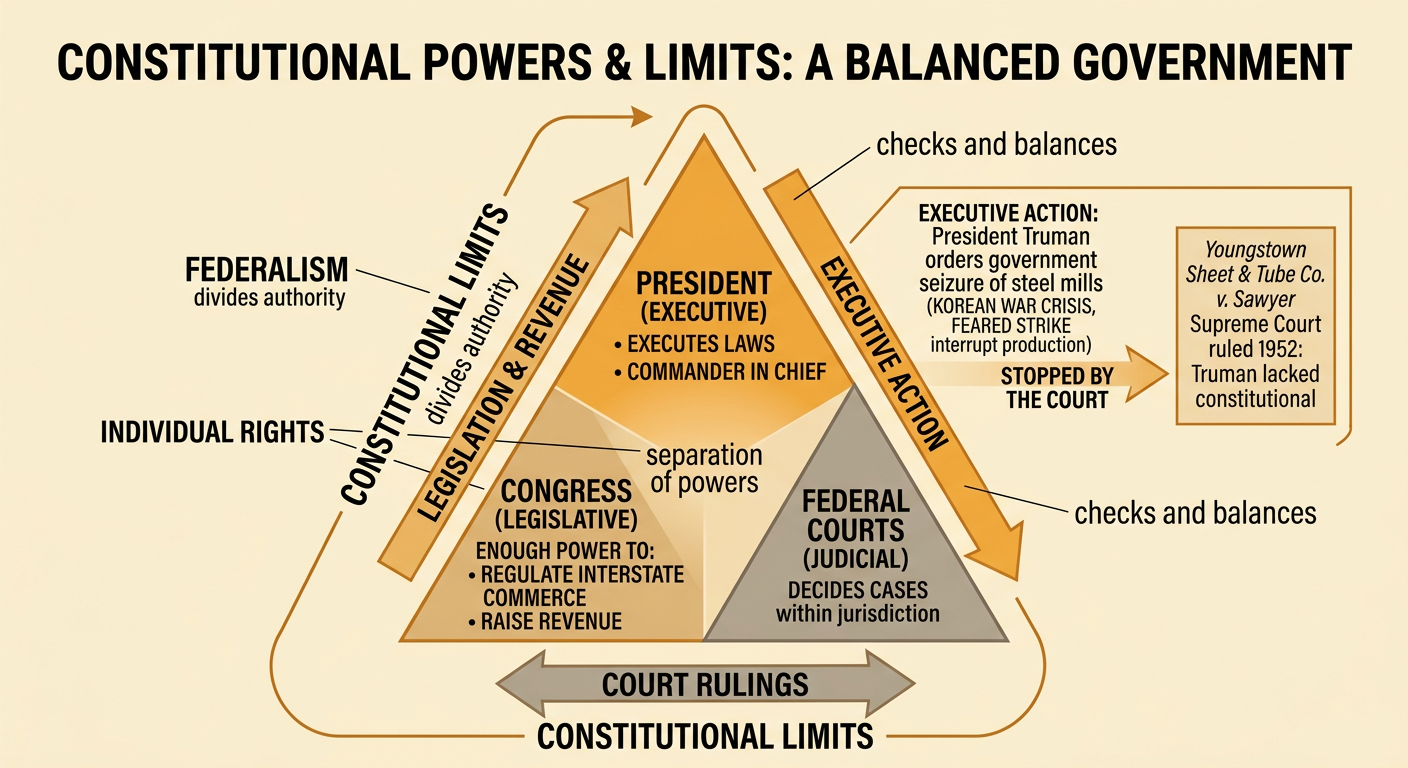
The Constitution grants government power while also limiting how that power may be used. Congress has enumerated powers, including regulating interstate commerce and raising revenue. The president executes laws and serves as commander in chief, while federal courts decide cases within their jurisdiction. Separation of powers prevents one branch from holding all governmental authority, and checks and balances allow each branch to restrain the others. Federalism further divides power between national and state governments. Individual rights create additional limits. For example, during the Korean War, President Harry Truman ordered the government to seize steel mills to prevent a strike from disrupting production. In Youngstown Sheet & Tube Co. v. Sawyer, the Supreme Court ruled in 1952 that the president lacked constitutional or statutory authority for the seizure. The case demonstrates that even emergency claims do not automatically create unlimited executive power.
Applying Precedent to a Modern Dispute
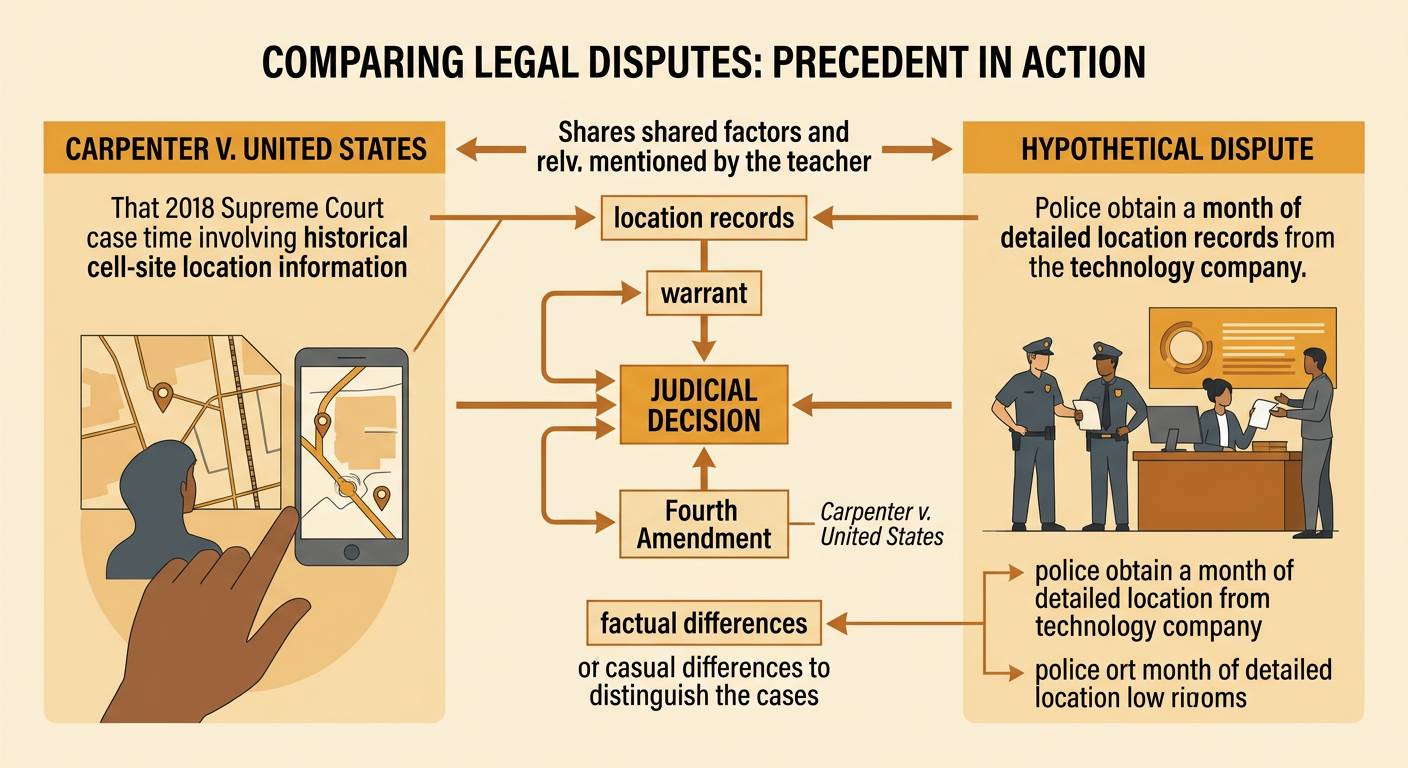
Courts apply precedent by comparing a new dispute with earlier decisions and explaining whether the same constitutional rule should govern. Imagine that police obtain a month of a person’s detailed location records from a technology company without a warrant. A court could begin with the Fourth Amendment, which protects against unreasonable searches and seizures. It might then examine Carpenter v. United States, a 2018 decision holding that the government generally needs a warrant to obtain historical cell-site location information. The court would compare the amount, precision, and revealing nature of the new records with the data considered in Carpenter. Government attorneys might distinguish the cases by arguing that the user voluntarily made particular information public. The court must decide whether the precedent controls, can be meaningfully distinguished, or should be extended to new technology while respecting constitutional limits on government surveillance.
Evaluating the Court’s Role
The Supreme Court’s role remains contested because judicial review can protect constitutional rights while allowing unelected judges to invalidate decisions made by elected officials. Supporters argue that an independent judiciary can defend minorities and enforce limits that political majorities might ignore. Brown v. Board of Education, for example, rejected state-required racial segregation in public schools and overturned the “separate but equal” rule associated with Plessy v. Ferguson. Critics respond that constitutional language can be open to interpretation and that justices may replace democratic choices with their own reasoning. The Court also faces practical limits: it must receive a proper case, depends on other officials to implement many rulings, and can reconsider precedent. Constitutional amendments, new legislation, presidential appointments, and public debate can shape the law over time. Evaluating the Court therefore requires weighing judicial independence, democratic accountability, individual rights, and constitutional stability.
