Kinetic and Potential Energy in Systems
Students use evidence and simple models to explain how an object's mass, speed, and position affect its kinetic and potential energy.
Illustrations are auto-generated and may be placeholders. They can be refreshed to match the narration.
Energy in Everyday Systems
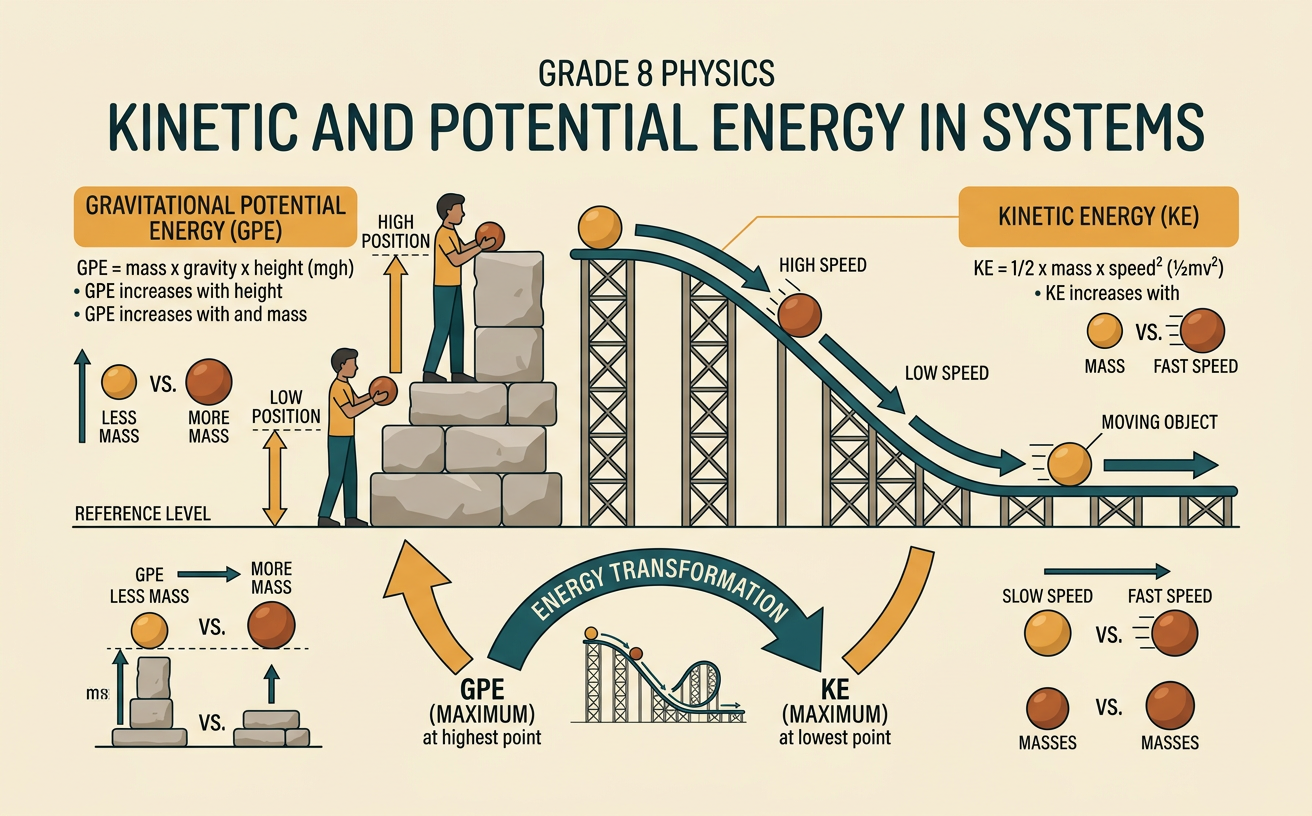
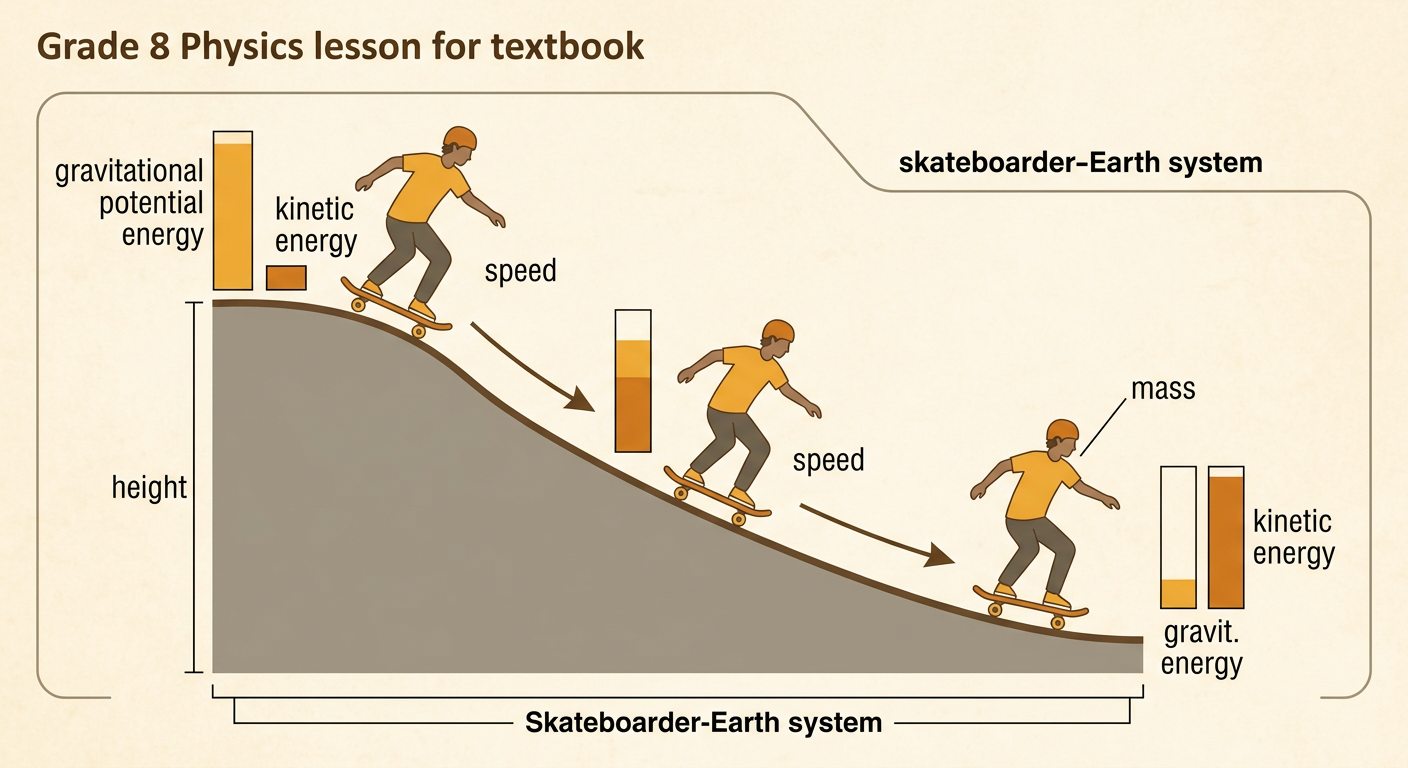
Energy is the ability of a system to cause change. A system is an object or group of interacting objects chosen for study. Kinetic energy is the energy of motion, while potential energy is stored because of position or interactions within a system. Consider a skateboarder at the top of a ramp. The skateboarder-Earth system has gravitational potential energy because the skateboarder is above the ground. As the skateboarder rolls downward, speed and kinetic energy increase while gravitational potential energy decreases. Scientists support explanations with evidence, such as measured height, speed, and mass. When gathering evidence, check who produced each source, how measurements were made, and whether other reliable sources agree. These checks help distinguish scientific evidence from unsupported claims.
Kinetic Energy: Mass and Speed
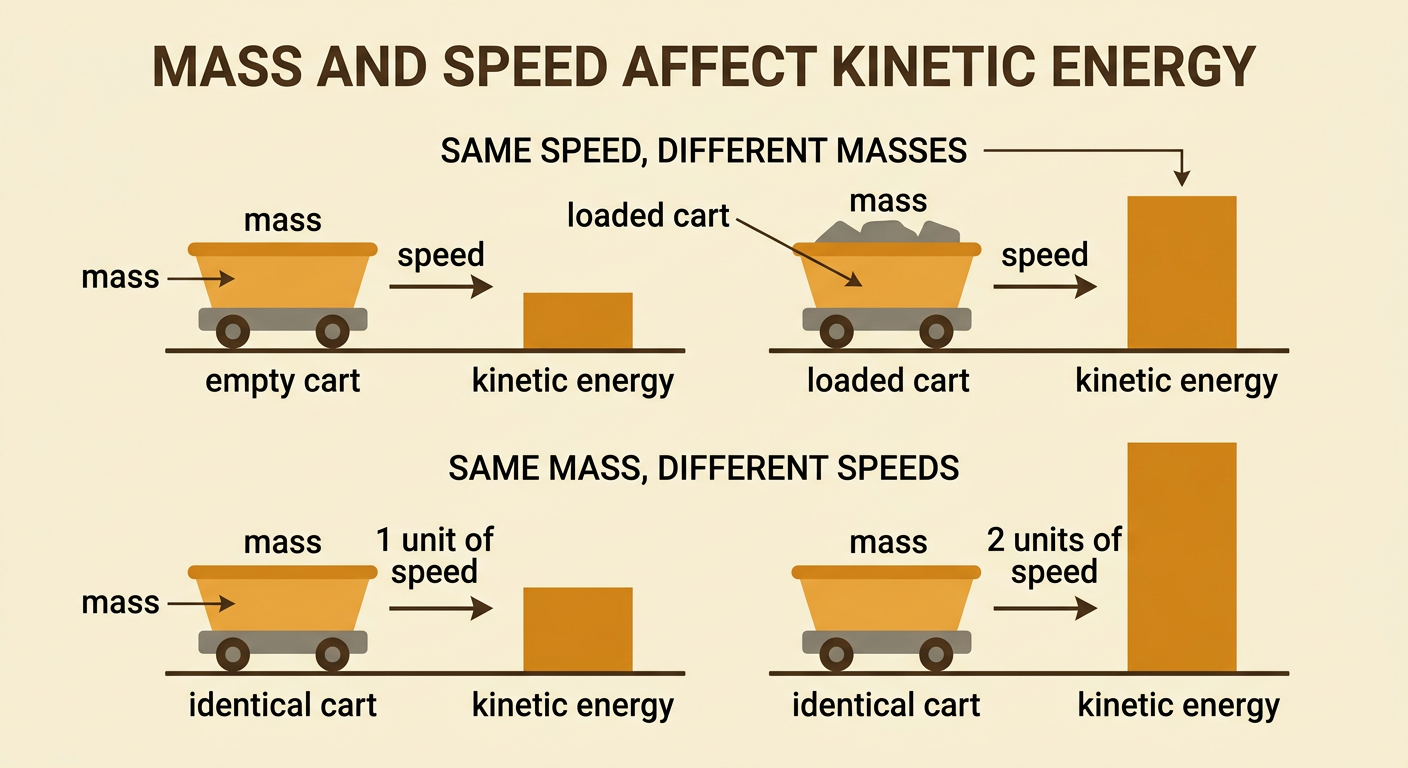
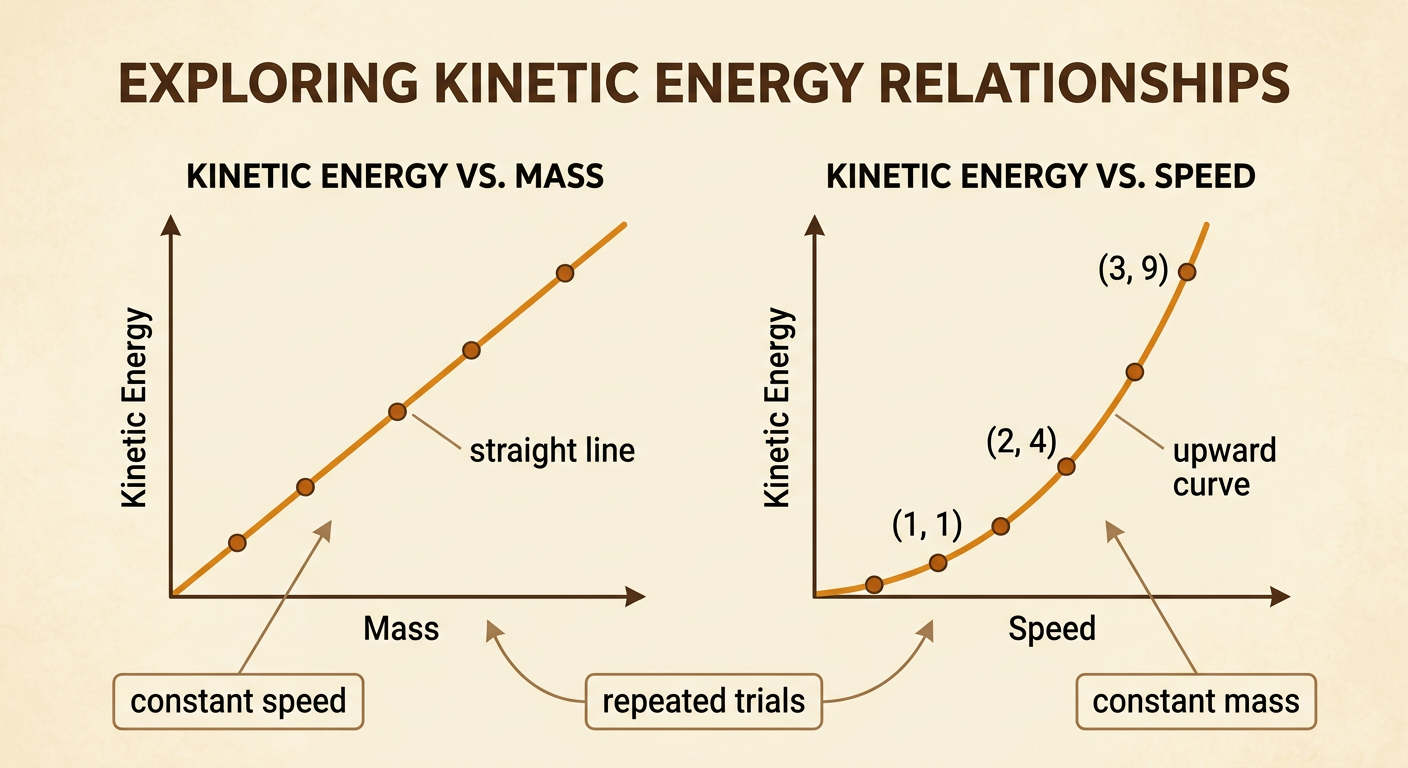
Kinetic energy depends on an object's mass and speed. It can be modeled with the equation KE = one-half times mass times speed squared. If two objects move at the same speed, the object with greater mass has more kinetic energy. For example, a loaded shopping cart moving at 2 meters per second has more kinetic energy than an empty cart moving at the same speed. Speed has an even stronger effect because it is squared. Doubling an object's speed makes its kinetic energy four times as great, as long as mass stays constant. Tripling the speed makes kinetic energy nine times as great. Evidence from repeated trials can show these patterns. To make a fair comparison, change only mass or only speed while keeping other conditions the same.
Potential Energy: Position and Interaction
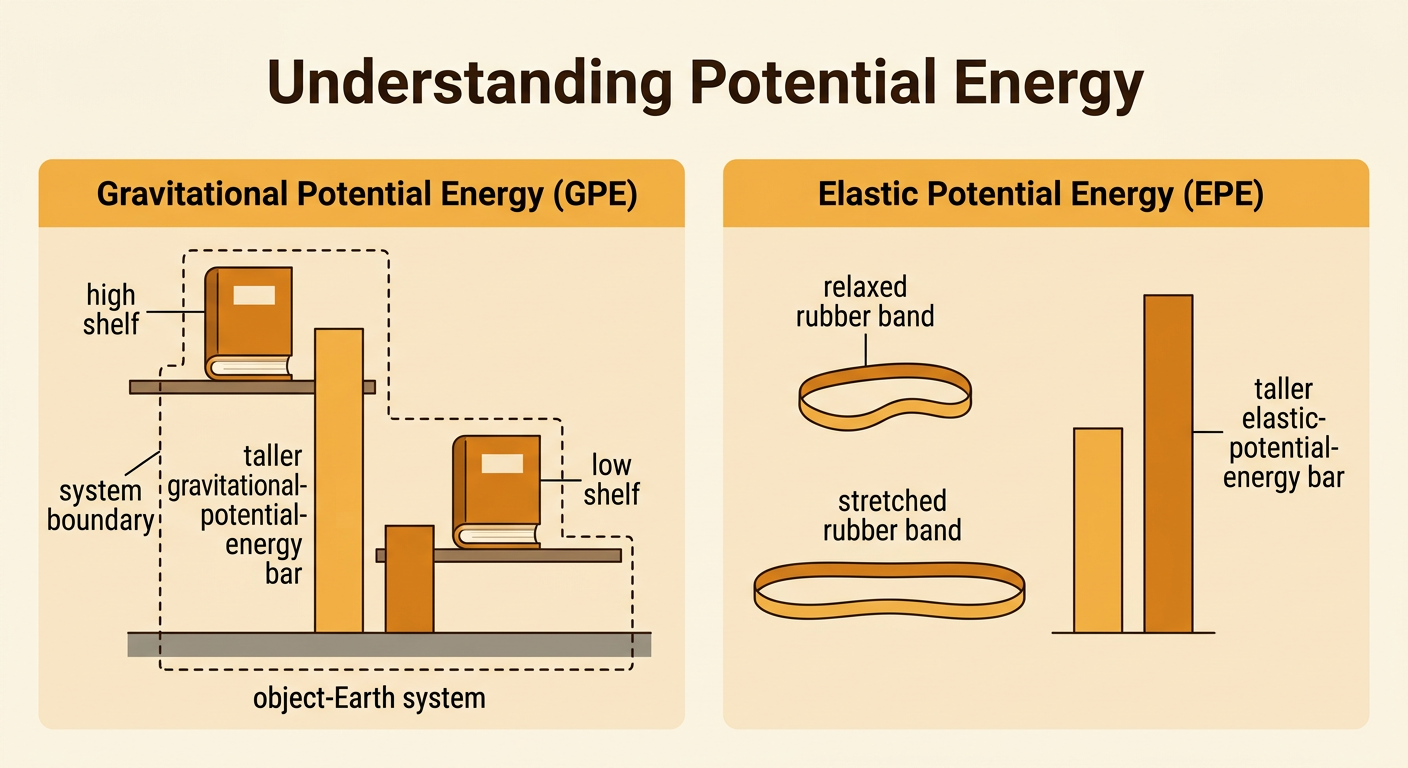
Potential energy depends on the positions of interacting objects in a system. Near Earth's surface, gravitational potential energy increases when an object is raised higher or has greater mass. A book on a high shelf has more gravitational potential energy than the same book on a low shelf because its position relative to Earth is higher. Potential energy can also come from elastic interactions. Stretching a rubber band farther from its relaxed shape generally stores more elastic potential energy. The system boundary matters when describing this energy. Gravitational potential energy belongs to the object-Earth system, not to the object alone. Elastic potential energy belongs to the interacting parts of the stretched or compressed system. Position does not automatically mean motion; a stationary object can have potential energy even when its kinetic energy is zero.
Interpreting Energy Graphs
Graphs reveal relationships between quantities. Begin by reading the title, axes, units, and legend. On a graph of kinetic energy versus mass at constant speed, the data form a straight line through the origin. This means equal increases in mass produce equal increases in kinetic energy. On a graph of kinetic energy versus speed at constant mass, the line curves upward. The curve becomes steeper because kinetic energy depends on speed squared. For example, points at speeds of 1, 2, and 3 meters per second have relative kinetic-energy values of 1, 4, and 9. Use specific points from the graph as evidence rather than saying only that energy increases. Also inspect the source, measurement method, and repeated trials before deciding whether the graph provides trustworthy evidence.
Explaining Energy Transformations
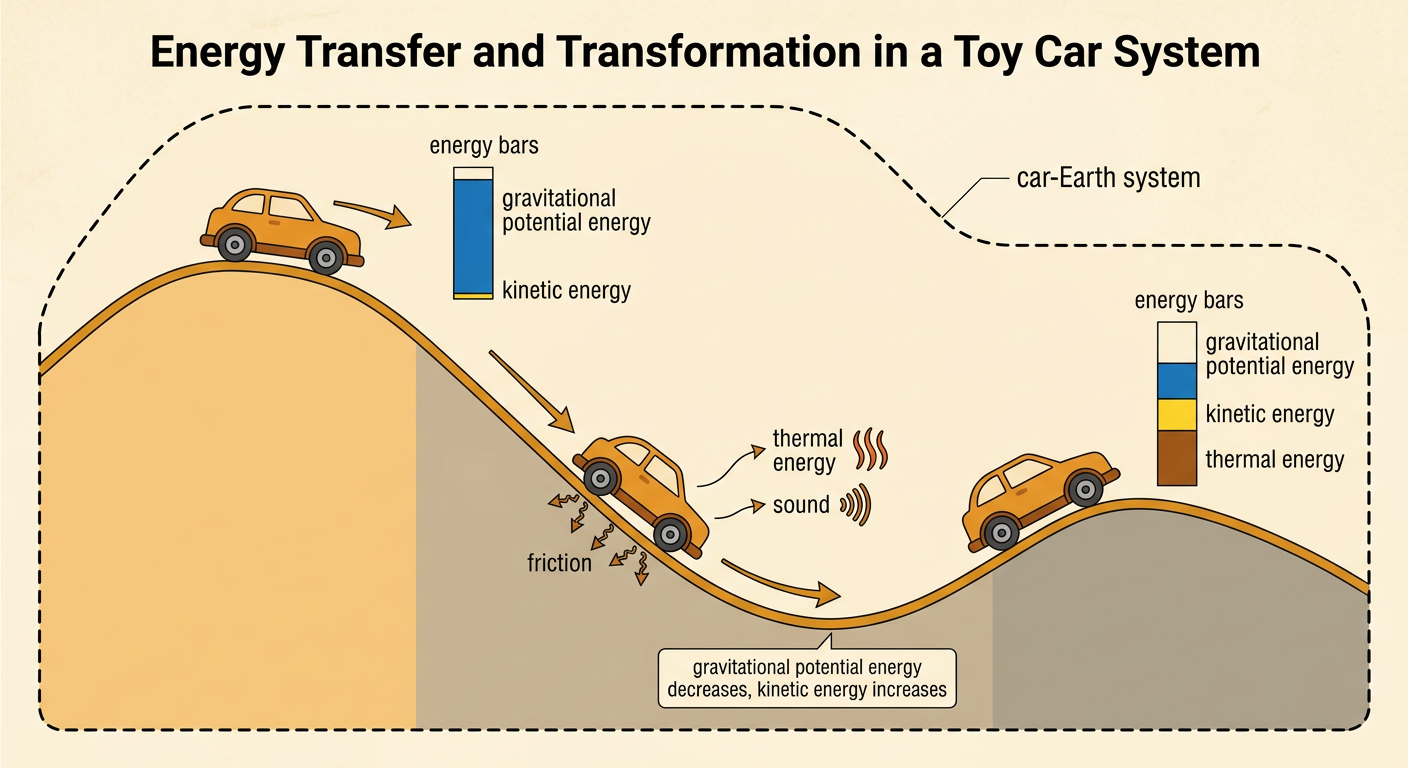
Energy can transfer between objects and change form, but it is accounted for within a well-defined system. Imagine releasing a toy car from the top of a track. At the top, the car-Earth system has high gravitational potential energy and little kinetic energy. As the car descends, gravitational potential energy decreases and kinetic energy increases. On a real track, friction transfers some energy to thermal energy in the wheels, track, and surrounding air, and some energy travels away as sound. Therefore, the car may not regain its original height on the next hill. A strong explanation identifies the system, describes the starting and ending energy, and cites observations such as height and speed measurements. A simple model can use energy bars and arrows to show transformations and transfers clearly.