
Kinetic and Potential Energy Transformations
Students compare kinetic and potential energy and trace how energy changes form in systems such as pendulums and roller coasters.
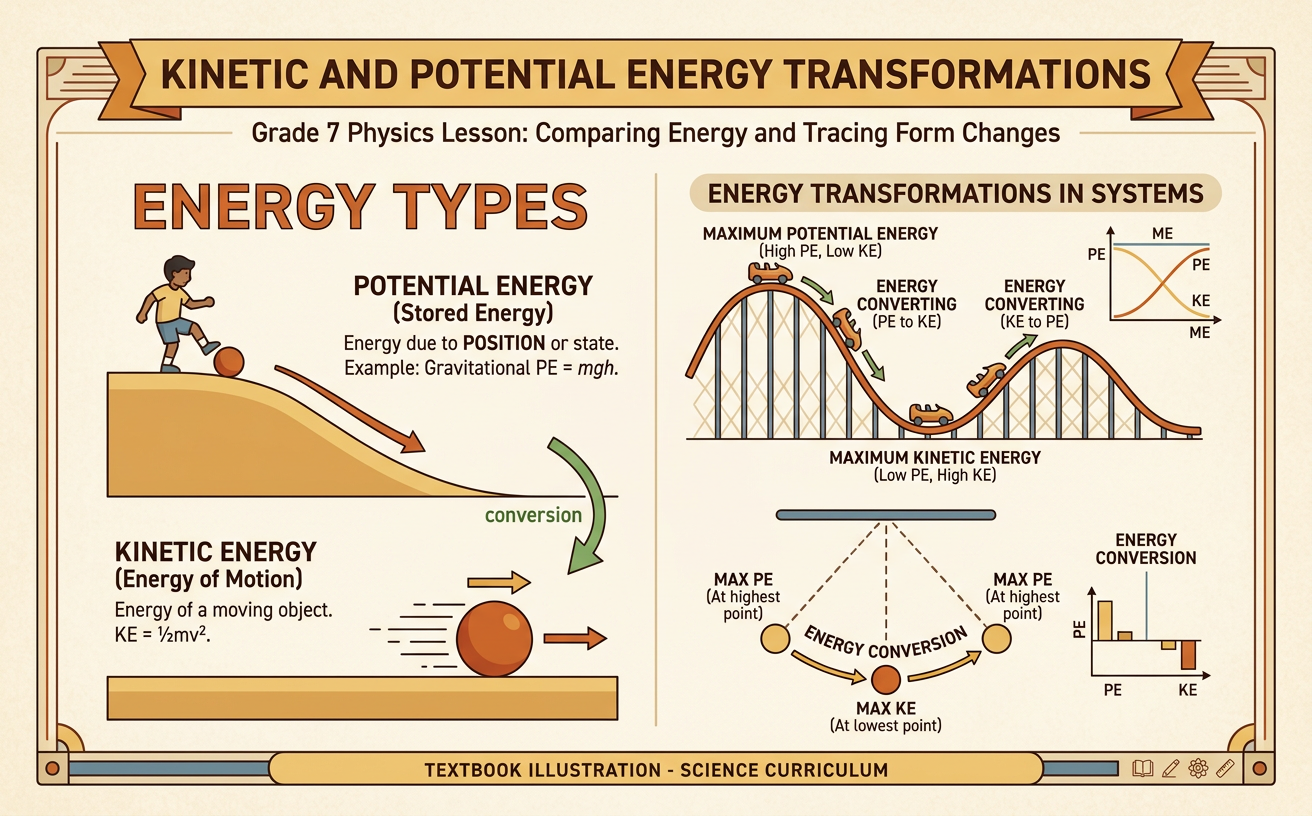
Illustrations are auto-generated and may be placeholders. They can be refreshed to match the narration.
Two Forms of Energy
Kinetic energy is the energy an object has because it is moving. A rolling soccer ball, a flying bird, and moving water all have kinetic energy. Faster objects have more kinetic energy than slower objects of the same mass. More massive moving objects also have more kinetic energy. Potential energy is stored energy related to an object’s position or condition. For example, a book on a high shelf has gravitational potential energy because it can fall. A stretched rubber band has elastic potential energy because it can snap back to its original shape. Kinetic and potential energy are different, but they can transform into each other. When a raised ball is released, its gravitational potential energy decreases as its kinetic energy increases. Energy is transferred or transformed rather than created from nothing or destroyed.
Energy at Different Positions
An object’s kinetic and potential energy can change as its position changes. Imagine a skateboarder moving through a U-shaped ramp. At the top of one side, the skateboarder is high above the bottom and moving slowly, so gravitational potential energy is high and kinetic energy is low. As the skateboarder moves downward, height and potential energy decrease while speed and kinetic energy increase. At the bottom, gravitational potential energy is lowest and kinetic energy is greatest. As the skateboarder travels up the other side, kinetic energy transforms back into potential energy. If friction and air resistance are small, the total mechanical energy stays nearly constant. In a real ramp, some mechanical energy is transformed into thermal energy and sound, so the skateboarder eventually slows unless more energy is added.
Pendulum Model
A pendulum consists of a mass called a bob attached to a fixed point by a string. When the bob is pulled to one side and held, it has high gravitational potential energy and no kinetic energy because it is not moving. After it is released, the bob swings downward. Its potential energy decreases while its kinetic energy increases. At the lowest point, the bob moves fastest, so kinetic energy is greatest and gravitational potential energy is lowest. As the bob swings upward on the other side, kinetic energy changes back into potential energy. In an ideal pendulum without friction or air resistance, the bob would return to its original height. A real pendulum rises slightly less on each swing because some mechanical energy transforms into thermal energy and sound at the pivot and in the air.
Roller-Coaster Model
A roller coaster demonstrates repeated transformations between gravitational potential energy and kinetic energy. A chain or motor first pulls the train up the tallest hill, transferring energy into the system. At the top, the train has high gravitational potential energy because of its height and relatively little kinetic energy because it is moving slowly. As the train descends, potential energy transforms into kinetic energy, causing its speed to increase. At the bottom, kinetic energy is greatest and gravitational potential energy is lowest. The train then climbs another hill, slowing as kinetic energy changes back into potential energy. Without another motor, later hills must usually be lower than the first because friction and air resistance transform some mechanical energy into thermal energy and sound. Brakes also transform kinetic energy mainly into thermal energy when the train slows at the end.
Tracking Transformations
To track an energy transformation, first identify the object or system, then compare its motion and position at several moments. Ask whether the object’s speed, height, or shape is changing. Energy bar charts can show the amount of each energy form at each moment. Consider a ball dropped from a ledge. Before release, its gravitational potential energy is high and its kinetic energy is zero. During the fall, potential energy decreases as kinetic energy increases. Just before impact, kinetic energy is greatest. When the ball hits the ground, some kinetic energy becomes elastic potential energy as the ball compresses. As it rebounds, elastic potential energy changes into kinetic and gravitational potential energy. Some energy also becomes thermal energy and sound, so the ball does not return to its original height. Including these forms helps account for the system’s energy.