
Kinetic Energy: How Mass and Speed Matter
Students interpret graphs and collision evidence to explain how an object's mass and speed affect its kinetic energy.

Illustrations are auto-generated and may be placeholders. They can be refreshed to match the narration.
Kinetic Energy in Everyday Motion
Kinetic energy is the energy an object has because it is moving. A motionless object has zero kinetic energy, but its kinetic energy increases when it begins moving. Both mass and speed affect the amount. For example, a bicycle and rider moving down a street have kinetic energy. If the rider pedals faster, their kinetic energy increases. If a heavier rider travels at the same speed as a lighter rider, the heavier rider and bicycle have more kinetic energy. Kinetic energy can be transferred during a collision. When the bicycle’s brakes press against the wheels, some kinetic energy changes into thermal energy, which warms the brakes and nearby parts. Scientists study motion, graphs, and collision results to compare kinetic energy even when they cannot observe the energy directly.

Comparing Mass and Energy
When speed stays the same, an object with more mass has more kinetic energy. The relationship is proportional: doubling the mass doubles the kinetic energy if speed does not change. Kinetic energy can be calculated as one-half times mass times speed squared. Consider a 0.5-kilogram cart and a 1-kilogram cart, each moving at 2 meters per second. The lighter cart has 1 joule of kinetic energy, while the heavier cart has 2 joules. If both strike identical foam blocks, the heavier cart may cause greater movement or deformation because it can transfer more energy. This is a fair comparison only when other conditions, including speed, surface, cart shape, and target material, are kept the same.

Comparing Speed and Energy
Speed has a stronger effect on kinetic energy than mass does because speed is squared in the kinetic energy calculation. If an object’s speed doubles while its mass stays constant, its kinetic energy becomes four times as great. For example, a 2-kilogram cart moving at 2 meters per second has 4 joules of kinetic energy. The same cart moving at 4 meters per second has 16 joules, not 8 joules. Tripling the speed would make the kinetic energy nine times as great. This relationship helps explain why faster vehicles generally require much more distance to stop. However, actual stopping distance also depends on the brakes, tires, road surface, slope, and reaction time, so speed is not the only factor in a real situation.

Reading Kinetic Energy Graphs
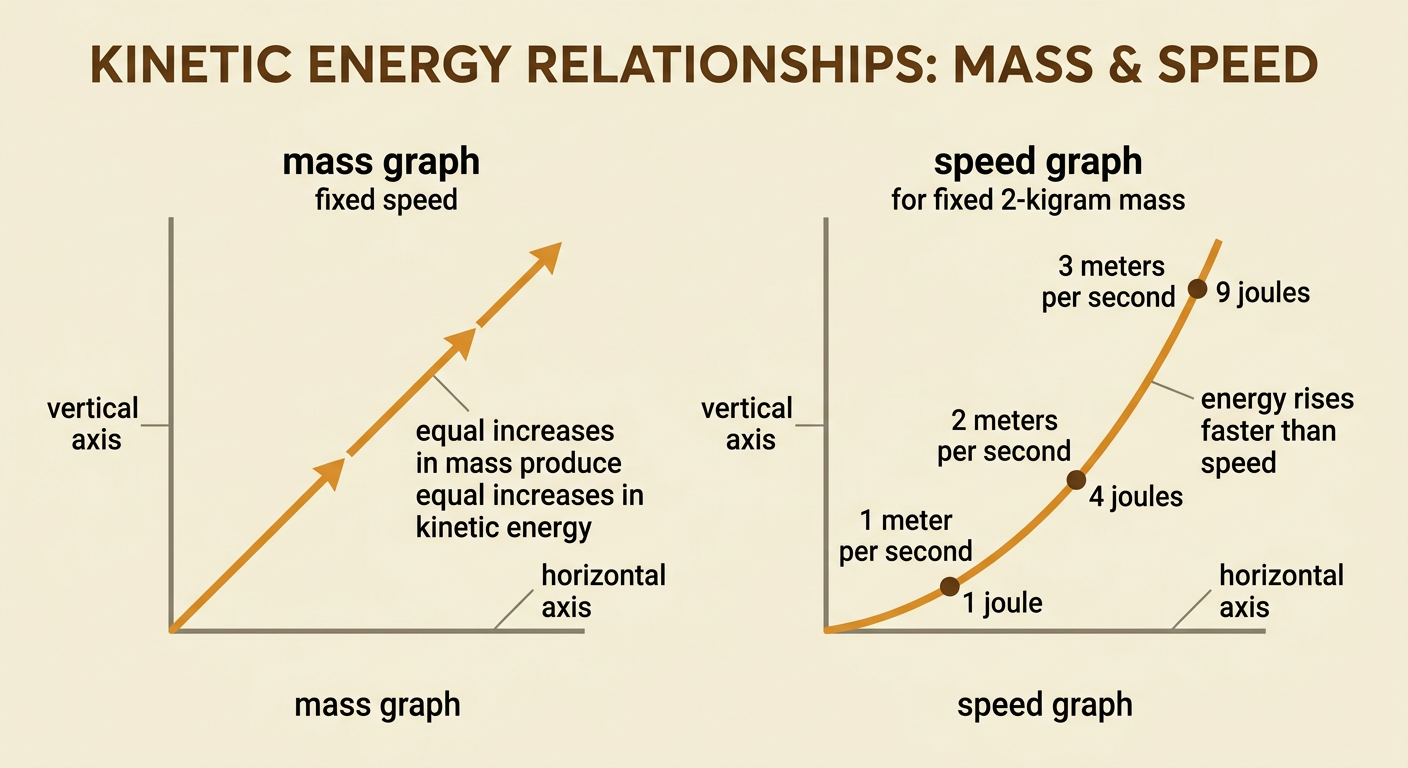
A graph can show how kinetic energy changes with mass or speed. First, read the title and axis labels, including units. The horizontal axis usually shows the variable being changed, while the vertical axis shows kinetic energy in joules. At a fixed speed, a graph of kinetic energy versus mass is a straight line through the origin because equal increases in mass produce equal increases in energy. At a fixed mass, a graph of kinetic energy versus speed curves upward because kinetic energy depends on speed squared. For example, points for a 2-kilogram cart at speeds of 1, 2, and 3 meters per second show 1, 4, and 9 joules. The growing gaps between these values provide visual evidence that kinetic energy increases more rapidly than speed.
Analyzing Collision Evidence
Collision tests provide indirect evidence about an object’s kinetic energy. In a controlled investigation, students might release the same cart at different measured speeds and record how far an identical target block slides after each collision. Suppose a 1-kilogram cart makes the block slide 2 centimeters at 1 meter per second, 7 centimeters at 2 meters per second, and 15 centimeters at 3 meters per second. The increasing distances support the idea that faster carts can transfer more energy during a collision. However, block distance is not a direct measurement of the cart’s kinetic energy. Friction, sound, heating, bouncing, and deformation affect where the energy goes. Repeating each trial, averaging results, and keeping the cart, track, target, and release method consistent make the evidence stronger.

Making an Evidence-Based Claim
A strong scientific argument includes a claim, evidence, reasoning, and a discussion of limitations. A claim answers the investigation question. Evidence should include specific measurements or graph patterns. Reasoning explains how the evidence supports the claim using scientific ideas. For example, a student might claim that speed has a greater effect on kinetic energy than the same proportional change in mass. The student could cite data showing that doubling a cart’s mass doubled its kinetic energy, while doubling its speed made the energy four times as great. The reasoning is that kinetic energy is proportional to mass but proportional to speed squared. The student should also acknowledge that collision results may be affected by friction and measurement error. Multiple trials and calculated kinetic energy strengthen the argument, but they do not remove every limitation.
