
Kinetic Energy: Mass and Speed
Students calculate and compare kinetic energy to determine how an object's mass and speed affect its energy of motion.
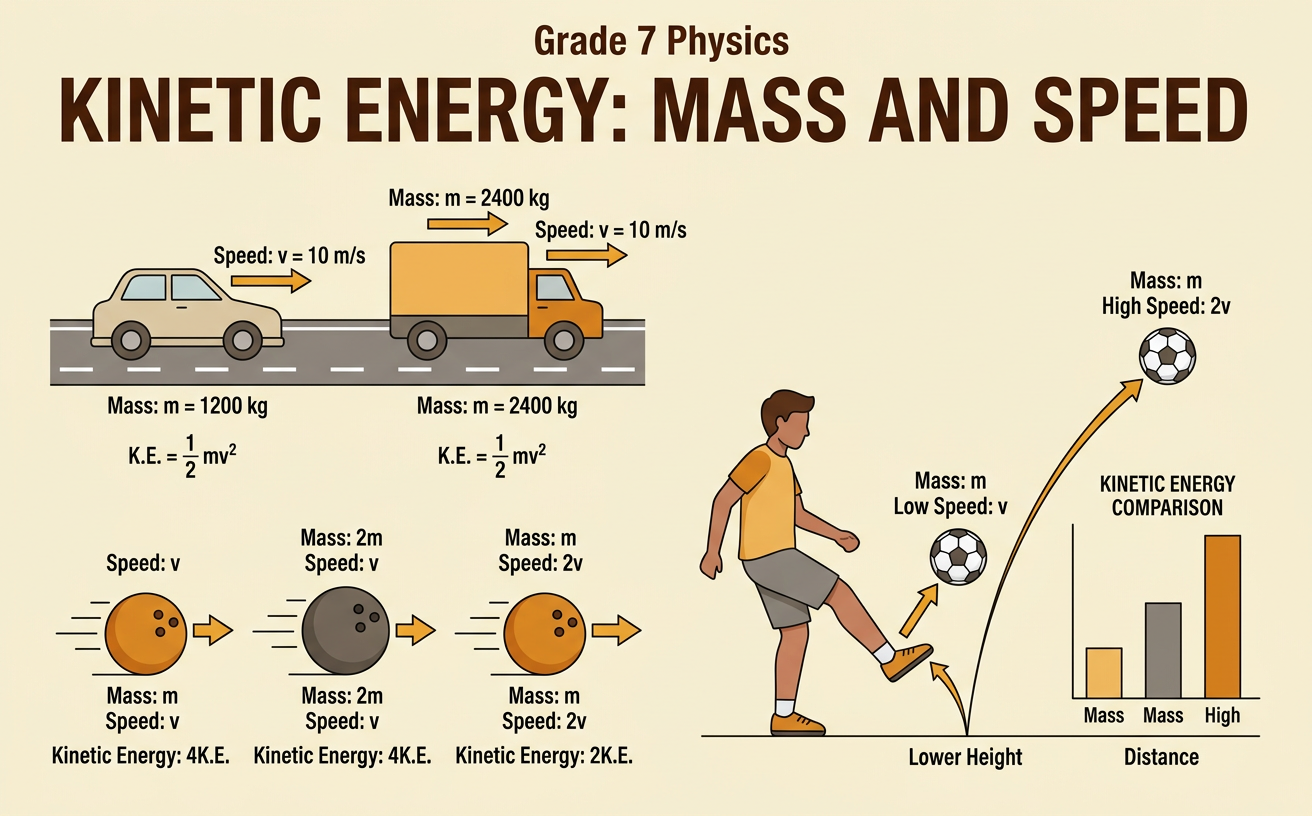
Illustrations are auto-generated and may be placeholders. They can be refreshed to match the narration.
Energy of Motion
Kinetic energy is the energy an object has because it is moving. A parked bicycle has no kinetic energy, but the same bicycle has kinetic energy when it rolls down the street. The amount of kinetic energy depends on two measurements: the object’s mass and its speed. Greater mass or greater speed means more kinetic energy. Kinetic energy is measured in joules, written with the symbol J. For example, a loaded shopping cart and an empty cart moving at the same speed do not have equal kinetic energy. The loaded cart has more mass, so it has more kinetic energy and is harder to stop. When either cart stops moving, its kinetic energy becomes zero because its speed is zero.
The Kinetic Energy Formula
The kinetic energy of a moving object can be calculated with the formula KE = 1/2mv². In this formula, KE is kinetic energy in joules, m is mass in kilograms, and v is speed in meters per second. The small 2 means that speed is squared, or multiplied by itself. Suppose a 4-kilogram scooter moves at 3 meters per second. Substitute the measurements into the formula: KE = 1/2 × 4 × 3². First calculate 3² = 9. Then calculate 1/2 × 4 × 9 = 18. The scooter has 18 joules of kinetic energy. Always use kilograms and meters per second when applying this formula so the final answer is correctly expressed in joules.
Changing Mass
When speed stays constant, kinetic energy changes in direct proportion to mass. This means that doubling the mass doubles the kinetic energy, while tripling the mass triples the kinetic energy. Imagine a 2-kilogram ball moving at 4 meters per second. Its kinetic energy is 1/2 × 2 × 4², or 16 joules. A 4-kilogram ball moving at the same speed has 1/2 × 4 × 4², or 32 joules. The second ball has twice the mass and twice the kinetic energy. It does not have four times the kinetic energy because only mass changed. This relationship can be shown on a graph as a straight line rising from the origin when speed remains constant.
Changing Speed
Speed has a stronger effect on kinetic energy than mass because speed is squared in the formula. If an object’s speed doubles, its kinetic energy becomes four times as great because 2² = 4. If its speed triples, its kinetic energy becomes nine times as great because 3² = 9. Consider a 2-kilogram ball moving at 2 meters per second. Its kinetic energy is 1/2 × 2 × 2², or 4 joules. At 4 meters per second, the same ball has 1/2 × 2 × 4², or 16 joules. The speed doubled, but the kinetic energy increased from 4 joules to 16 joules. This squared relationship explains why fast-moving objects can be much harder to stop safely.
Comparing Moving Objects
To compare moving objects, calculate each object’s kinetic energy using the same units and formula. Do not decide by looking only at mass or only at speed. For example, Object A has a mass of 6 kilograms and moves at 2 meters per second. Its kinetic energy is 1/2 × 6 × 2² = 12 joules. Object B has a mass of 2 kilograms and moves at 4 meters per second. Its kinetic energy is 1/2 × 2 × 4² = 16 joules. Although Object A has three times the mass, Object B has more kinetic energy because its greater speed is squared. A table can organize the mass, speed, and calculated kinetic energy so the comparison is clear. Object B has 4 joules more kinetic energy than Object A.