
Levels of Organization and Body Systems
Students trace how specialized cells form tissues, organs, and interacting organ systems in multicellular organisms.

Illustrations are auto-generated and may be placeholders. They can be refreshed to match the narration.
Specialized Cells
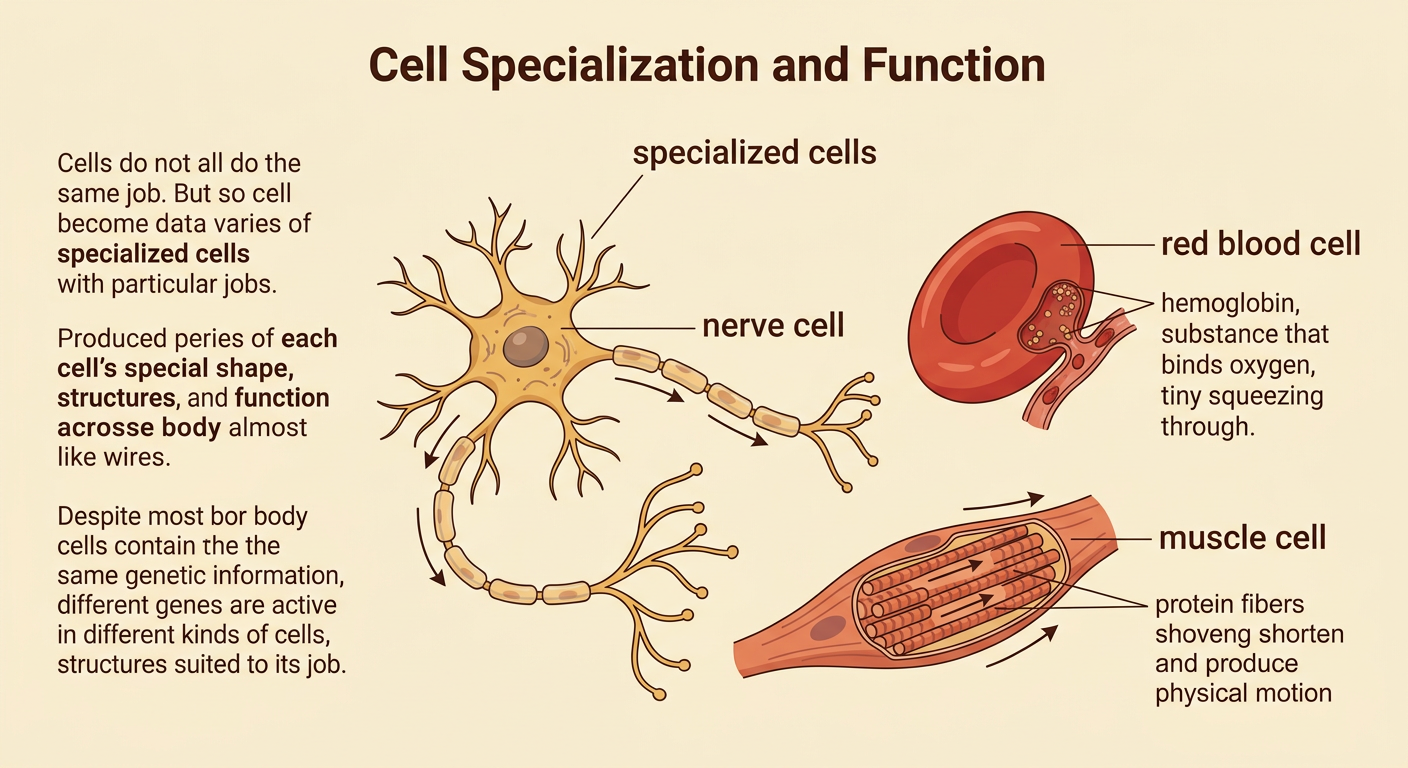
In a multicellular organism, cells become specialized to perform particular jobs. Although most body cells contain the same genetic information, different genes are active in different cell types. This produces differences in a cell’s shape, structures, and function. For example, a nerve cell has long extensions that carry electrical signals across the body. A red blood cell has a flexible, disk-shaped form and contains hemoglobin, which binds oxygen. A muscle cell contains protein fibers that shorten to produce movement. These features provide evidence that structure and function are related. Specialized cells usually cannot meet all their needs alone. They depend on other cells to deliver oxygen and nutrients, remove wastes, and help maintain stable conditions. Working together allows many specialized cell types to support the survival of the whole organism.
Cells to Tissues
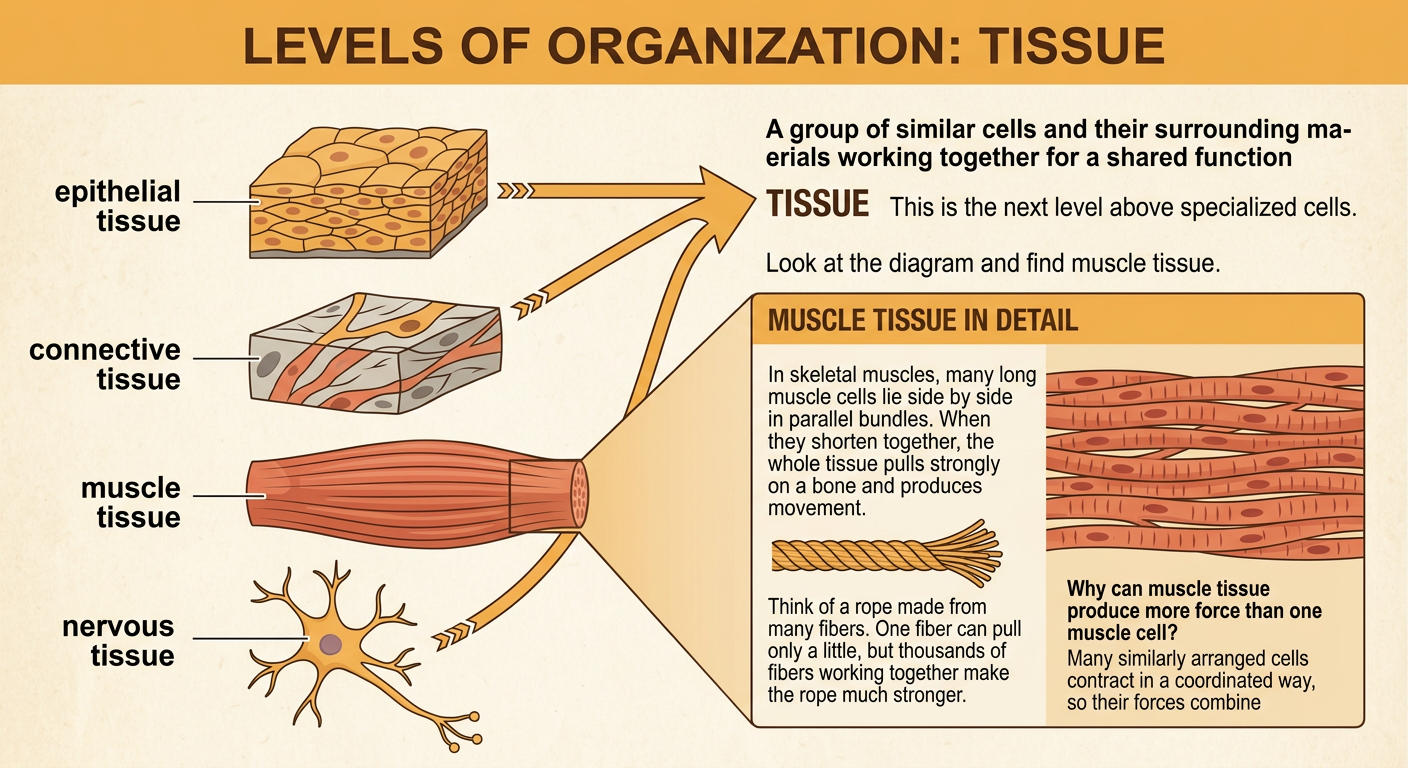
A tissue is a group of similar cells and their surrounding materials working together to perform a shared function. The human body has four major tissue types: epithelial, connective, muscle, and nervous tissue. Epithelial tissue covers surfaces and lines organs, while connective tissue supports, binds, or transports materials. Muscle tissue contracts, and nervous tissue carries signals. For example, skeletal muscle tissue contains many long muscle cells arranged in parallel bundles. When the cells contract together, the tissue can pull on a bone and produce movement. One muscle cell can shorten, but a coordinated tissue produces a much stronger force. Evidence from the cells’ similar shapes, arrangement, and activity explains how the properties of the tissue arise from its component cells. Organization into tissues is the next level above specialized cells.
Tissues to Organs
An organ is a structure made of two or more tissue types that work together to carry out one or more major functions. Each tissue contributes a different part of the organ’s job. The stomach, for example, contains epithelial tissue that lines and protects its inner surface. Muscle tissue contracts to churn food, connective tissue supports and holds the stomach’s layers together, and nervous tissue coordinates movement and helps detect changes. No single tissue could perform all these tasks by itself. Their arrangement allows the stomach to store food, mix it with digestive substances, and move it toward the small intestine. The relationship among these tissues provides evidence that an organ is more than a collection of cells: it is an organized subsystem whose parts interact. In the hierarchy of organization, organs form from tissues and become parts of organ systems.
Major Organ Systems
An organ system is a group of organs that cooperate to perform broad functions. The digestive system breaks food into nutrients and absorbs them. The respiratory system exchanges oxygen and carbon dioxide. The circulatory system transports gases, nutrients, hormones, and wastes. The nervous system detects information and coordinates rapid responses, while the muscular and skeletal systems support movement. The urinary system removes certain wastes and regulates water and dissolved substances. For example, the digestive system includes the mouth, esophagus, stomach, small intestine, large intestine, liver, and pancreas. These organs have different roles, but materials pass between them in an organized sequence. Food is mechanically and chemically broken down, and most nutrients enter the blood through the small intestine. This evidence shows that a system’s overall function depends on relationships among its organs, not on the action of only one organ.
Interacting Body Systems
Body systems are interacting subsystems, not isolated parts. During a run, the respiratory system brings oxygen into the lungs. Oxygen moves into capillaries, and the circulatory system carries it to muscle cells. The digestive system supplies glucose, which also travels in the blood. Muscle cells use oxygen and glucose in cellular respiration to release usable energy for contraction. Carbon dioxide produced by the cells enters the blood, travels back to the lungs, and is exhaled. At the same time, the nervous system signals muscles to contract and helps adjust breathing and heart rate. This chain of evidence connects structures and processes across several levels: specialized cells form tissues, tissues form organs, and organs cooperate in systems. If one subsystem fails to supply or transport needed materials, other subsystems cannot function normally. The body survives because its parts exchange matter and information in coordinated ways.