Life’s Three Domains and Six Kingdoms
Students use cellular traits to classify organisms within the three-domain system and traditional six-kingdom model while examining how biological classification has changed with new evidence.
Illustrations are auto-generated and may be placeholders. They can be refreshed to match the narration.
Why Scientists Classify Life
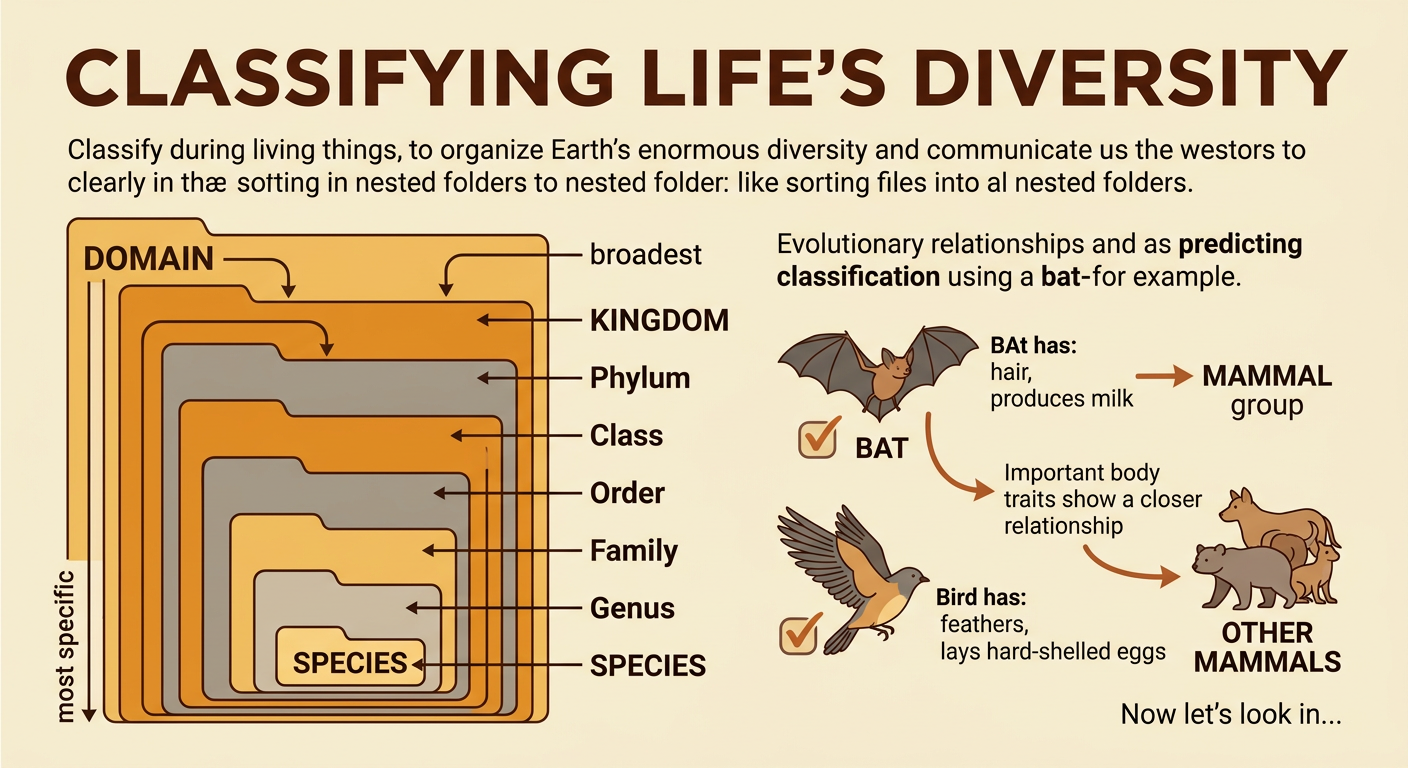
Scientists classify living things to organize Earth’s diversity and communicate clearly about organisms. Classification places organisms into nested groups based on shared traits and evolutionary relationships. The broadest group is the domain, followed by kingdom and increasingly specific groups such as phylum, class, order, family, genus, and species. Scientific names help prevent confusion caused by different common names. Classification also helps scientists make predictions. For example, bats and birds both have wings, but bats have hair and produce milk, so they are classified as mammals. Birds have feathers and lay hard-shelled eggs. These cellular and body traits show that bats are more closely related to other mammals than to birds. Classification therefore depends on multiple lines of evidence, not simply on an organism’s appearance or where it lives.
Cell Traits Used in Classification
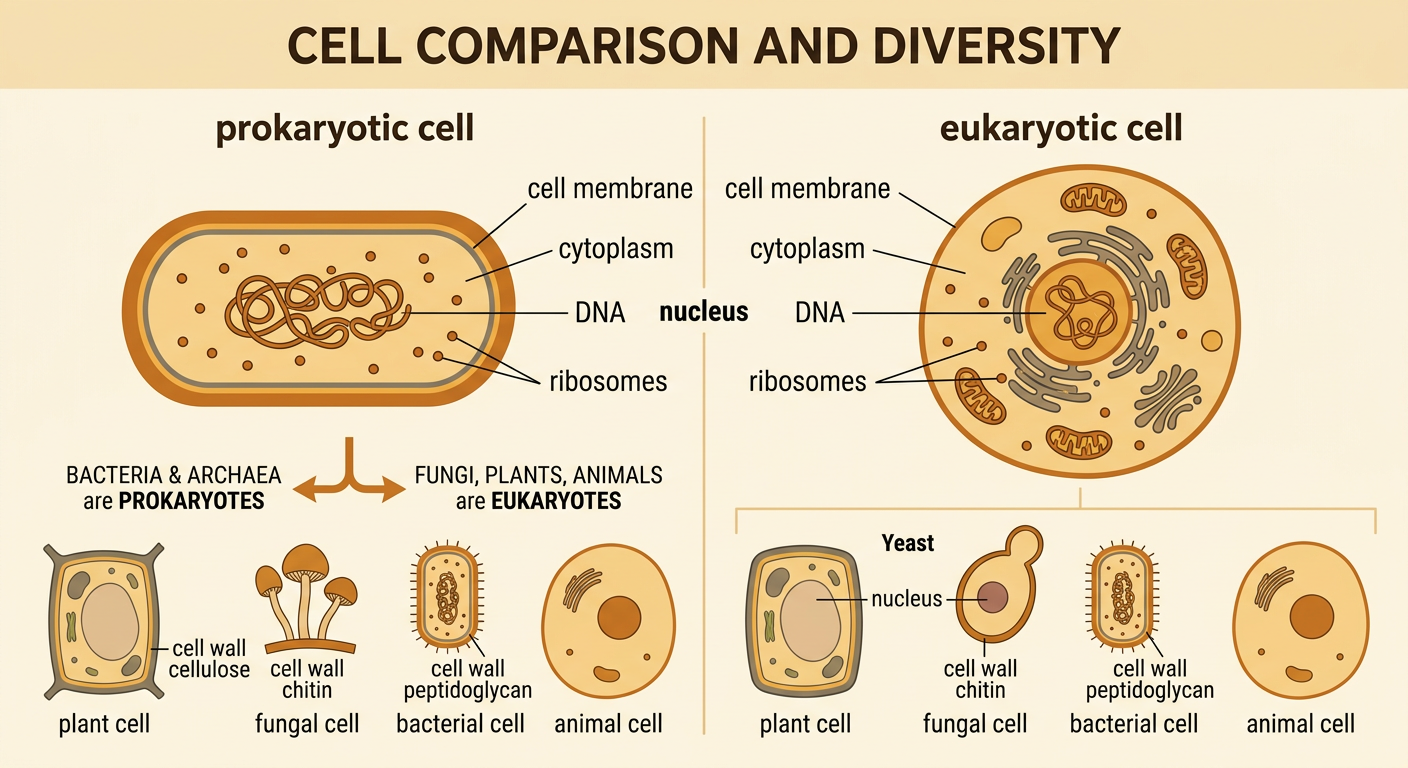
Cells provide important evidence for classification. All cells have a cell membrane, cytoplasm, DNA, and ribosomes, but their structures differ. Prokaryotic cells do not have a membrane-bound nucleus or other membrane-bound organelles. Bacteria and archaea are prokaryotes and are usually unicellular. Eukaryotic cells have a nucleus and membrane-bound organelles; eukaryotes may be unicellular or multicellular. Scientists also compare cell walls and methods of obtaining energy. Plant cell walls contain cellulose, fungal cell walls contain chitin, and most bacterial cell walls contain peptidoglycan. Animal cells lack cell walls. For example, yeast is unicellular, but its nucleus and chitin-containing cell wall identify it as a eukaryotic fungus rather than a bacterium. No single trait always gives the complete answer, so scientists compare several traits together.
The Three Domains
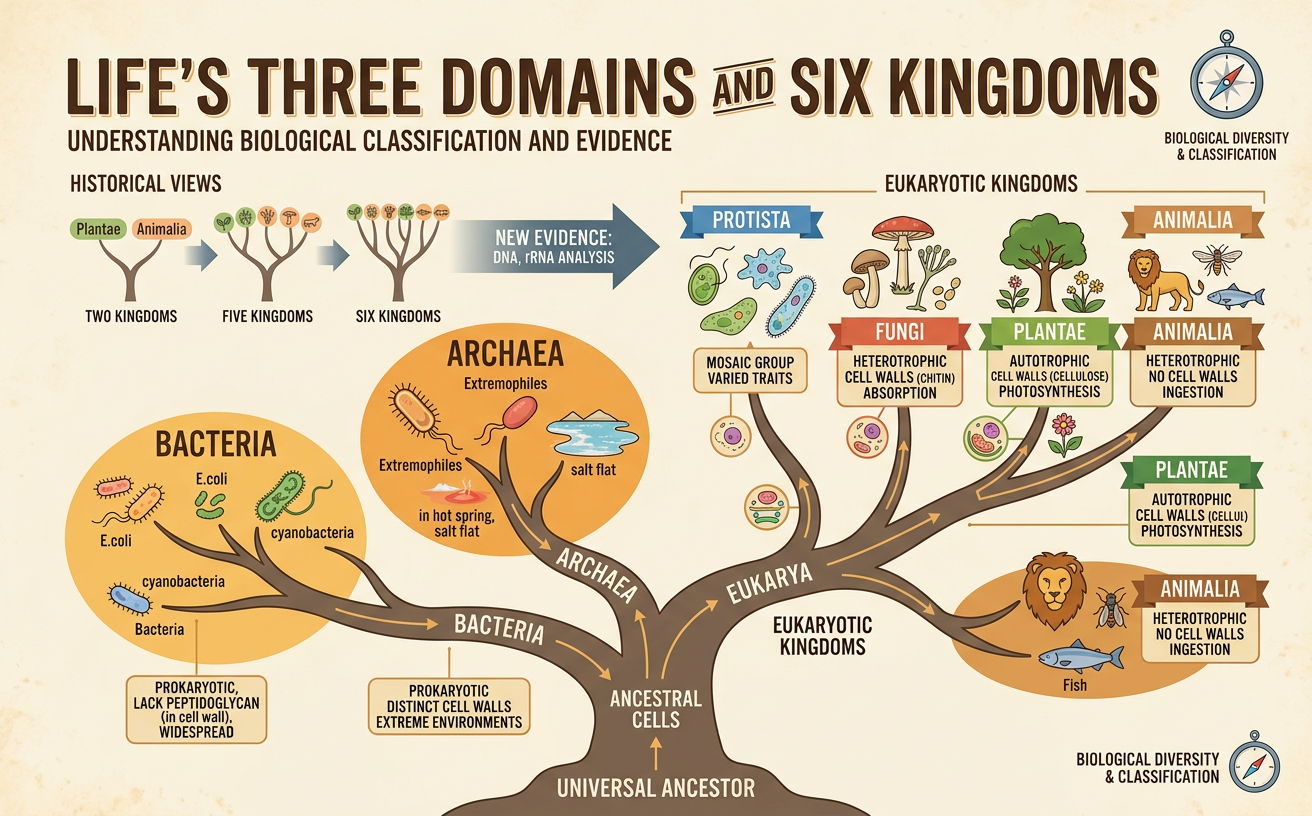
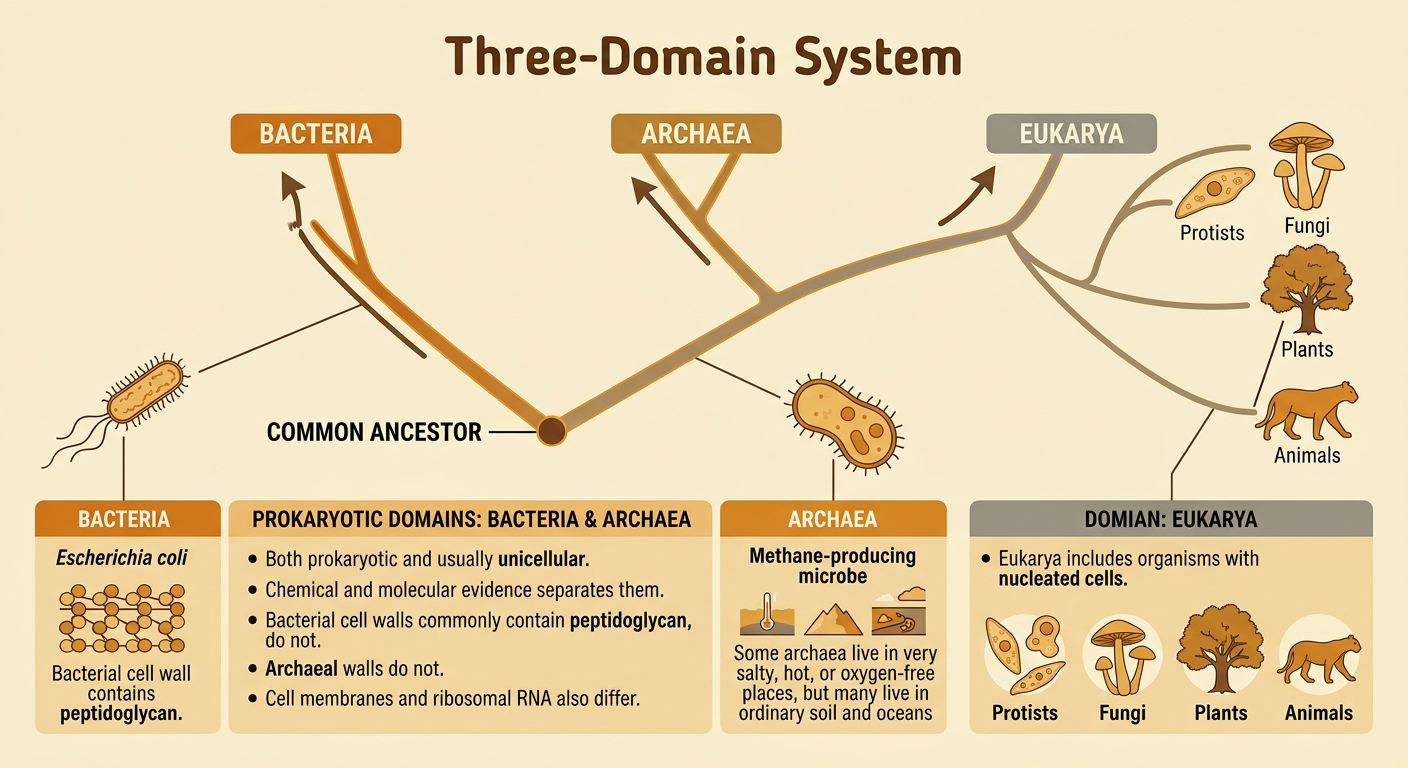
The three-domain system divides cellular life into Bacteria, Archaea, and Eukarya. Organisms in Bacteria and Archaea are prokaryotic and usually unicellular, but molecular and chemical evidence separates these domains. Bacterial cell walls commonly contain peptidoglycan, while archaeal cell walls do not. Their cell membranes and ribosomal RNA also differ. Some archaea live in extremely salty, hot, or oxygen-free environments, although many live in ordinary habitats such as oceans and soil. Eukarya includes all organisms whose cells contain a nucleus, including protists, fungi, plants, and animals. For example, Escherichia coli belongs to Bacteria, a methane-producing microbe may belong to Archaea, and an oak tree belongs to Eukarya. Branching diagrams show Archaea and Eukarya sharing a more recent common ancestor with each other than either shares with Bacteria.
The Traditional Six Kingdoms
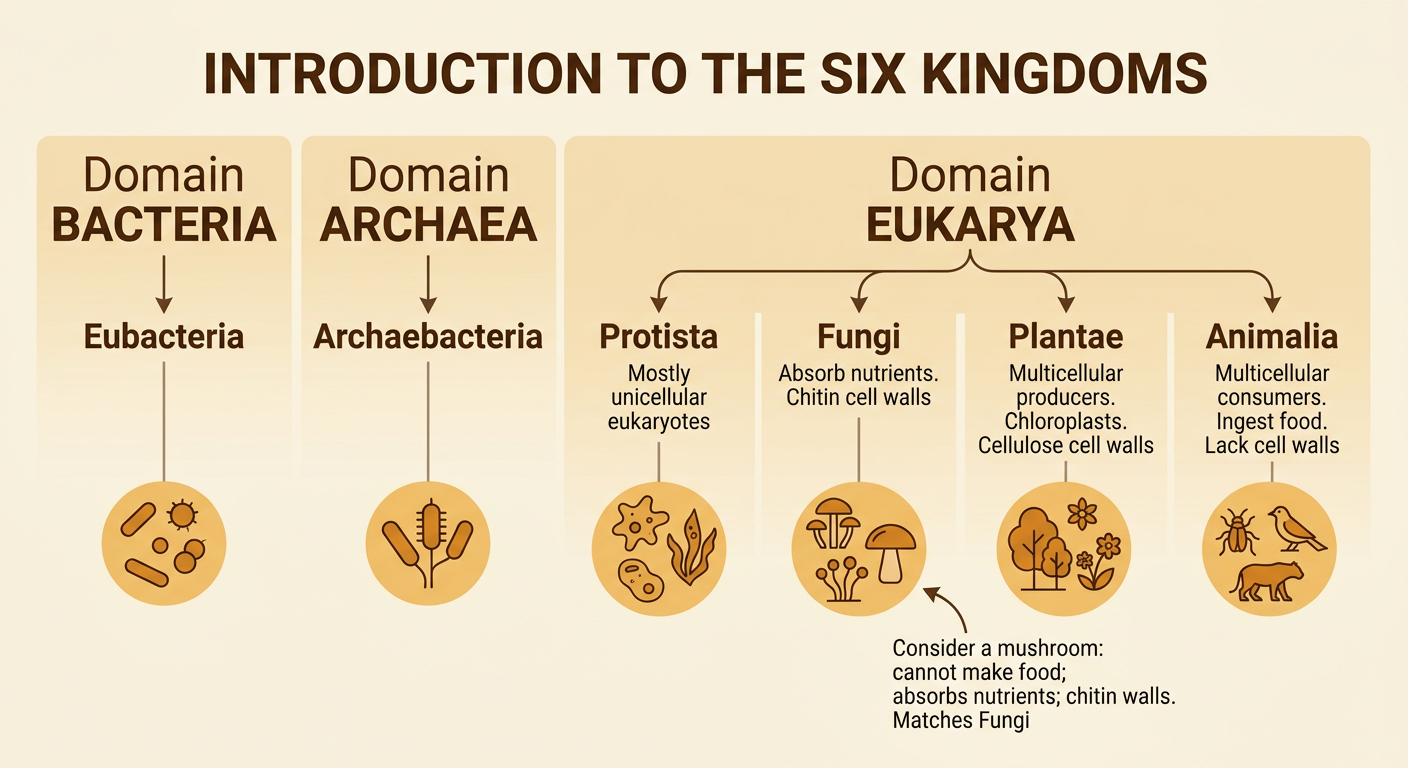
The traditional six-kingdom model divides organisms into Eubacteria, Archaebacteria, Protista, Fungi, Plantae, and Animalia. Eubacteria corresponds generally to Domain Bacteria, while Archaebacteria corresponds generally to Domain Archaea. The other four kingdoms belong to Domain Eukarya. Protista includes mostly unicellular eukaryotes, such as amoebas and many algae, although this traditional group contains organisms with varied traits. Fungi are heterotrophs that absorb nutrients and usually have chitin cell walls. Plants are multicellular producers with cellulose cell walls and chloroplasts. Animals are multicellular consumers that ingest food and lack cell walls. A mushroom, for example, cannot make food by photosynthesis. Its chitin cell walls and nutrient absorption place it in Fungi rather than Plantae. The six-kingdom model is useful for comparing major traits, even though modern classification revises some of its groups.
Classify Mystery Organisms
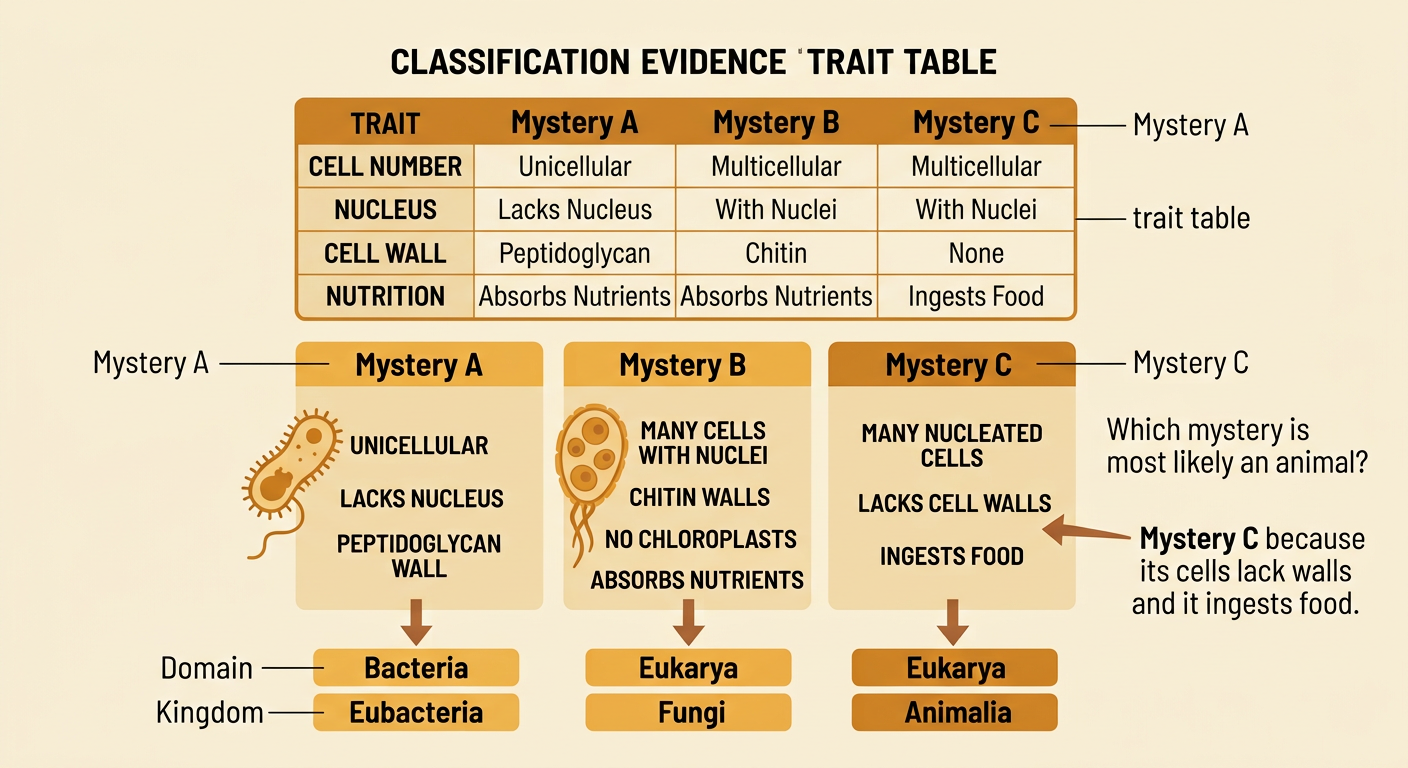
To classify an unknown organism, compare several observable or measured traits rather than relying on one feature. Suppose Mystery A is unicellular, lacks a nucleus, and has a peptidoglycan cell wall. These traits support placement in Domain Bacteria and the traditional kingdom Eubacteria. Mystery B has many cells with nuclei, chitin cell walls, and no chloroplasts; it absorbs nutrients from its surroundings. It belongs to Domain Eukarya and Kingdom Fungi. Mystery C also has many nucleated cells, but its cells lack walls and the organism ingests food. It belongs to Eukarya and Animalia. A trait table makes the reasoning visible: each row is evidence, while each column represents an organism. Cell number can be recorded as one or many, but classification requires combining that evidence with cell structure, wall material, and nutrition.
How Classification Changes
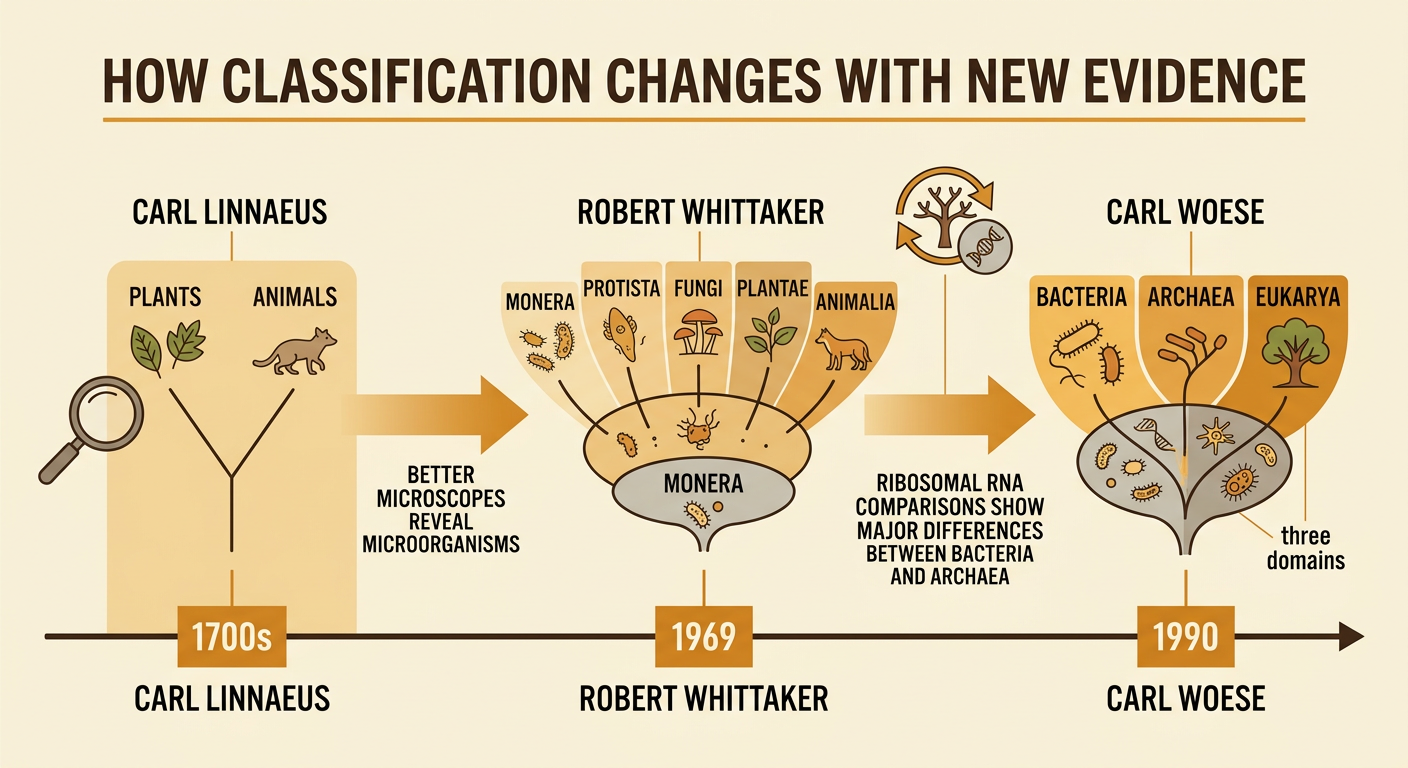
Biological classification changes when new evidence or new technology reveals relationships that earlier systems missed. In the 1700s, Carl Linnaeus used visible traits to organize organisms, mainly within plant and animal kingdoms. Improved microscopes later revealed microorganisms and detailed cell structures, leading scientists to add kingdoms. In 1969, Robert Whittaker proposed a five-kingdom system that included Monera for prokaryotes. Comparisons of ribosomal RNA led Carl Woese and colleagues to recognize major differences between bacteria and archaea. In 1990, they proposed the three domains Bacteria, Archaea, and Eukarya. Splitting Monera also supported the traditional six-kingdom model. The change is the number and arrangement of major groups; the continuity is the use of shared traits and nested groups. Modern DNA evidence continues to revise branches, so classification is a scientific explanation that improves with evidence, not an unchangeable list.