
Light and Electromagnetic Radiation
Students examine the electromagnetic spectrum and evaluate when wave and particle models best explain the behavior of light.
Illustrations are auto-generated and may be placeholders. They can be refreshed to match the narration.
The Electromagnetic Spectrum
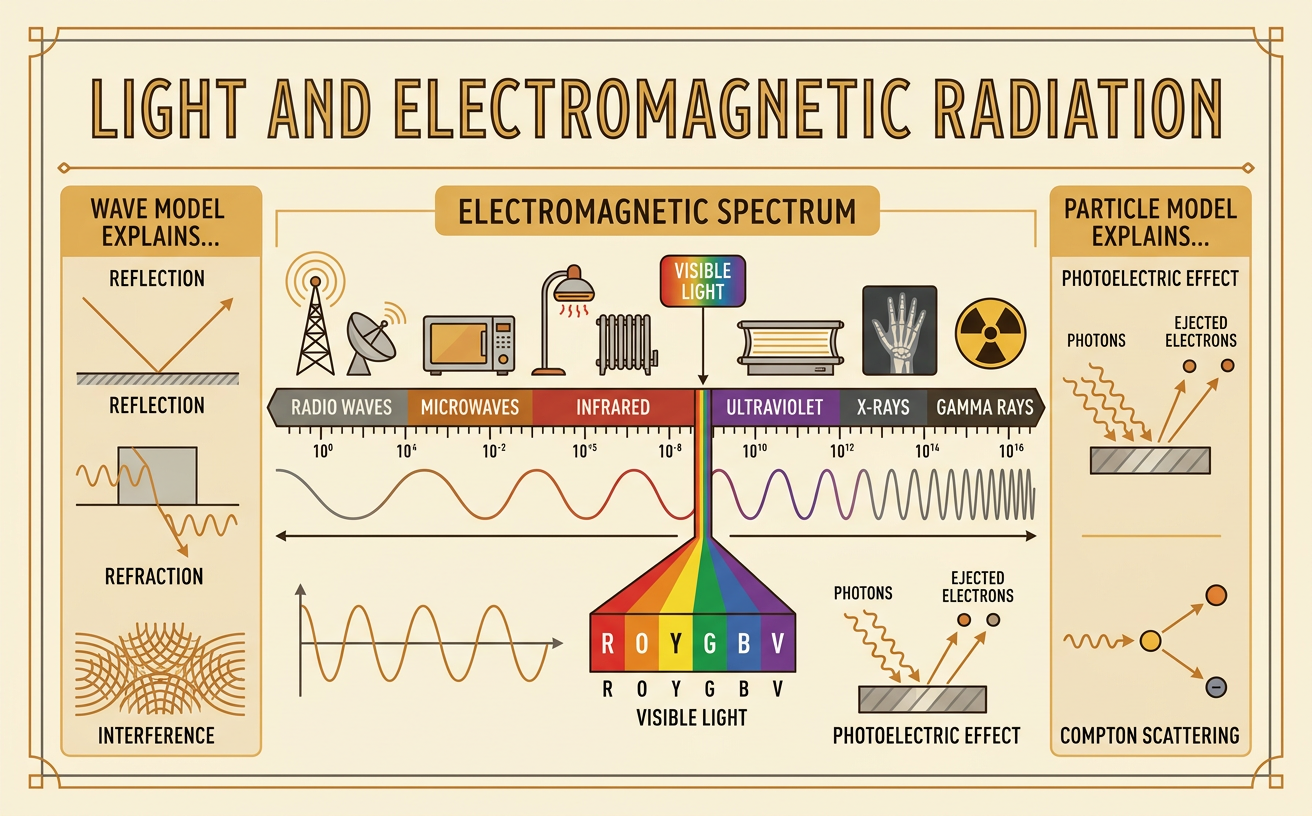
Electromagnetic radiation is energy that travels through space as changing electric and magnetic fields. The electromagnetic spectrum includes radio waves, microwaves, infrared radiation, visible light, ultraviolet radiation, X-rays, and gamma rays. All electromagnetic waves travel through a vacuum at about 3.0 × 10^8 meters per second. Their frequency and wavelength are related by c = fλ, so higher frequency means shorter wavelength. Frequency also determines the energy carried by each photon. For example, a microwave oven uses relatively low-frequency microwaves to transfer energy to food, while medical X-rays have much higher frequencies and can pass through soft tissue. Visible light occupies only a narrow portion of the entire spectrum, from longer-wavelength red light to shorter-wavelength violet light.
Light as a Wave
The wave model describes light by its wavelength, frequency, amplitude, and direction of travel. It is especially useful for explaining interference and diffraction. Interference occurs when light waves overlap: waves that arrive in step reinforce one another, while waves that arrive out of step reduce or cancel one another. Diffraction is the spreading of waves as they pass through a narrow opening or around an edge. In a double-slit experiment, light passing through two closely spaced slits produces alternating bright and dark bands on a screen. Bright bands form where waves reinforce one another, and dark bands form where they interfere destructively. This repeating pattern is strong evidence for the wave model because a simple stream of classical particles would not predict the same pattern of regularly spaced bands.
Reflection and Refraction
The wave model helps explain how light changes direction at boundaries. Reflection occurs when light returns from a surface. The angle of reflection equals the angle of incidence, with both angles measured from a line perpendicular to the surface called the normal. Refraction occurs when light enters a material in which its speed is different. Light entering glass from air slows down and bends toward the normal. Its frequency remains constant, but its wavelength becomes shorter. When light leaves glass and returns to air, it speeds up and bends away from the normal. For example, a drinking straw in a glass of water appears bent because rays from the submerged part refract as they move from water into air. The eye traces those rays backward in straight lines, making the underwater portion appear displaced.
Light as Particles
The particle model describes electromagnetic radiation as packets of energy called photons. The energy of one photon is E = hf, where h is Planck’s constant and f is frequency. Higher-frequency radiation therefore consists of higher-energy photons. The photoelectric effect provides strong evidence for this model. When light shines on certain metals, electrons are emitted only if the light’s frequency is above a threshold value. Increasing the intensity of light below that threshold does not release electrons, even though more energy reaches the surface overall. However, increasing the frequency above the threshold can release electrons with greater kinetic energy. For example, violet light may eject electrons from a particular metal while bright red light does not. This result is explained when individual photons transfer energy to individual electrons.
Model Evidence and Limitations
Scientists evaluate a model by asking whether its claims match evidence and whether its reasoning predicts observations. The wave model successfully predicts interference, diffraction, reflection, refraction, and polarization. However, a purely classical wave model does not explain why electrons in the photoelectric effect are released only above a threshold frequency. The photon model explains energy transfer in the photoelectric effect and the detection of light as separate events. However, treating photons as ordinary classical particles does not by itself predict interference patterns. For example, a very dim double-slit experiment records one photon detection at a time, yet many detections gradually form an interference pattern. This evidence shows that neither simple model explains every situation alone. Modern quantum theory provides a more complete description, while wave and particle models remain useful tools for making predictions in appropriate situations.