Light Helps Us See
Students compare objects in darkness and light to discover that objects can be seen only when light is available to illuminate them.

Illustrations are auto-generated and may be placeholders. They can be refreshed to match the narration.
When Can We See an Object?
We see an object when light shines on it and some of that light reaches our eyes. In a bright room, light from a lamp or window falls on many objects. That is why we can see their colors, shapes, and sizes. In complete darkness, an object is still there, but we cannot see it. Imagine a red ball on a table. With the classroom lights on, you can describe the ball as red and round. If the room becomes completely dark, you cannot see those details. Your eyes need light to see the ball. Never stare at the Sun or a very bright light because it can hurt your eyes.

Observe a Covered Object
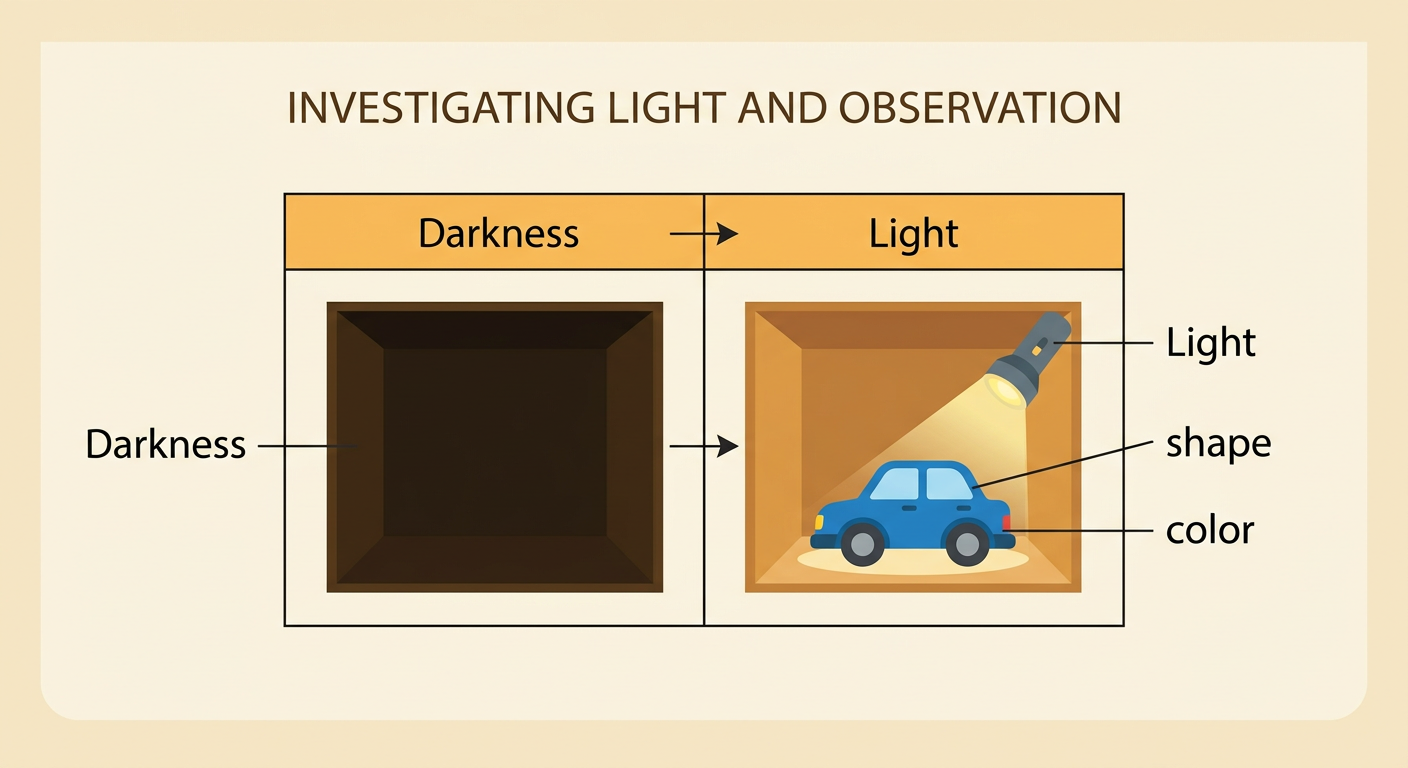
Your teacher can place a small toy inside a box and close the lid. A safe viewing hole lets you look inside without opening the box. First, look through the hole while no light enters the box. Do not reach inside. Can you tell what the object is? You may see nothing, or you may see only a very faint shape if a little light leaks in. Record exactly what you observe. For example, a blue toy car may be inside the box, but in complete darkness you cannot identify its blue color or its wheels. The car has not disappeared. It is simply not illuminated. Share your first observation with a partner and listen to what your partner noticed.

Add a Light Source
Now the teacher adds light safely. The teacher may uncover a small opening so light from a flashlight enters the box. Look through the viewing hole again. What can you see now? You may notice the toy car's blue color, four wheels, and small windows. The object did not change; the amount of light changed. The flashlight illuminated the car. Light struck the car, and some light traveled from the car to your eyes. This gave you evidence that light helps you see objects. Compare your new observation with your first one. Use a sentence such as, “When light entered the box, I could see the blue car.” Only an adult should handle the flashlight during the investigation, and no one should shine it into another person's eyes.

Compare Light and Darkness
Compare what you observed in the two conditions. In darkness, the toy was present, but you could not see enough detail to identify it. With light, you could see its shape, color, and parts. Make a simple two-column chart called “Darkness” and “Light.” Under “Darkness,” you might record, “I could not see the car.” Under “Light,” you might record, “I saw a blue car with four wheels.” These observations show a pattern: more useful light made more details visible. Light does not create the object, and darkness does not make it disappear. Light allows our eyes to receive information from the object. Different groups can compare charts and check whether their observations show the same pattern.
Share Evidence
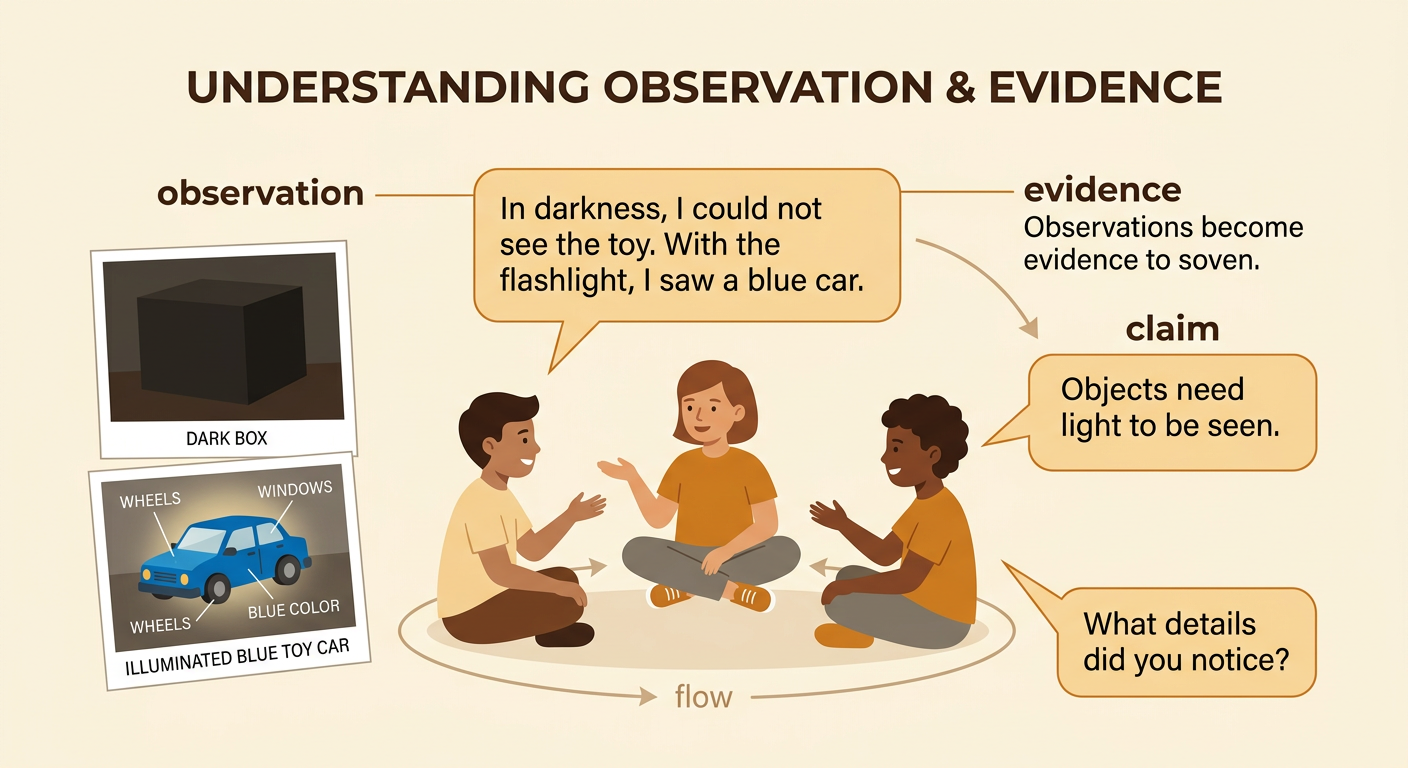
Scientists use observations as evidence. Evidence is information that helps explain what happened. Work with classmates to build an account of the box investigation. Take turns speaking, listening, and asking questions. You might say, “In darkness, I could not see the toy. When the flashlight illuminated it, I saw a blue car. This is evidence that objects need light to be seen.” A partner might ask, “What details did you notice after the light was added?” Answer with what you truly observed, such as the wheels or windows. It is fine if classmates noticed different details. Discuss the evidence respectfully and decide which claim it supports. Together, your observations support the idea that an object can be seen when light is available to illuminate it.
Find Helpful Lights in Our Community
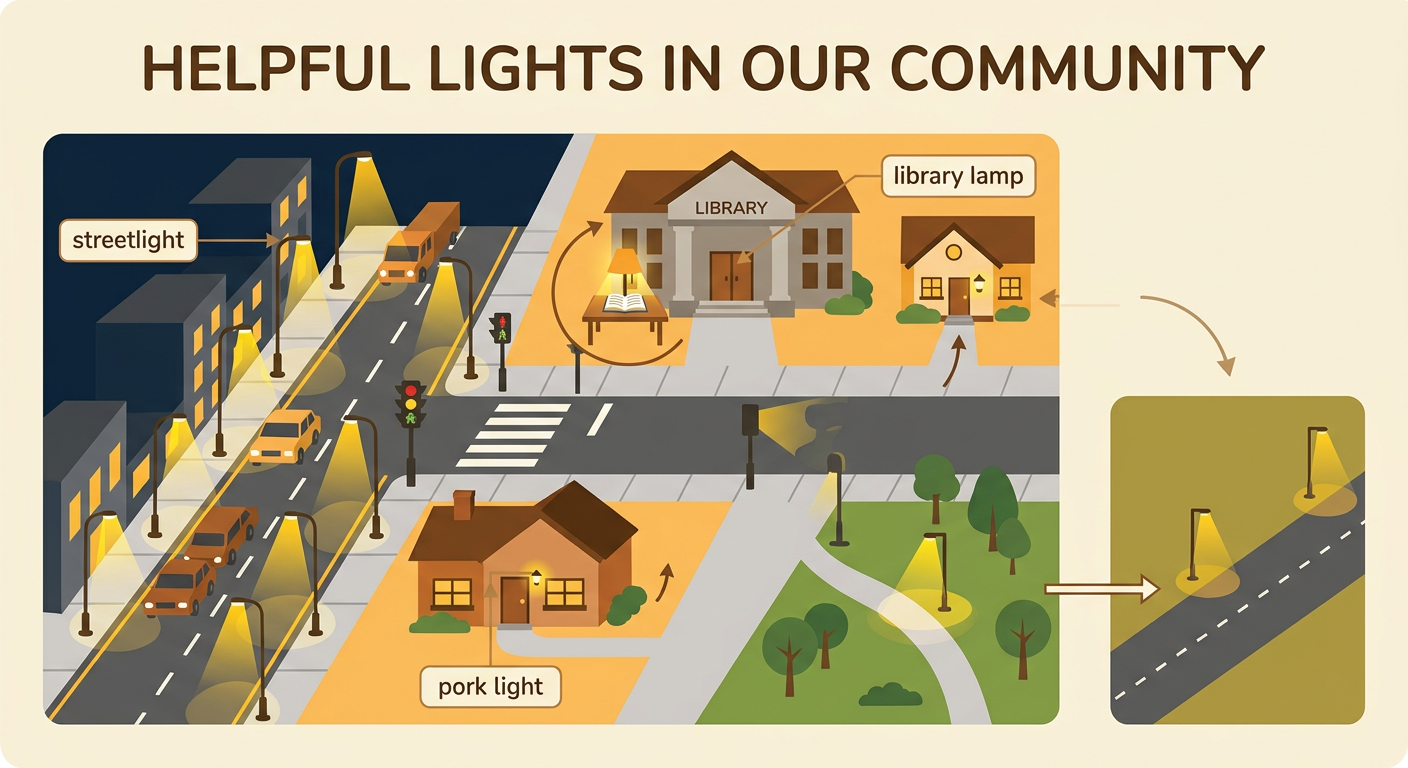
Lights help people see in different places in a community. Streetlights illuminate roads and sidewalks at night. A library lamp helps readers see words and pictures. Porch lights help people find doors, and lights at a crosswalk can help drivers and walkers notice signals. The lights used in a place often match its environmental and cultural characteristics. For example, a busy city street may have many bright streetlights, while a rural road may have fewer lights because homes are farther apart. A community may also use decorative lights during a cultural celebration. Choose one familiar place and identify a helpful light there. Explain what the light illuminates and whom it helps. For example, “The park light illuminates the path so families can see where they are walking.”