
Light, Mirrors, and Signals
Students model how light reflects from mirrors into the eye and explore how people have used reflected light to communicate.

Illustrations are auto-generated and may be placeholders. They can be refreshed to match the narration.
How Light Helps Us See
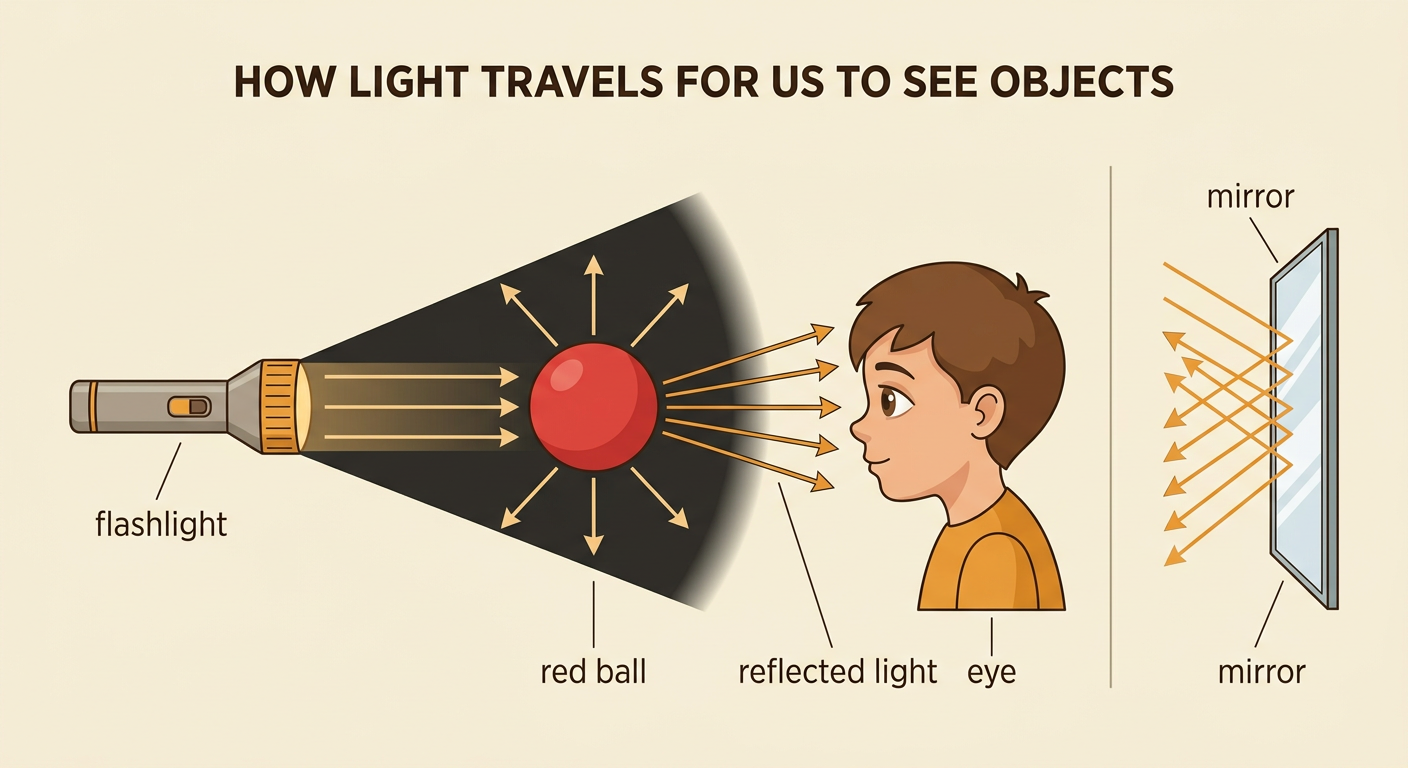
We see an object when light from that object enters our eyes. Some objects, such as the Sun and a flashlight, produce light. Most objects do not produce light. Instead, light from a source strikes them and reflects, or bounces, in many directions. When some of that reflected light enters your eye, you can see the object. For example, a red ball in a dark closet is hard to see because little or no light reaches it. When you turn on a flashlight, light travels from the flashlight to the ball. The ball reflects some light toward your eye, so the ball becomes visible. A mirror also reflects light, but its smooth surface sends the light in a more organized direction.
Testing Light with a Mirror
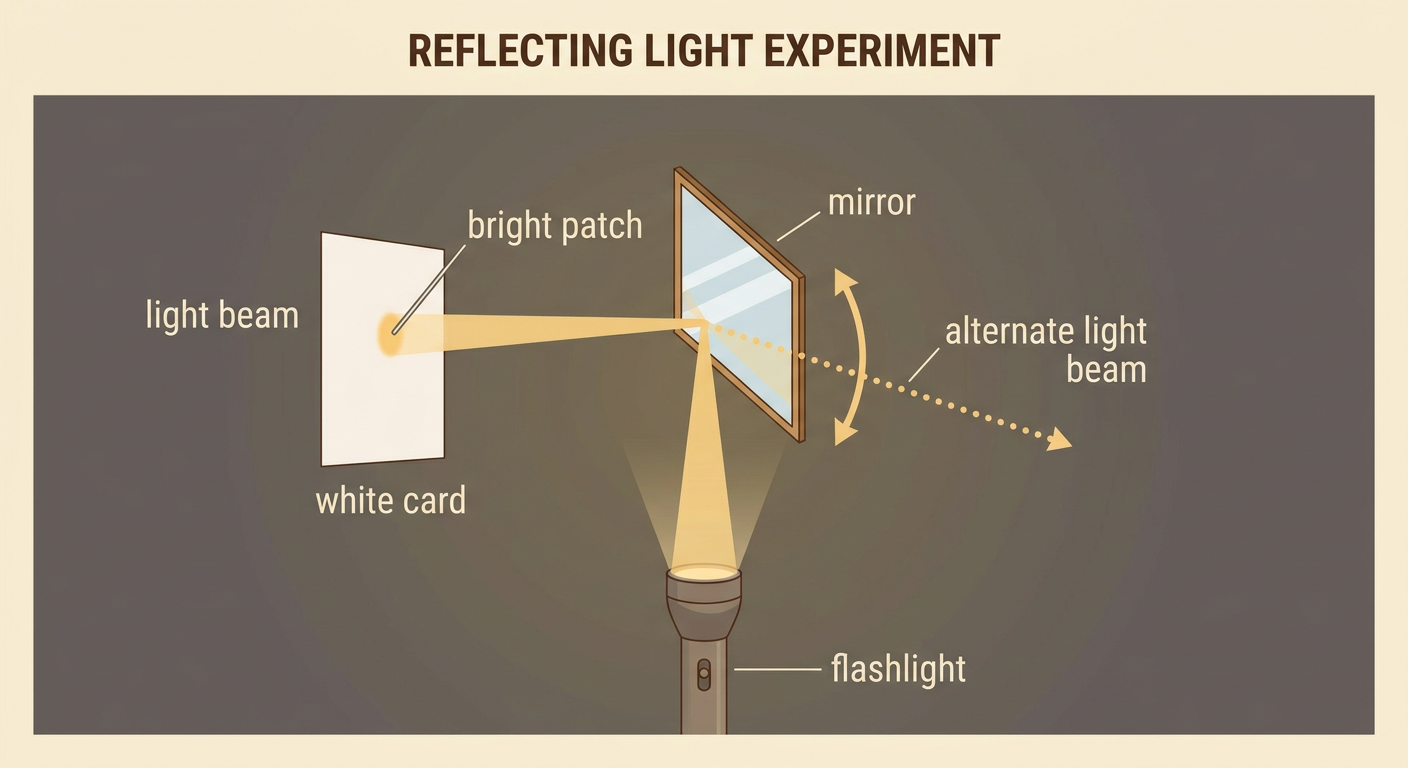
You can test reflection with a flashlight, a small mirror, and a white card. Work in a dim room with an adult or teacher, and never shine light into anyone's eyes. Stand the mirror upright on a table. Place the card to one side of the mirror. Aim the flashlight at the center of the mirror and look for a bright patch on the card. Slowly turn the mirror while keeping the flashlight still. Record where the bright patch moves. This procedure shows that changing the mirror's position changes the direction of reflected light. For example, turning the mirror slightly to the right may move the bright patch farther across the card. Repeat the test to check whether the same mirror position produces the same result.
Tracing Reflected Light
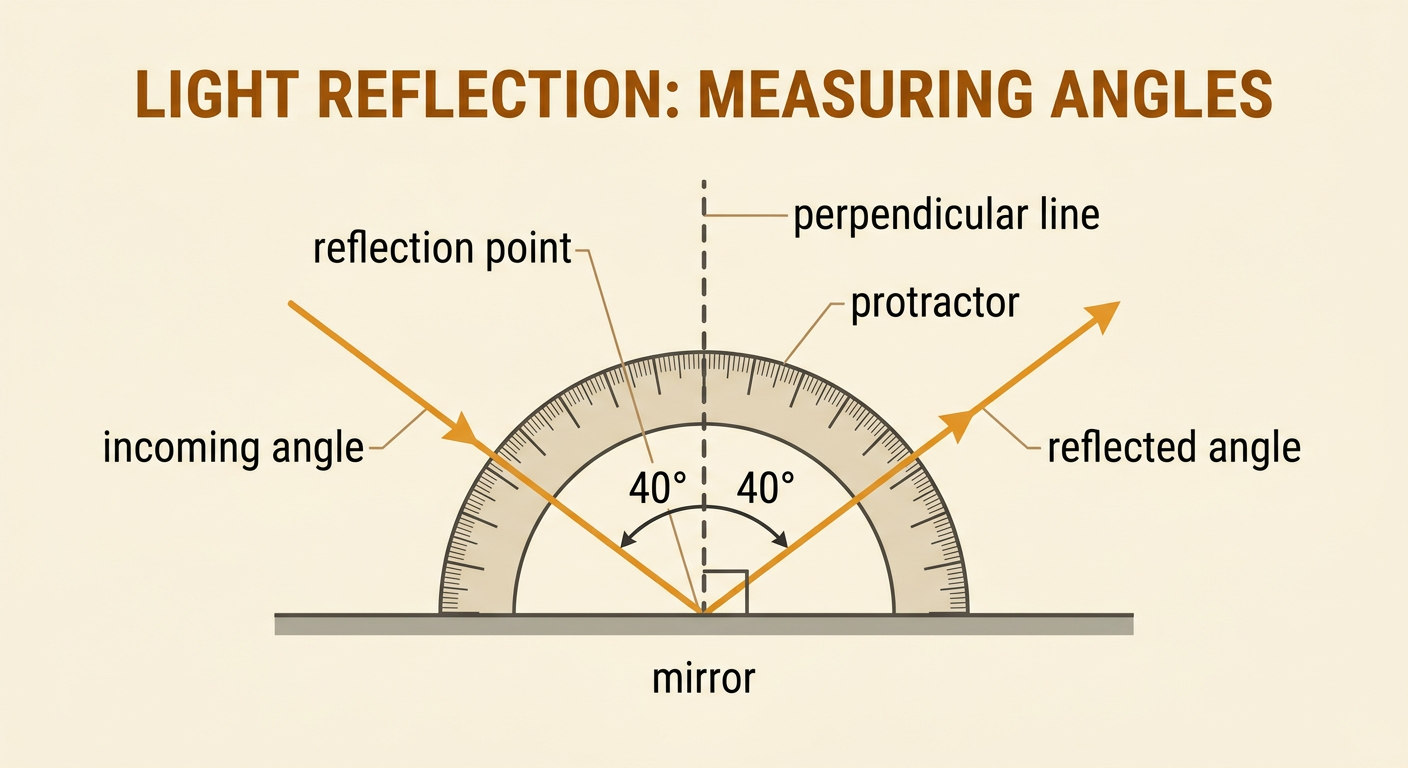
A ray is a straight line used in a model to show the direction light travels. To trace reflected light, place a mirror on a sheet of paper and mark its position. Aim a narrow flashlight beam at one point on the mirror. Mark two points along the incoming beam and two points along the reflected beam. Remove the mirror, use a ruler to connect the marks, and add arrowheads to show direction. One ray should point toward the mirror, and the other should point away. For example, light may travel from the lower left to the mirror and then toward the upper right. This tracing is a model because it represents the light path with lines and arrows rather than showing every part of the real beam.

Measuring Changes in Direction
An angle is a geometric shape formed by two rays that share a common endpoint. In a reflection model, the incoming ray and reflected ray meet at the reflection point, so they form an angle. You can use a protractor to measure this angle in degrees. Place the protractor's center mark on the reflection point. Line up its straight edge with one ray, then read the number where the other ray crosses the scale. For example, the two rays might form an angle of 80 degrees. Scientists often draw a line perpendicular to the mirror at the reflection point. The incoming and reflected rays make equal angles with this line. If the incoming angle is 40 degrees, the reflected angle is also 40 degrees. Turning the mirror changes these ray directions.
Historical Mirror Signals
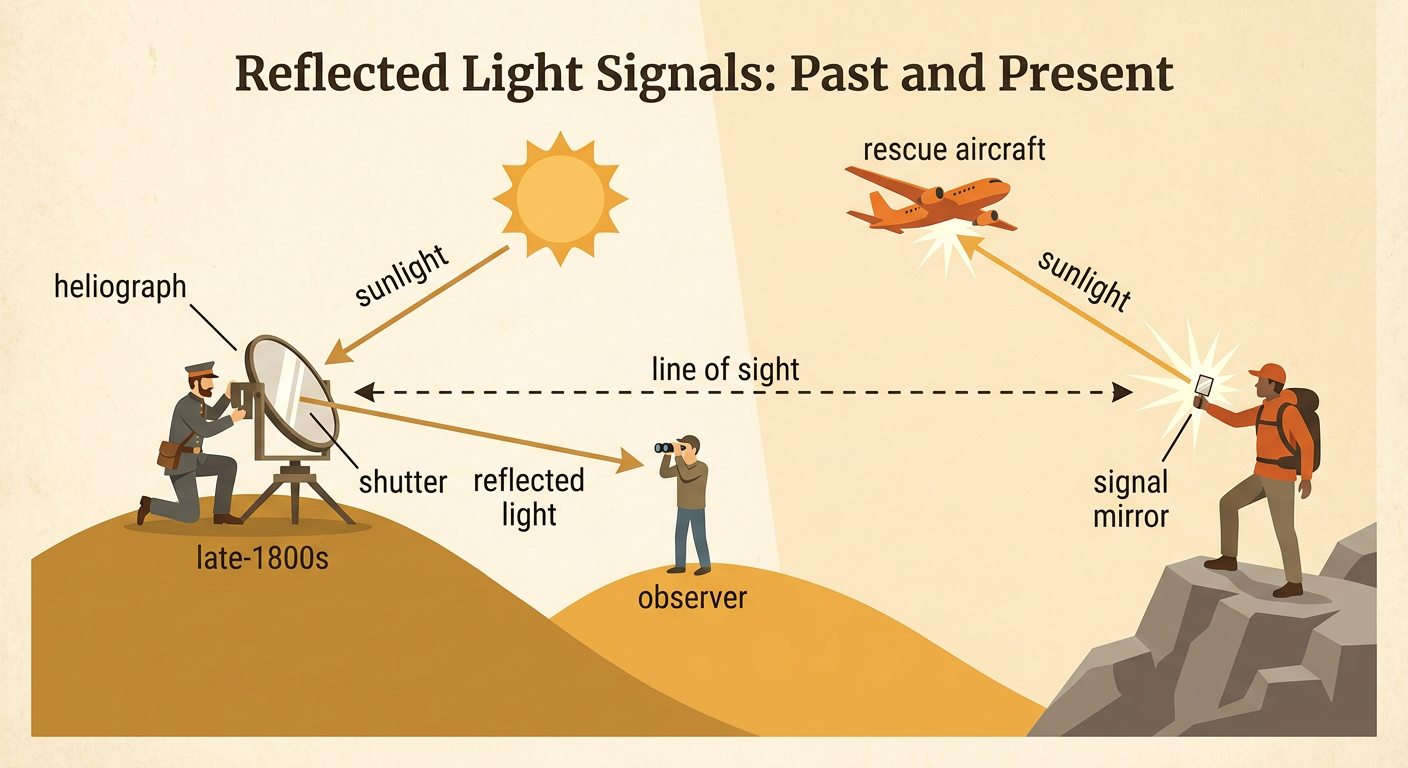
Before radios and cell phones, people sometimes used reflected sunlight to send signals across long distances. In the late 1800s, military groups used a device called a heliograph. Its mirror reflected sunlight toward a distant observer. A shutter or a small mirror movement created short and long flashes that could represent coded messages, including Morse code. A sender on one hill might flash a warning to someone on another hill. Heliographs could communicate quickly without wires, but they required sunlight, clear weather, and a direct line of sight. Today, people can send voice, text, and emergency messages through electronic devices in many weather conditions. However, reflected-light signals can still be useful in emergencies. A person can aim flashes from a signal mirror toward rescuers, aircraft, or boats.
Draw and Explain a Light Model
Create a model that explains how a person sees an object in a mirror. Draw a light source, an object, a mirror, and an eye. Use a ruler to draw one arrow from the light source to the object. Draw another arrow from the object to the mirror, showing light reflected by the object. Then draw a final arrow from the mirror to the eye. Make every arrow point in the direction the light travels. For example, your model might show a lamp lighting a toy car, light reflecting from the car to a wall mirror, and light reflecting from the mirror into a child's eye. Beneath the drawing, explain the sequence in complete sentences. State that the eye sees the car because reflected light enters the eye, not because the eye sends light outward.
