Limiting Reactants, Percent Yield, and Sustainable Manufacturing
Students use balanced equations and manufacturing data to identify limiting reactants, calculate theoretical and percent yield, and evaluate efficient use of chemical resources.
Illustrations are auto-generated and may be placeholders. They can be refreshed to match the narration.
Conservation of Atoms and Balanced Equations
A balanced chemical equation represents conservation of atoms: every atom present in the reactants must also appear in the products. Consider nitrogen and hydrogen forming ammonia: N₂ + 3H₂ → 2NH₃. The reactant side contains two nitrogen atoms and six hydrogen atoms. The product side has the same totals because two ammonia molecules contain two nitrogen atoms and six hydrogen atoms. Coefficients, such as 3 and 2, multiply entire formulas and may be adjusted to balance an equation. Subscripts, such as the 2 in N₂, are part of a substance’s identity and must not be changed. Manufacturers rely on balanced equations to predict required inputs and possible outputs. If an equation is not balanced, its production calculations will conflict with atom conservation and give incorrect material requirements.

Mole Ratios in Chemical Production
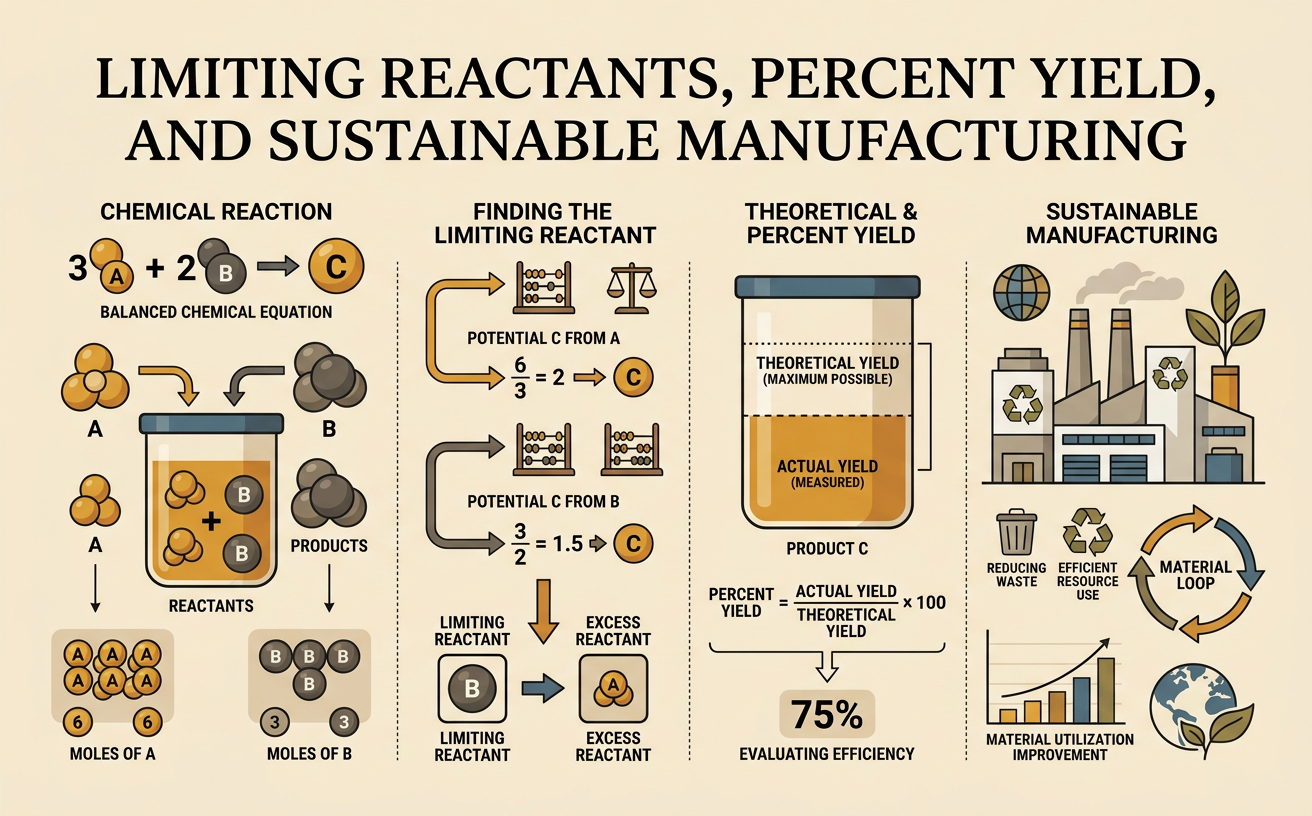
Coefficients in a balanced equation provide mole ratios that connect the amounts of reactants and products. In N₂ + 3H₂ → 2NH₃, one mole of nitrogen reacts with three moles of hydrogen to produce two moles of ammonia. A plant planning to react 10.0 moles of nitrogen would require 30.0 moles of hydrogen and could produce 20.0 moles of ammonia if the reaction were complete. A conversion factor expresses the same relationship. For example, 10.0 mol N₂ × 2 mol NH₃ per 1 mol N₂ equals 20.0 mol NH₃. Mole ratios apply to numbers of particles or moles, not directly to equal masses. To use data reported in grams or kilograms, manufacturers first divide each mass by the substance’s molar mass, apply the mole ratio, and then convert the result back to mass if needed.

Identifying the Limiting Reactant
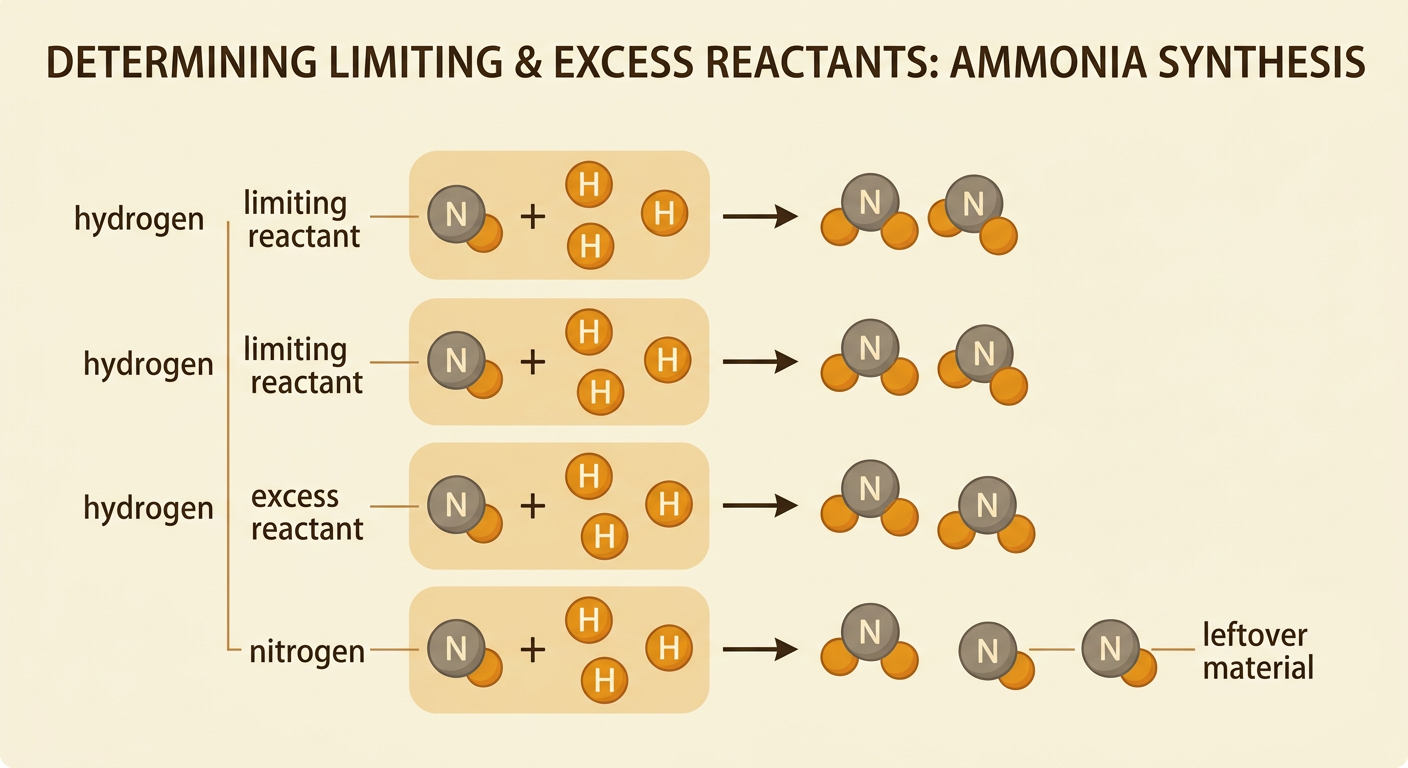
The limiting reactant is consumed first and therefore sets the maximum amount of product. Other reactants present beyond the required ratio are excess reactants. Suppose a reactor receives 5.0 moles of N₂ and 12.0 moles of H₂. The equation N₂ + 3H₂ → 2NH₃ shows that 5.0 moles of N₂ would require 15.0 moles of H₂, but only 12.0 moles are available. Hydrogen is therefore limiting. Alternatively, compare possible product amounts: nitrogen could produce 10.0 moles of NH₃, while hydrogen could produce only 8.0 moles. The smaller product amount identifies the limiting reactant. The 12.0 moles of hydrogen react with 4.0 moles of nitrogen, leaving 1.0 mole of nitrogen unused. Identifying this leftover material helps manufacturers adjust feed ratios, recover excess chemicals, and reduce waste.
Calculating Theoretical and Percent Yield
The theoretical yield is the greatest product amount predicted from the limiting reactant, assuming complete reaction and no product loss. In the reactor with 12.0 moles of limiting H₂, the mole ratio gives 12.0 mol H₂ × 2 mol NH₃ per 3 mol H₂ = 8.00 mol NH₃. Using ammonia’s molar mass of 17.03 grams per mole, the theoretical yield is 136 grams of NH₃. Actual yield is the amount collected in practice. If the plant collects 122 grams, percent yield equals actual yield divided by theoretical yield, multiplied by 100. Thus, percent yield = 122 g ÷ 136 g × 100 = 89.7 percent. Yield may be below 100 percent because reactions are incomplete, side reactions occur, or material is lost during separation. A reported yield above 100 percent usually suggests impurities, retained solvent, or measurement error.

Evaluating Waste and Manufacturing Efficiency
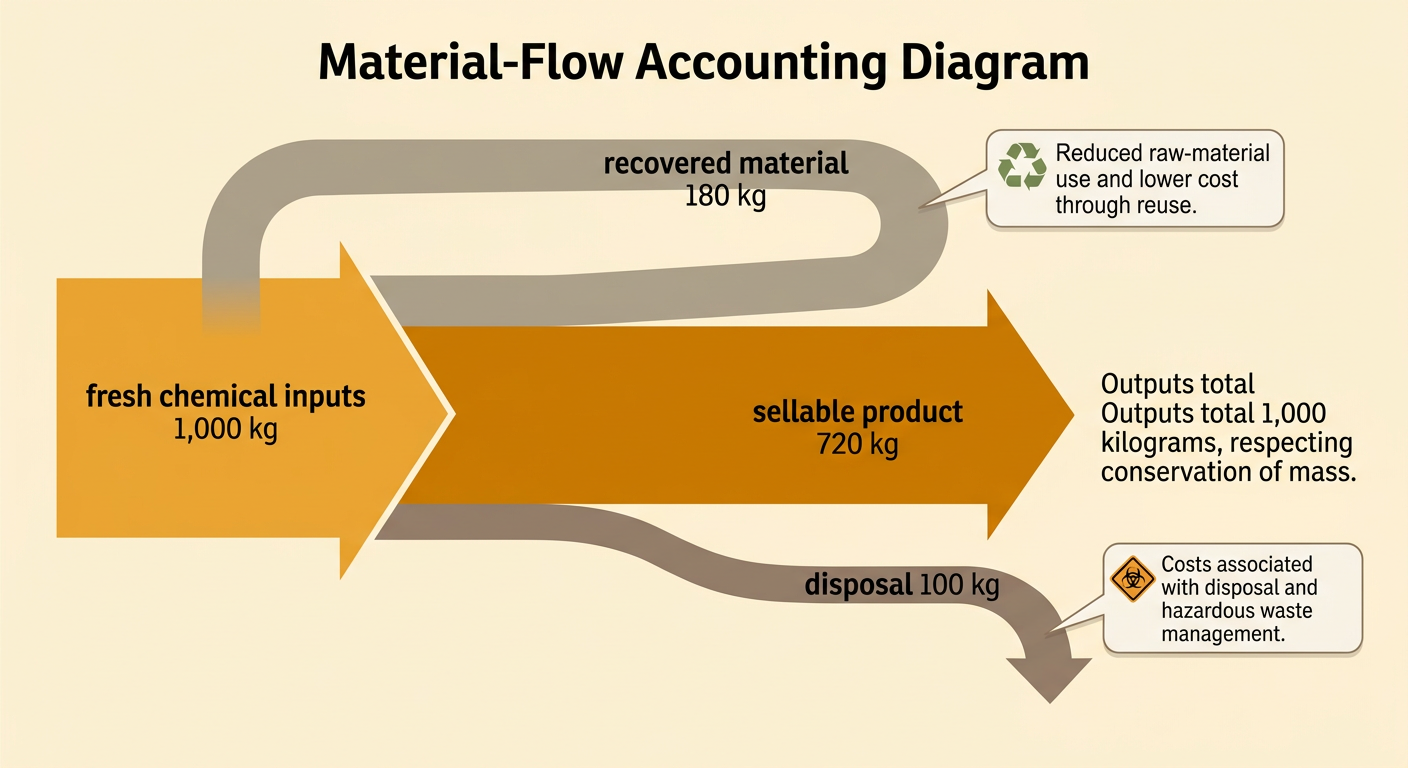
Efficient manufacturing seeks high product yield while reducing raw-material use, hazardous waste, energy demand, and cost. Imagine a plant using 1,000 kilograms of fresh chemical inputs during one production period. Its records show 720 kilograms of sellable product, 180 kilograms of material recovered for reuse, and 100 kilograms sent to disposal. This mass accounting balances the inputs and shows that 72 percent becomes product while 10 percent becomes waste. Raising percent yield or recycling an excess reactant could reduce purchases and disposal. However, yield alone does not measure energy use, toxicity, or total environmental impact. Economic incentives influence plant decisions: disposal fees can encourage waste reduction, while tax credits can support cleaner equipment. These policies may benefit nearby residents and workers through lower pollution but may create short-term costs for owners, customers, or taxpayers. Evaluating a policy requires comparing these costs and benefits across groups.