
Linear Equations, Inequalities, and Graphs
Students solve linear equations and inequalities and connect their solutions to straight-line graphs.
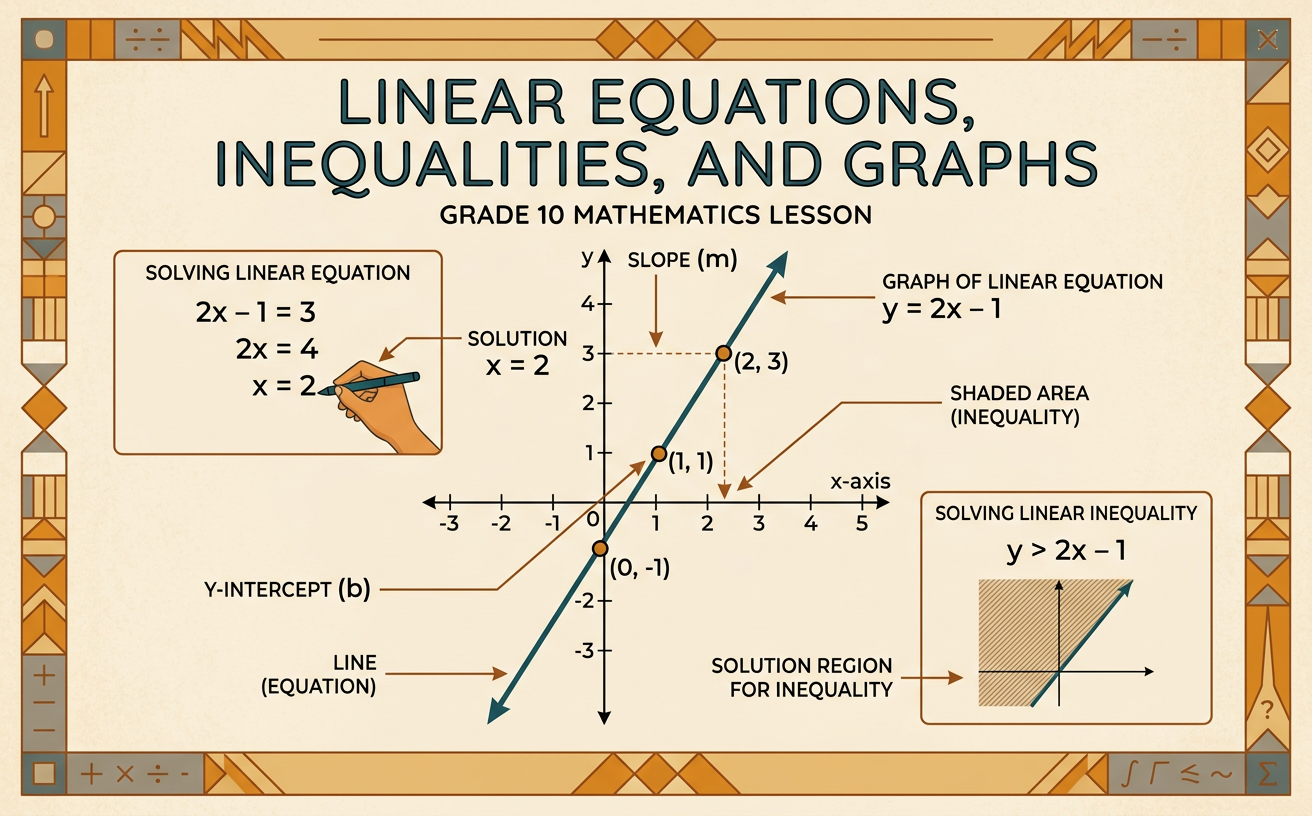
Illustrations are auto-generated and may be placeholders. They can be refreshed to match the narration.
Solving Linear Equations
A linear equation states that two expressions are equal, and its variable has power 1. Solving the equation means finding the value that makes the statement true. Keep the equation balanced by performing the same operation on both sides. For example, solve 3x + 5 = 20. First subtract 5 from both sides: 3x + 5 - 5 = 20 - 5, so 3x = 15. Then divide both sides by 3 to obtain x = 5. Check by substituting 5 into the original equation: 3(5) + 5 = 20, which is true. When an equation contains brackets, expand them first when useful. For example, 2(y + 3) = 14 becomes 2y + 6 = 14, then 2y = 8, so y = 4.
Changing the Subject
The subject of a formula is the variable written alone on one side. Changing the subject means rearranging the formula to make a different variable stand alone. Use inverse operations and apply every operation to both sides. Consider the formula A = lw, where A is the area of a rectangle, l is its length, and w is its width. To make w the subject, divide both sides by l: A/l = lw/l. Therefore, w = A/l, provided l is not zero. As another example, make t the subject of v = u + at. Subtract u from both sides to get v - u = at. Divide by a to obtain t = (v - u)/a, provided a is not zero. Substitution can check the rearrangement using known numerical values.
Linear Inequalities
A linear inequality compares expressions using <, >, ≤, or ≥. Solve it like a linear equation, but remember one special rule: multiplying or dividing both sides by a negative number reverses the inequality sign. For example, solve 2x + 3 ≤ 11. Subtract 3 from both sides to get 2x ≤ 8, then divide by 2 to obtain x ≤ 4. On a number line, place a closed circle at 4 because 4 is included, and shade to the left. Now solve -3x > 9. Dividing both sides by -3 reverses > to <, giving x < -3. Use an open circle at -3 because -3 is not included, and shade to the left. Always check whether the endpoint satisfies the original inequality.
Coordinate Tables
A coordinate table lists values of x and the corresponding values of y for a relationship. Each row or column pair gives an ordered pair (x, y) that can be plotted on a coordinate plane. For the linear rule y = 2x + 1, choose convenient x-values such as -2, -1, 0, 1, and 2. Substitute each value into the rule. When x = -2, y = 2(-2) + 1 = -3. The completed y-values are -3, -1, 1, 3, and 5. Thus, the table gives the points (-2, -3), (-1, -1), (0, 1), (1, 3), and (2, 5). A constant increase of 2 in y whenever x increases by 1 indicates a straight-line relationship.
Graphs of Straight Lines
The graph of a linear relationship is a straight line. In the form y = mx + c, m is the gradient and c is the y-intercept. The gradient measures the change in y divided by the change in x. For y = 2x + 1, the y-intercept is 1, so the line crosses the y-axis at (0, 1). Its gradient is 2, meaning that moving 1 unit to the right requires moving 2 units upward. Plot several points from a coordinate table, then join them with a ruler and extend the line in both directions. The line for y = 2x + 1 passes through (-1, -1), (0, 1), and (1, 3). Any point on the line satisfies the equation; points away from it do not.
Simultaneous Equations
Simultaneous equations describe two conditions that must be true at the same time. Their solution is the pair of values that satisfies both equations. Consider x + y = 7 and x - y = 1. Add the equations to eliminate y: 2x = 8, so x = 4. Substitute x = 4 into x + y = 7 to get 4 + y = 7, so y = 3. The solution is (4, 3). Check it in both equations: 4 + 3 = 7 and 4 - 3 = 1. Graphically, each equation represents a straight line, and their intersection is the solution. If two lines are parallel, there is no solution. If they are the same line, there are infinitely many solutions because every point on one line is also on the other.