
Logarithms and Surds
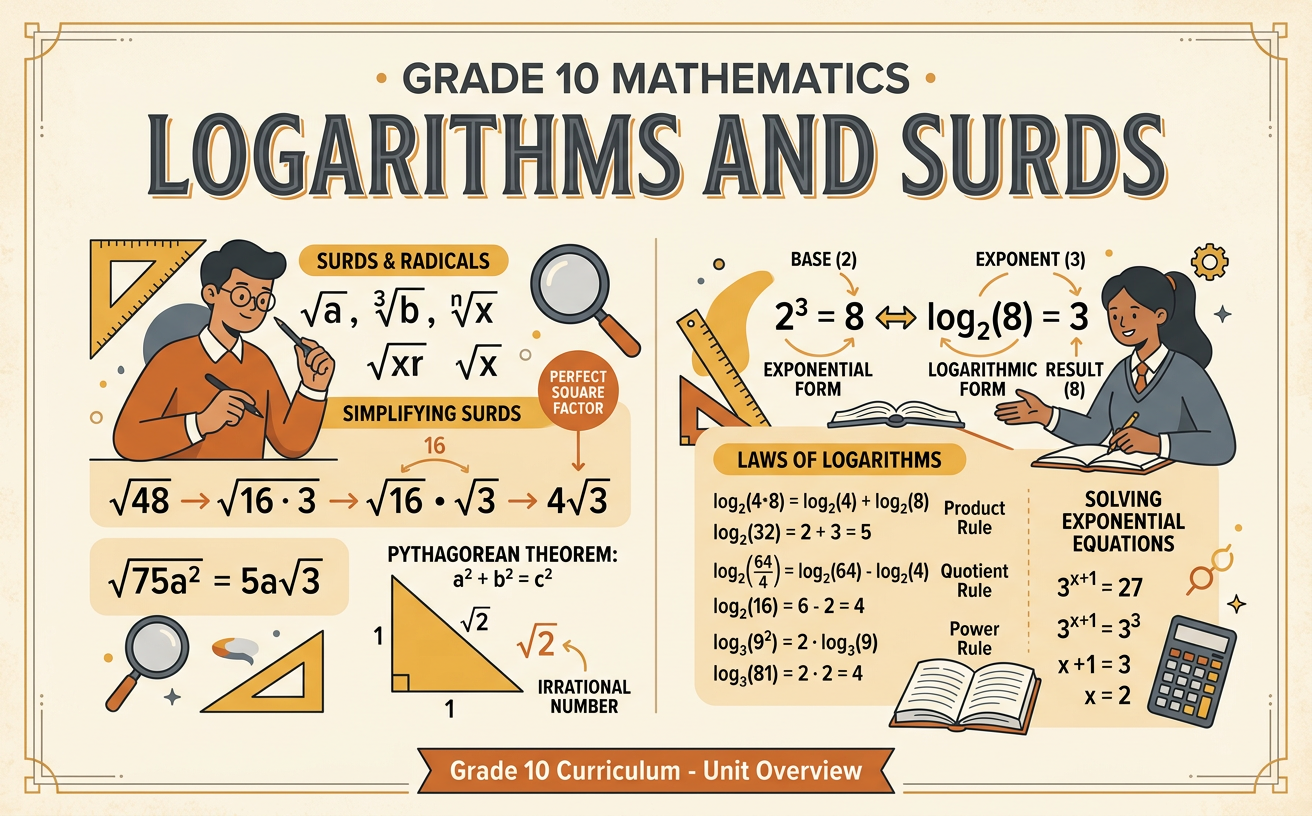
Students simplify surds and use logarithmic relationships to evaluate expressions and solve basic exponential equations.
Illustrations are auto-generated and may be placeholders. They can be refreshed to match the narration.
Understanding Surds
A surd is an irrational root that cannot be written as a simple fraction or whole number. For example, sqrt(2) is a surd because 2 is not a perfect square, so sqrt(2) cannot be simplified to a rational number. Its decimal value continues without ending or repeating. In contrast, sqrt(25) = 5, so sqrt(25) is not a surd. Surds can represent exact measurements more accurately than rounded decimals. For example, a square with side length 3 cm has a diagonal d found using d2 = 32 + 32 = 18. Therefore, d = sqrt(18) = 3sqrt(2) cm. Writing 3sqrt(2) keeps the value exact, while 4.24 cm is only an approximation.
Simplifying Surds
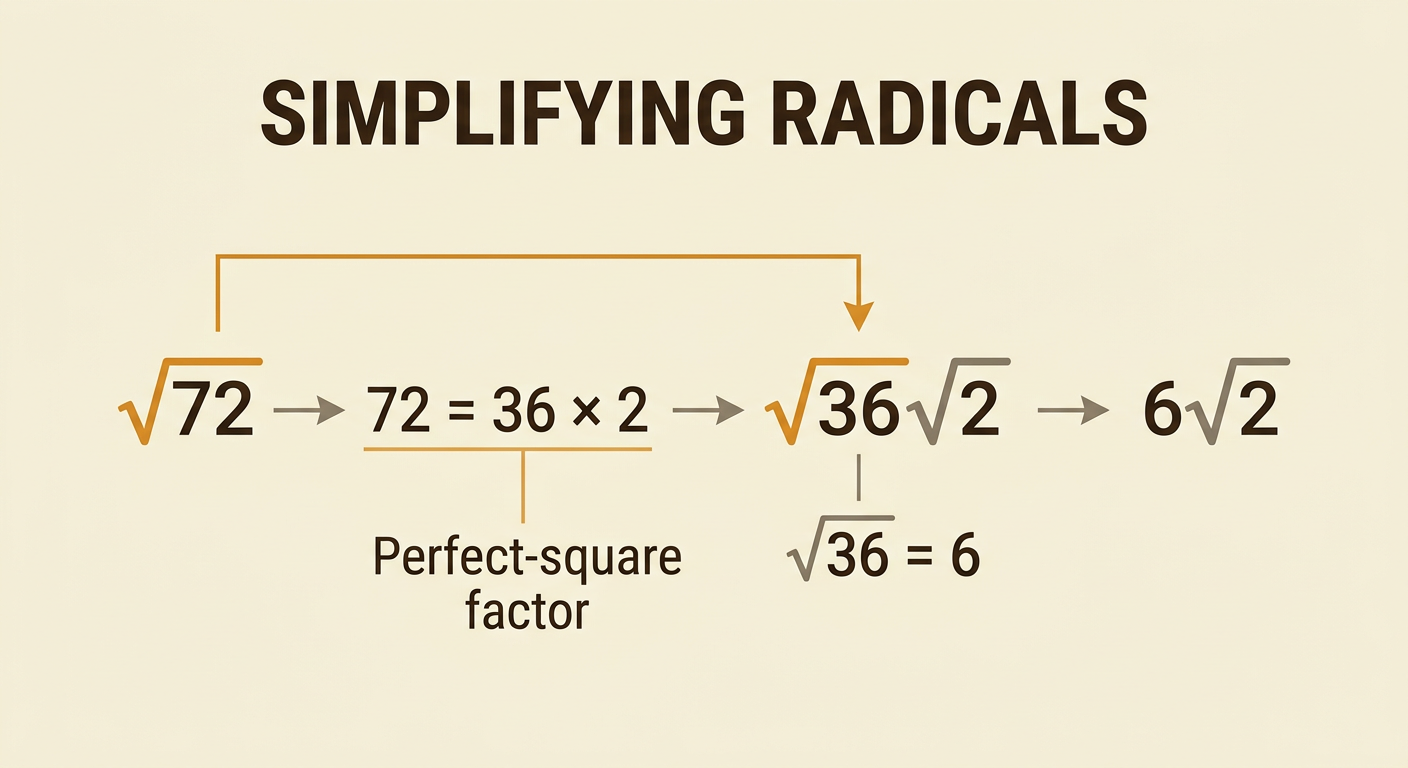
To simplify a surd, identify the largest perfect-square factor inside the root. Then use sqrt(ab) = sqrt(a)sqrt(b). For example, simplify sqrt(72). Since 72 = 36 × 2 and 36 is a perfect square, sqrt(72) = sqrt(36)sqrt(2) = 6sqrt(2). Like surds can be added or subtracted by combining their coefficients. Thus, 3sqrt(2) + 5sqrt(2) = 8sqrt(2). Simplify each surd before deciding whether terms are like terms. For example, sqrt(8) + sqrt(18) = 2sqrt(2) + 3sqrt(2) = 5sqrt(2). However, sqrt(2) + sqrt(3) cannot be combined because the numbers inside the roots are different. When multiplying surds, sqrt(3) × sqrt(12) = sqrt(36) = 6.
Meaning of a Logarithm
A logarithm tells us the exponent to which a base must be raised to produce a given number. The statement log_b(a) = c means exactly the same as bc = a. Here, b is the base, a is the argument, and c is the exponent. For example, log_2(8) = 3 because 23 = 8. Similarly, log_10(1000) = 3 because 103 = 1000. When no base is written in many school calculations, log usually means base 10. A logarithm is defined only when its argument is positive, and its base must be positive and not equal to 1. Logarithms help convert questions about powers into questions about exponents. For instance, since 52 = 25, it follows that log_5(25) = 2.
Laws of Logarithms
The laws of logarithms allow products, quotients, and powers to be rewritten. For positive M and N, log_b(MN) = log_b(M) + log_b(N). Also, log_b(M/N) = log_b(M) - log_b(N), and log_b(Mk) = klog_b(M). The same base must be used throughout. For example, evaluate log_10(100) + log_10(10). By the product law, this equals log_10(100 × 10) = log_10(1000) = 3. The power law gives log_2(82) = 2log_2(8) = 2 × 3 = 6. Two useful facts are log_b(1) = 0 because b0 = 1, and log_b(b) = 1 because b1 = b. These laws also expand expressions: log_b(xy2) = log_b(x) + 2log_b(y), provided x and y are positive.
Exponential Equations
An exponential equation has the unknown in an exponent. First try to express both sides using the same base. If am = an and a is positive but not 1, then m = n. For example, solve 2x+1 = 16. Since 16 = 24, write 2x+1 = 24. Therefore, x + 1 = 4, so x = 3. Check: 23+1 = 24 = 16. If the two sides cannot easily be written with the same base, logarithms can be used. To solve 3x = 20, take logarithms: log(3x) = log(20). By the power law, xlog(3) = log(20), so x = log(20)/log(3), which is approximately 2.73. Substitution confirms that 32.73 is close to 20.