Love Canal and the Creation of Superfund
Students examine scientific data, resident activism, and government decisions to explain how the Love Canal toxic waste crisis led to a major federal environmental cleanup program.
Illustrations are auto-generated and may be placeholders. They can be refreshed to match the narration.
Industrial Waste Beneath a Neighborhood
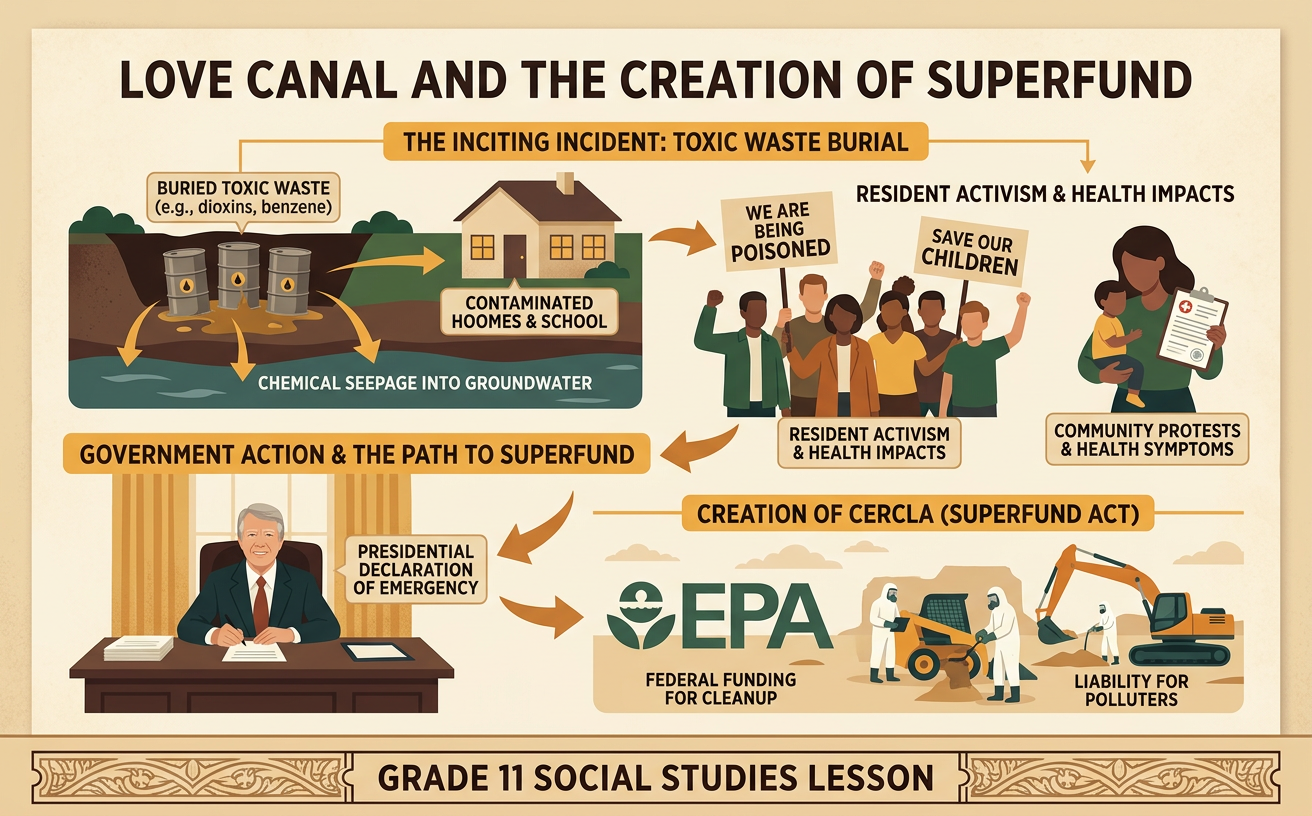
Love Canal began as an unfinished canal project in Niagara Falls, New York. From 1942 to 1953, Hooker Electrochemical Company disposed of approximately 21,000 tons of chemical waste in the canal, then covered the site with soil and clay. In 1953, the company transferred the property to the local school board with a deed warning about the buried chemicals. A school and hundreds of homes were later built nearby. Construction disturbed parts of the protective cover, while heavy rain and a rising water table helped chemicals move through soil and into basements, yards, and storm drains. For example, residents reported strong odors and dark chemical residues appearing after wet weather. The crisis demonstrated how land-use decisions and failures to contain industrial waste can create long-term risks for communities and natural systems.

Health Evidence and Data Analysis
Residents and scientists used several kinds of evidence to investigate possible health effects. Residents recorded odors, chemical burns, illnesses, miscarriages, and birth defects, while government teams sampled air, soil, water, and household areas. Some studies reported unusually high rates of reproductive problems in particular sections of the neighborhood, especially near former drainage channels. However, small sample sizes, uncertain exposure histories, and other health factors made precise cause-and-effect conclusions difficult. Students can analyze the evidence by graphing a quantitative variable, such as measured chemical concentration, against distance from the waste site. A downward trend would suggest that contamination generally decreased with distance, but it would not prove that a particular chemical caused a specific illness. Investigators therefore had to combine statistical patterns with chemical tests, maps, medical records, and residents’ observations.

Resident Activism and Media Attention
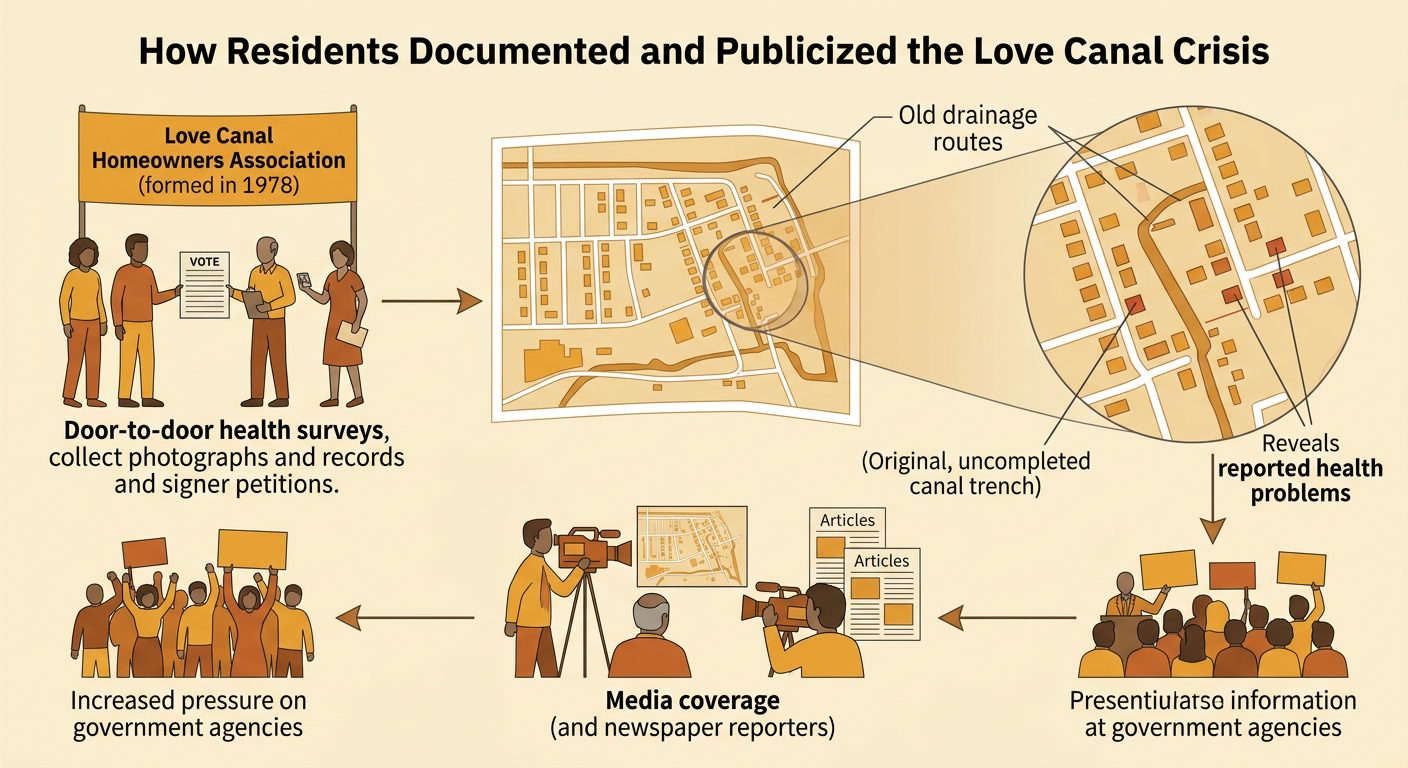
Love Canal became a national issue partly because residents organized and made their evidence visible. In 1978, resident Lois Gibbs helped form the Love Canal Homeowners Association after learning that her son’s school stood near the buried waste site. Residents conducted door-to-door health surveys, gathered photographs and records, signed petitions, attended public meetings, and contacted reporters. Their findings were not substitutes for controlled scientific studies, but they identified patterns that officials had not adequately investigated. Television reports showing chemical residues, damaged homes, and fearful families brought national attention to the neighborhood. For example, residents used maps to mark households reporting miscarriages, illnesses, or birth defects and compared those locations with old drainage routes. Activism and media coverage increased pressure on state and federal agencies to test the area, communicate risks, provide assistance, and reconsider earlier decisions.
Government Responsibility and Relocation
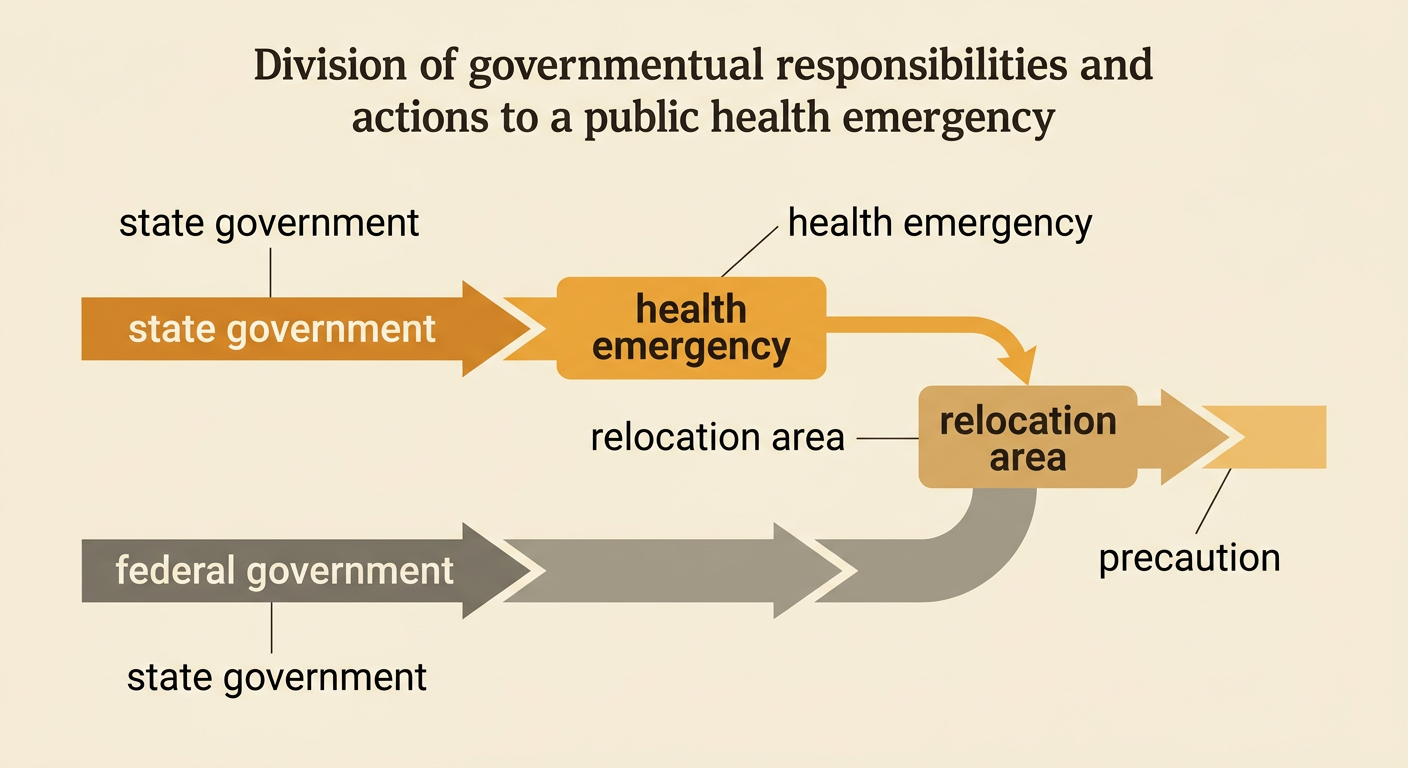
The Love Canal emergency raised difficult questions about who should protect residents and pay for the response. Local officials had approved development near the disposal area, New York State agencies were responsible for public health decisions, and the federal government had limited authority for abandoned hazardous-waste sites. In August 1978, state officials declared a health emergency and recommended relocating pregnant women and young children from the most affected area. President Jimmy Carter later issued federal emergency declarations, and state and federal actions eventually supported the relocation of roughly 800 families. Decisions changed as new sampling results, health concerns, public pressure, and legal questions emerged. For example, officials had to decide whether uncertain evidence justified relocation. Acting too slowly could increase exposure, while acting without clear standards could create unequal treatment. The case showed the importance of precaution, transparent communication, and clearly assigned government responsibility.
From Love Canal to the Superfund Program
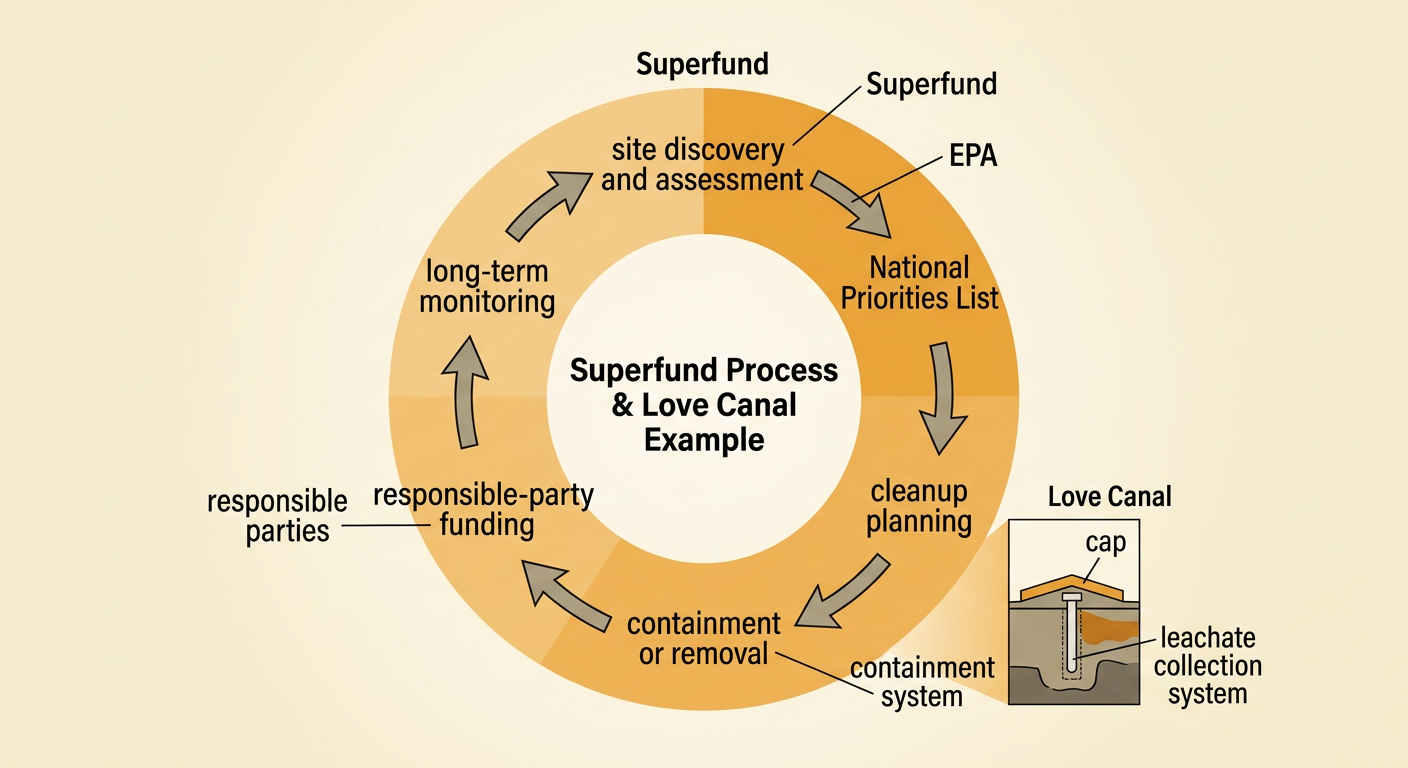
Love Canal was not the only hazardous-waste crisis in the United States, but its national visibility helped build support for a permanent federal response. In December 1980, Congress enacted the Comprehensive Environmental Response, Compensation, and Liability Act, commonly called Superfund. The law authorized the Environmental Protection Agency to identify dangerous sites, place the most serious on the National Priorities List, organize emergency or long-term cleanups, and seek payment from responsible parties. At Love Canal, cleanup measures included containment, drainage and leachate collection, treatment, monitoring, and removal of some contaminated materials. Each solution involved tradeoffs in cost, speed, environmental disturbance, and long-term protection. For example, a containment system can reduce the movement of pollutants, but it requires continued inspection and maintenance. Superfund turned lessons from Love Canal into a broader process for investigating hazards, assigning liability, reducing exposure, and monitoring sites over time.