
Magnet Mysteries: Forces Without Touching
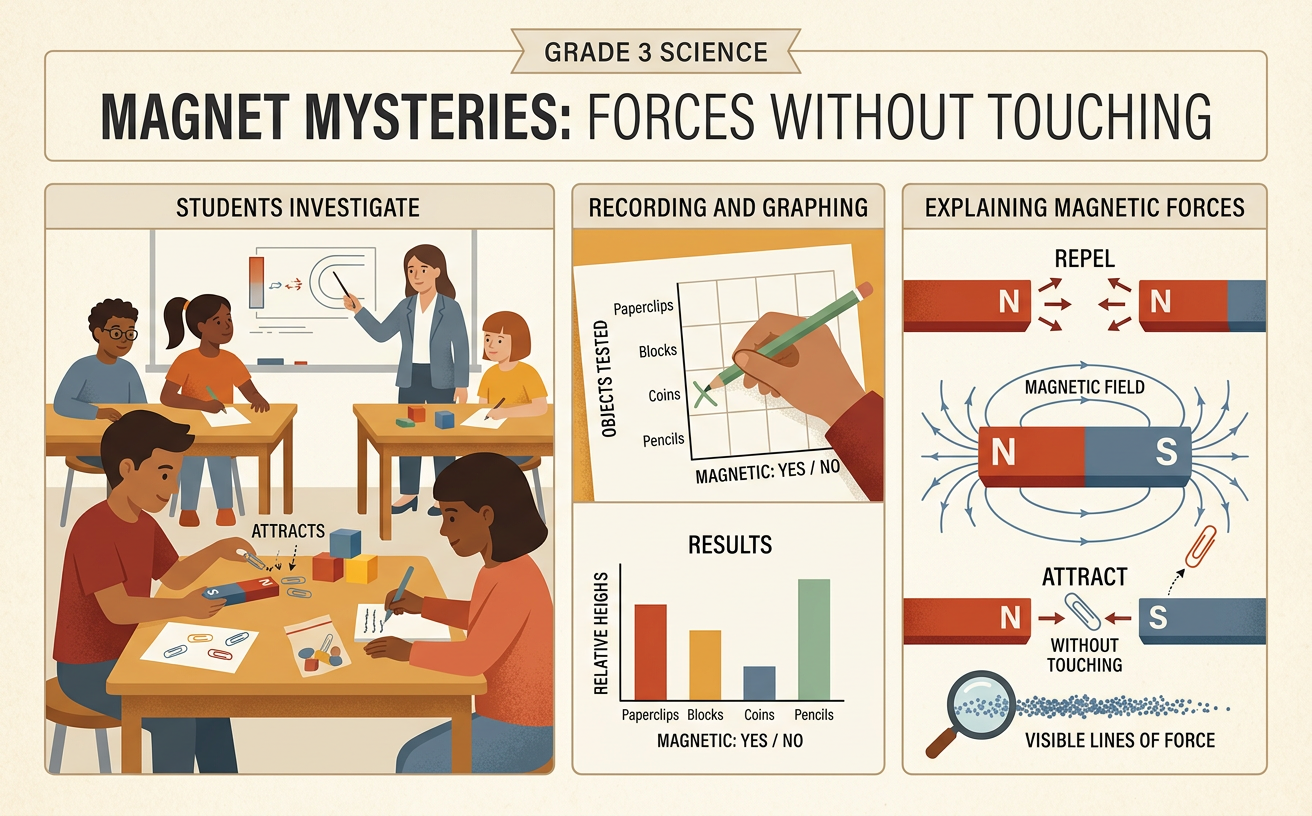
Students test magnetic interactions, record and graph results, and explain how magnets can attract or repel without touching.
Illustrations are auto-generated and may be placeholders. They can be refreshed to match the narration.
Observe a Force at a Distance
A force is a push or a pull. Magnets can exert a force even when they are not touching another object. Place a bar magnet near a steel paper clip without letting them touch. As the magnet moves closer, the paper clip may slide or jump toward it. This motion is evidence of magnetic attraction. The magnet and paper clip interact across the space between them. However, magnets do not attract every object. A magnet may attract an iron nail but not a wooden craft stick, plastic button, or aluminum foil. Observe carefully and describe only what you notice. You might say, “The paper clip moved toward the magnet when they were one centimeter apart.” This observation identifies the objects, their distance, and the motion caused by the magnetic force.

Ask a Magnetic Question
Scientists begin investigations by asking questions that can be answered with observations or measurements. A useful magnetic question changes one factor and identifies what you will observe. For example, ask, “How does the distance between a magnet and a paper clip affect whether the paper clip moves?” You can test several distances while keeping the same magnet, paper clip, and table surface. Work with your group to predict what might happen and explain your thinking. Then choose helpful sources. A classroom investigation can provide direct evidence about movement, while a science book can explain magnetic poles. An advertisement for a magnetic toy may not provide reliable test results. Listen to each group member, compare ideas, and agree on a question that is safe, clear, and testable.

Test Attraction and Repulsion
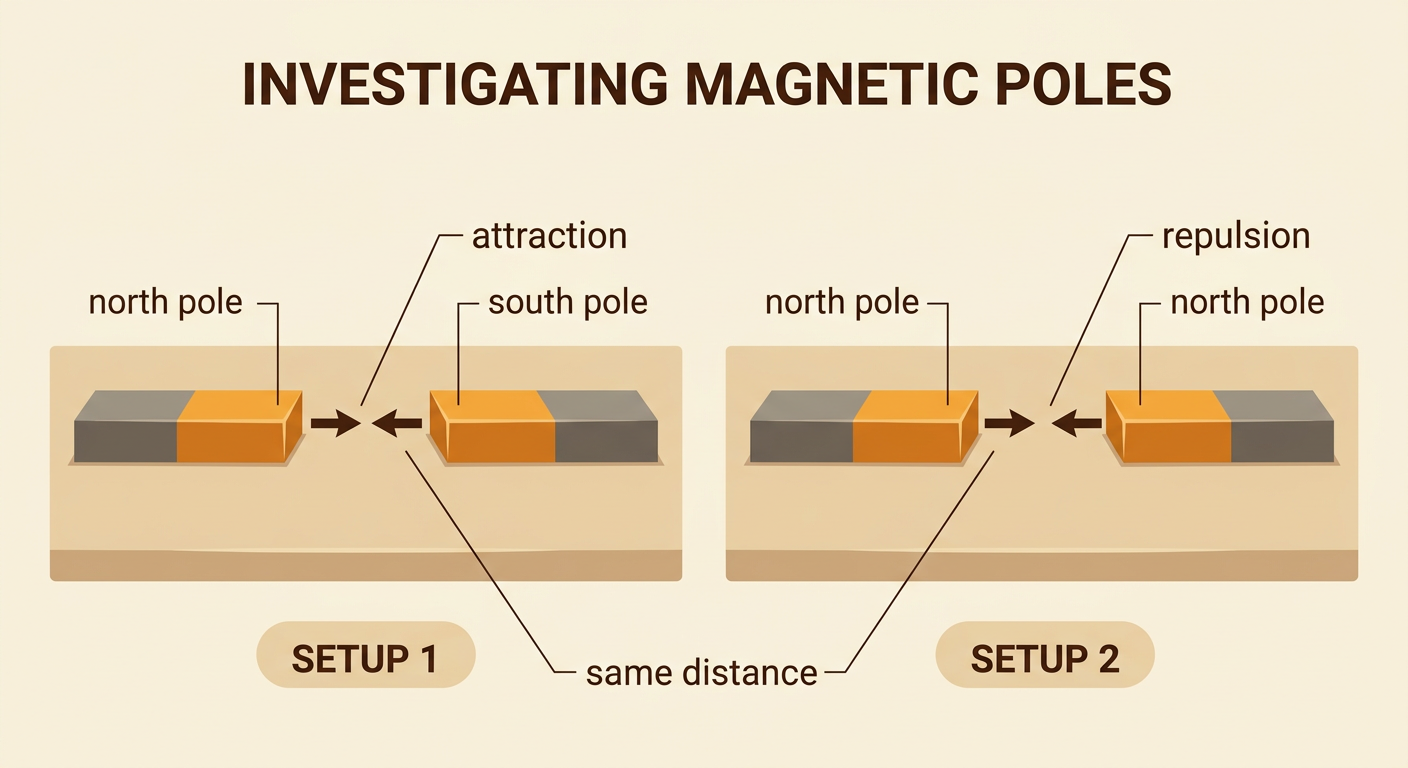
Every bar magnet has two poles, called north and south. Different poles attract, so a north pole and a south pole pull toward each other. Like poles repel, so two north poles or two south poles push away from each other. To test these interactions, place one magnet on a smooth table. Slowly bring a second magnet near it without touching. First face north toward south, and record whether the table magnet moves closer. Next face north toward north, and record whether it moves away. Begin each trial at the same distance and use the same magnets and surface. Repeat each setup several times because repeated trials make the evidence more dependable. Keep magnets away from electronic devices, and do not let them snap together near fingers. Record attraction, repulsion, or no visible movement after every trial.
Graph the Results
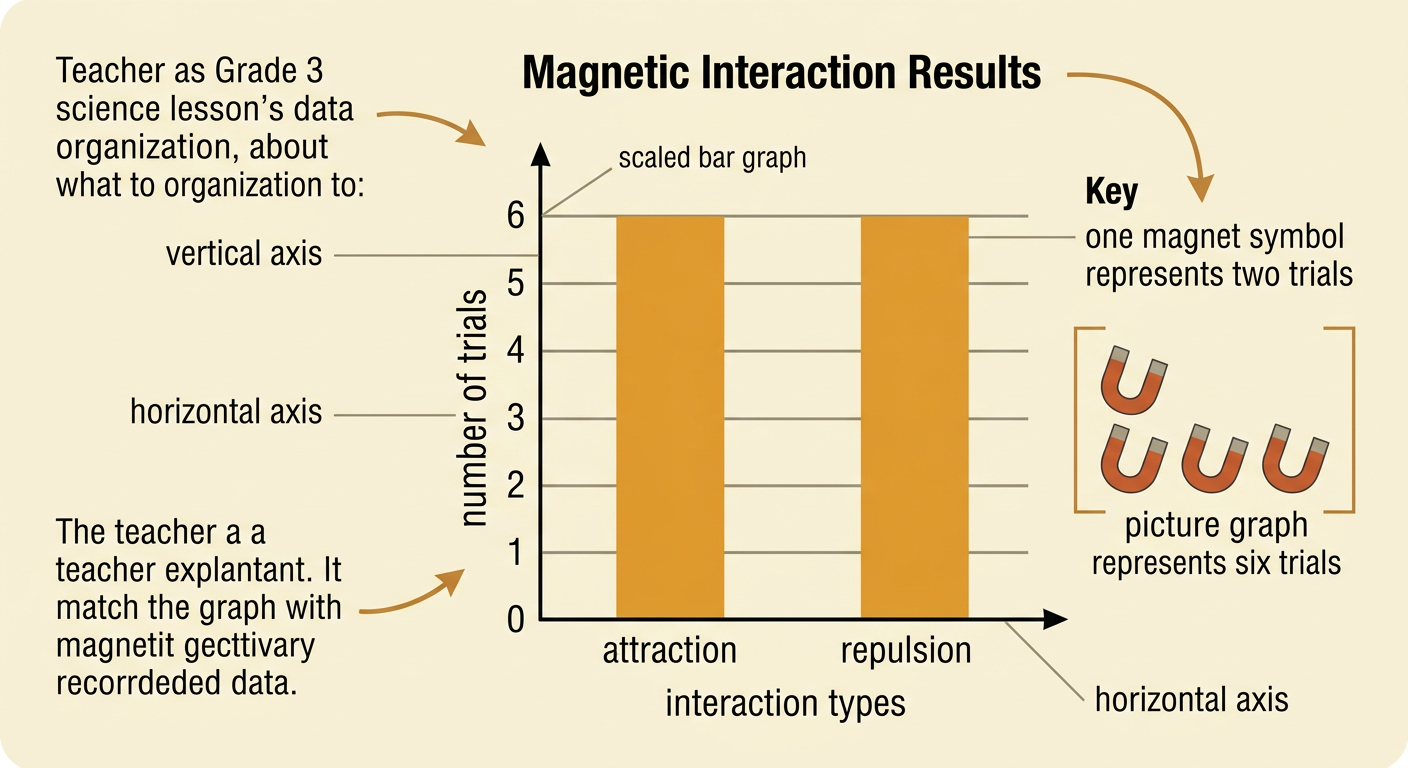
A graph helps you compare results and notice patterns. Suppose your group completes six trials with opposite poles facing and six trials with like poles facing. You observe attraction in all six opposite-pole trials and repulsion in all six like-pole trials. Make a bar graph with interaction types along the horizontal axis and the number of trials along the vertical axis. Use a scale in which each grid square represents one trial. Draw the attraction bar up to 6 and the repulsion bar up to 6. If you use a picture graph instead, one magnet symbol could represent two trials, so three symbols would represent six trials. Include a title, labels, and a key when needed. Check that each bar or picture matches your data table before using the graph as evidence.
Explain the Magnetic Evidence
Use a claim, evidence, and reasoning to explain your results. A claim answers the investigation question. You might claim, “Magnets can attract or repel without touching.” Evidence comes from observations and recorded data. For example, the magnets moved together in six opposite-pole trials and moved apart in six like-pole trials, even though a gap remained between them. Reasoning connects the evidence to science ideas: magnetic forces can act across space, opposite poles attract, and like poles repel. Share your explanation with classmates and listen for questions. A classmate might ask whether the starting distance was the same in every trial. Use your procedure and data table to answer. If the evidence is unclear, repeat the test or collect more measurements. Strong explanations identify the cause, describe the effect, and use dependable evidence.
