
Magnetic Fields and Electromagnetic Induction
Students examine forces produced by magnetic fields and explain how changing magnetic flux generates electric current.
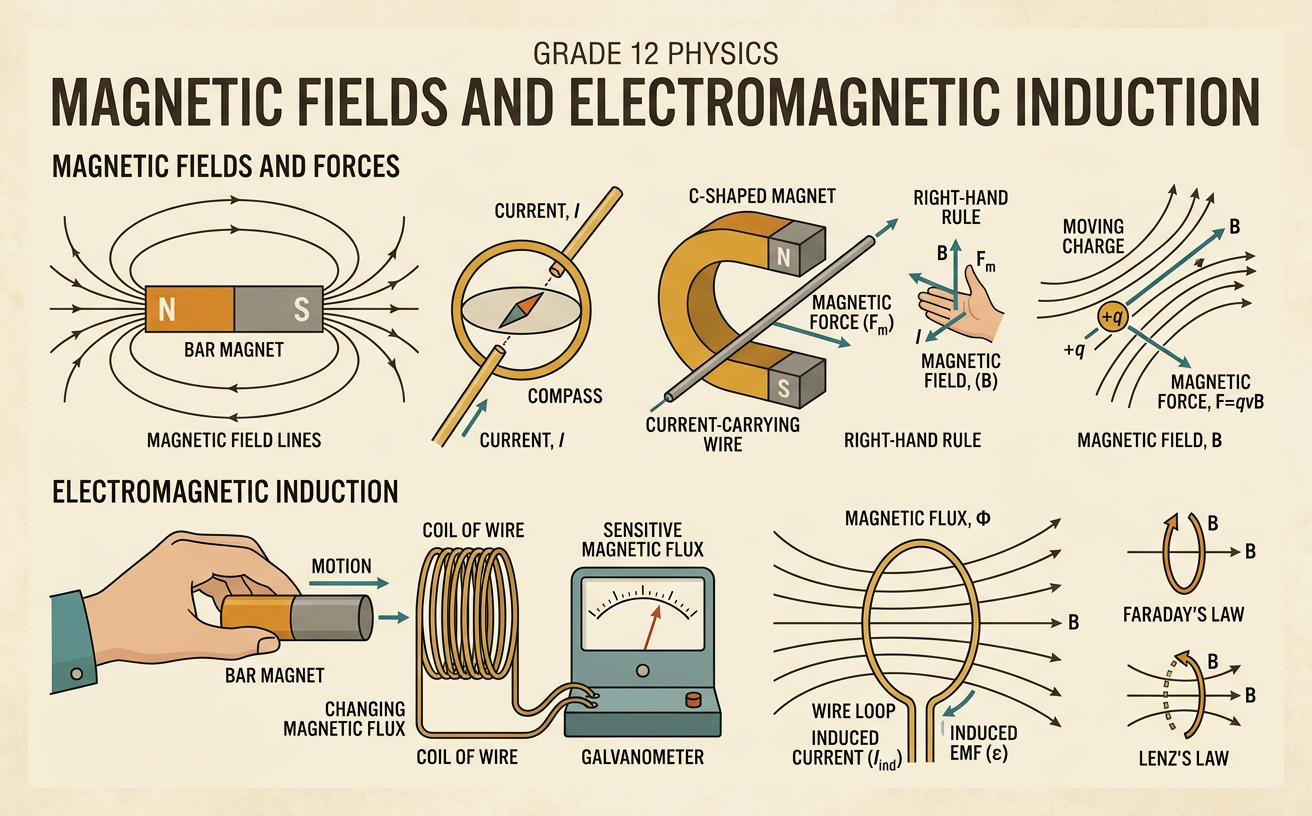
Illustrations are auto-generated and may be placeholders. They can be refreshed to match the narration.
Magnetic Fields
A magnetic field is a region in which a magnet, moving charge, or electric current experiences a magnetic force. The field is represented by the vector B and measured in teslas (T). Outside a bar magnet, magnetic field lines point from the north pole toward the south pole; inside the magnet, they return from south to north, forming closed loops. Closely spaced lines indicate a stronger field. Electric currents also produce magnetic fields. Around a straight wire, the field forms concentric circles, with direction found using the right-hand rule: point your thumb in the direction of conventional current, and your curled fingers show the field direction. For example, a compass placed near a current-carrying wire turns because its magnetic needle aligns with the wire’s magnetic field.
Force on Moving Charges
A charged particle moving through a magnetic field experiences a force described by F = qvB sin θ, where q is charge, v is speed, B is magnetic field strength, and θ is the angle between velocity and the field. The force is greatest when motion is perpendicular to the field and zero when motion is parallel to it. For a positive charge, point the fingers of your right hand along the velocity and curl them toward B; your thumb indicates the force. A negative charge experiences force in the opposite direction. Because magnetic force is perpendicular to velocity, it changes the particle’s direction but not its speed or kinetic energy. For example, a proton entering a uniform magnetic field at right angles follows a circular path, while an electron curves in the opposite direction.
Force on Current-Carrying Wires
A current-carrying wire in an external magnetic field experiences a force because the moving charges inside the wire are pushed by the field. For a straight wire, the force magnitude is F = ILB sin θ, where I is conventional current, L is the length of wire within the field, and θ is the angle between the current and B. The force is maximum when the wire is perpendicular to the field and zero when it is parallel. Its direction follows the vector relationship F = IL × B and can be found with the right-hand rule. For example, if current flows to the right through a horizontal wire while a magnetic field points into the page, the wire is forced upward. Reversing either the current or the magnetic field reverses the force.
Magnetic Flux
Magnetic flux measures how much magnetic field passes through a surface. For a uniform field and a flat loop, flux is ΦB = BA cos θ, where B is field strength, A is the loop’s area, and θ is the angle between the magnetic field and the area vector, which is perpendicular to the loop. Flux is measured in webers (Wb). Flux is greatest when B is parallel to the area vector, meaning the field passes straight through the loop. It is zero when B lies in the plane of the loop. Flux can change if the field strength, loop area, or orientation changes. For example, a 0.50 m² loop perpendicular to a 0.20 T field has a flux of 0.10 Wb because θ = 0° and cos 0° = 1.
Faraday’s and Lenz’s Laws
Faraday’s law states that changing magnetic flux through a circuit produces an induced electromotive force, or emf. For a coil of N turns, the average induced emf is ε = −NΔΦB/Δt. A faster flux change or more turns produces a larger emf. Current appears only if the circuit is closed. The negative sign represents Lenz’s law: the induced current creates a magnetic field that opposes the change in flux, not simply the original field. For example, when the north pole of a magnet moves toward a coil, the flux through the coil increases. The coil’s near face becomes a north pole, repelling the approaching magnet. Viewed from the magnet side, the induced current is counterclockwise. Pulling the magnet away reverses the flux change and the induced current.
Motors and Generators
Motors and generators both use interactions among current, magnetic fields, and motion, but their energy transformations are opposite. An electric motor converts electrical energy into mechanical energy. Current in a coil between magnetic poles produces opposite forces on the coil’s two sides, creating torque and rotation. In a simple direct-current motor, a split-ring commutator reverses the coil current every half-turn so the torque continues in the same rotational direction. A generator converts mechanical energy into electrical energy. When a coil rotates in a magnetic field, its magnetic flux changes, inducing an emf according to Faraday’s law. For example, turning a hand-cranked generator rotates a coil between magnetic poles and sends current through an external lamp. Increasing the rotation rate increases the rate of flux change and usually increases the generated emf.