
Magnetic Forces: A Push or Pull Without Touching
Students investigate how magnets attract or repel without touching, measure the distance of magnetic interactions, and connect magnetism to compasses used for navigation.

Illustrations are auto-generated and may be placeholders. They can be refreshed to match the narration.
Notice Magnetic Pushes and Pulls
A magnet can make some objects move without touching them. This is called a magnetic force. A pull toward a magnet is attraction. For example, when a bar magnet moves close to a steel paper clip, the clip may slide toward the magnet before they touch. Magnets can also push other magnets away. This is called repulsion. Every magnet has two poles, called north and south. Opposite poles attract, while matching poles repel. Magnetic force acts across a gap, but it usually becomes weaker as the distance grows. Not every object is attracted to a magnet. A wooden craft stick, a plastic button, and an aluminum foil ball usually do not move toward a classroom magnet. Careful observations help identify which motions are caused by magnetic force.

Ask a Testable Question
Scientists ask questions that can be answered by making observations or measurements. A testable question about magnets should name what will be changed and what will be observed. One useful question is, “How does the distance between a magnet and a paper clip affect whether the paper clip moves?” In this investigation, the distance is changed. The movement of the paper clip is observed. Other conditions should stay the same, including the magnet, paper clip, table surface, and way the magnet is moved. You might predict that the paper clip will move when the magnet is close but not when it is far away. A question such as “Are magnets amazing?” is based on opinion and cannot be tested with measurement data. Asking a focused question makes it easier to look for a cause-and-effect relationship.

Test Magnets Without Touching
Place a steel paper clip on a smooth table. Put a bar magnet about 10 centimeters away, making sure the magnet does not touch the clip. Slowly move the magnet closer. Watch for the first moment when the paper clip moves. Stop and mark the magnet’s position. The gap shows that the magnet pulled the clip without contact. Repeat the test several times to check whether the result is similar. To investigate repulsion, place two ring magnets on a nonmetallic rod with matching poles facing each other. One magnet may appear to float above the other because the matching poles push apart. Keep fingers away from the gap during observation so they do not add another push. Change only one part of a test at a time, and handle strong magnets only with adult supervision.

Measure and Record Interaction Distance
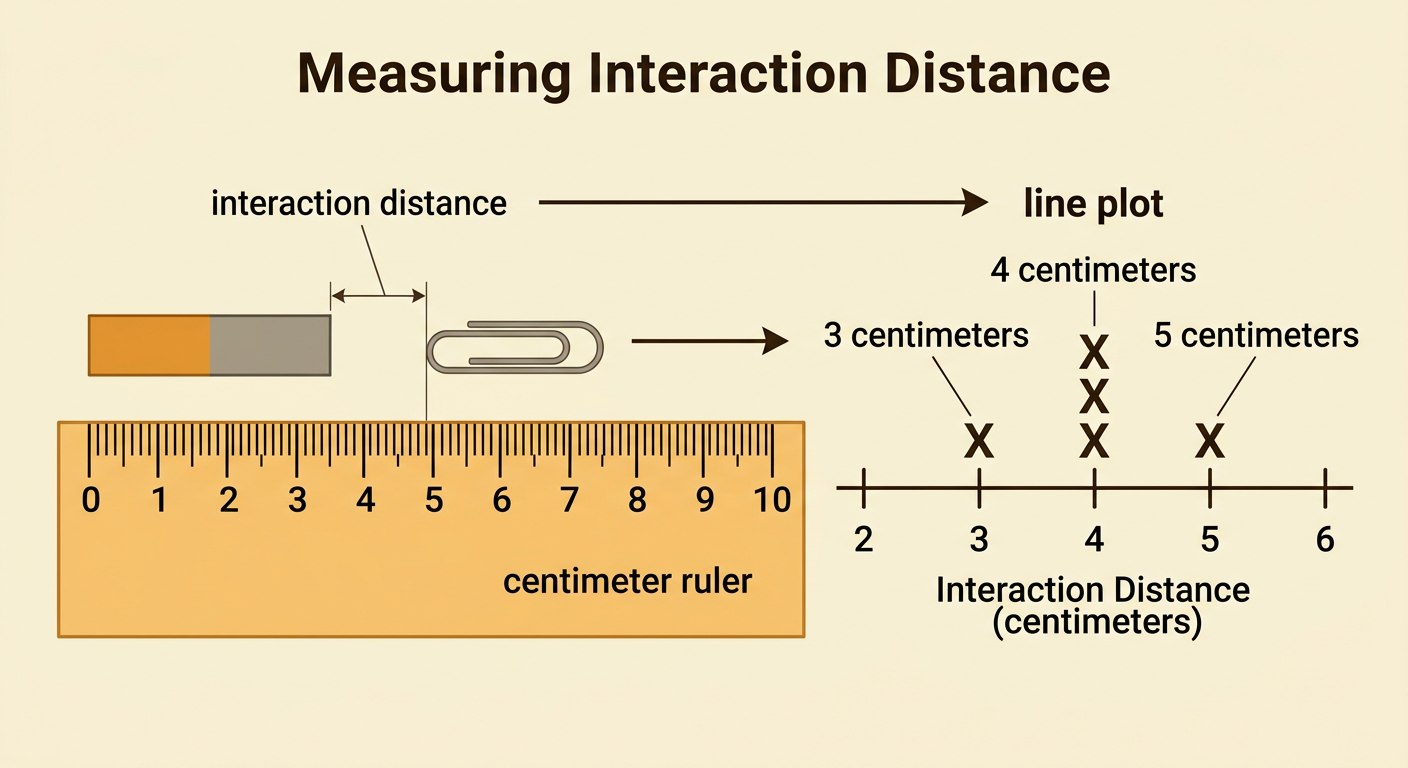
Measure the interaction distance from the nearest edge of the magnet to the nearest edge of the paper clip when the clip first moves. Use a centimeter ruler and record each result to the nearest whole centimeter. Suppose five trials give distances of 3, 4, 4, 5, and 4 centimeters. Each number is one measurement, and repeated trials show how much the results vary. Display the data on a line plot. Write the distance scale along a number line, then place one X above the matching number for every trial. The example has one X at 3, three Xs at 4, and one X at 5. The tallest stack shows that 4 centimeters occurred most often. Measuring from the same points and using the same procedure each time makes comparisons fair and the data more useful.
Explain Cause and Effect
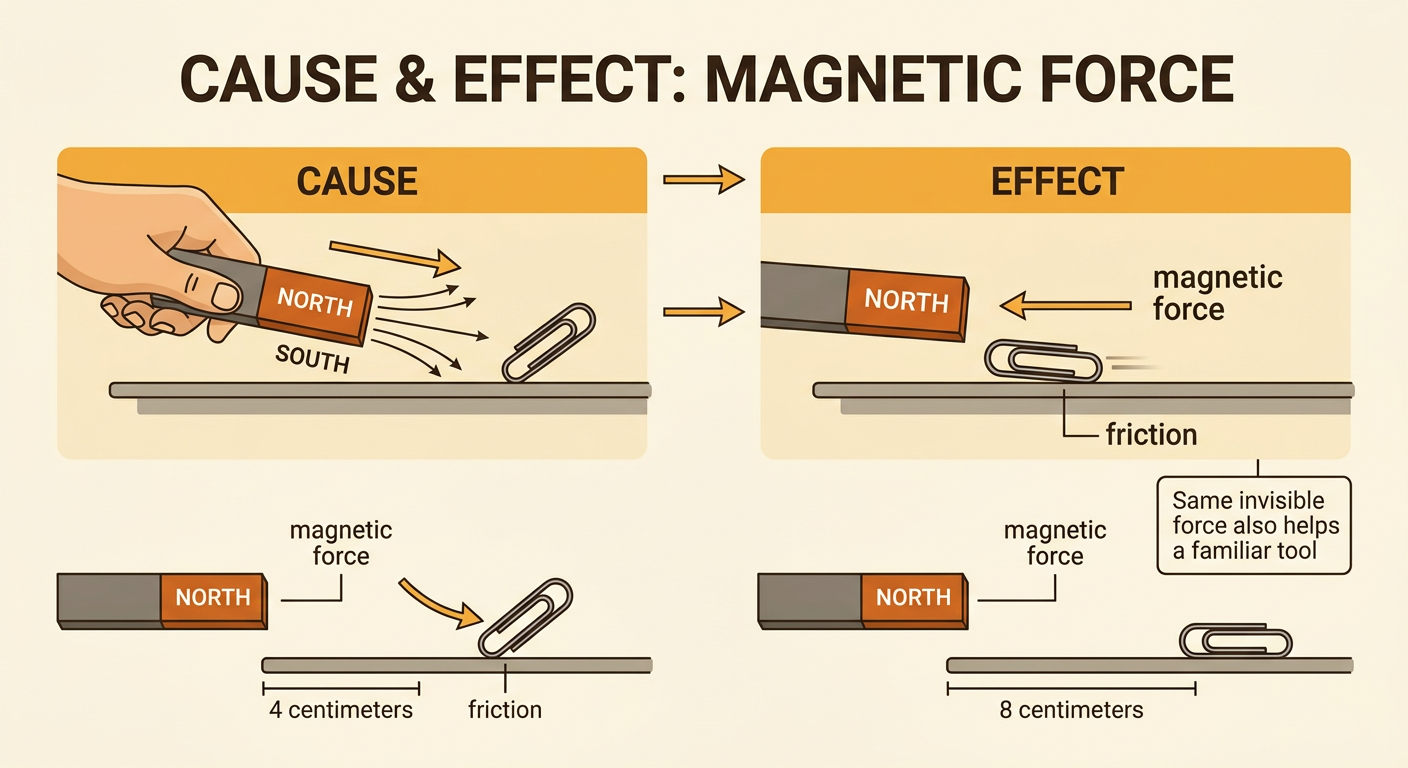
A cause is what makes something happen, and an effect is what happens. In the paper clip test, bringing the magnet close enough is the cause. The paper clip moving toward the magnet is the effect. The objects are not touching, so the movement is evidence that magnetic force acts across the gap. Distance also affects the result. When the magnet is closer, its force on the paper clip is usually stronger. When it is farther away, the force may be too weak to overcome friction between the clip and the table. Pole direction matters when two magnets interact. Opposite poles cause attraction, while matching poles cause repulsion. Evidence should support an explanation. For example, if the clip moved in four trials at 4 centimeters but never at 8 centimeters, those observations support the claim that distance affects magnetic interaction.
Connect Magnets to Compasses
A compass contains a small magnetized needle that can turn freely. Earth acts like a giant magnet and creates a magnetic field. The needle lines up with that field, so its north-seeking end points roughly toward north. Travelers can use this direction to help choose a route. Long ago, sailors used magnetic compasses with maps, landmarks, stars, and careful observations to navigate across water. Compasses were especially helpful when familiar landmarks could not be seen. Today, hikers and sailors still use compasses, but many people also use electronic maps and satellite-based GPS devices. Unlike a phone, a simple compass does not need a battery or satellite signal. A nearby magnet or large iron object can pull the needle away from its usual direction, so a compass should be used away from those objects. Magnetism connects a classroom investigation to navigation in the past and present.
