Magnetic Forces Act at a Distance
Students investigate magnetic attraction and repulsion, measure how distance affects magnetic interactions, and connect compasses to navigation past and present.
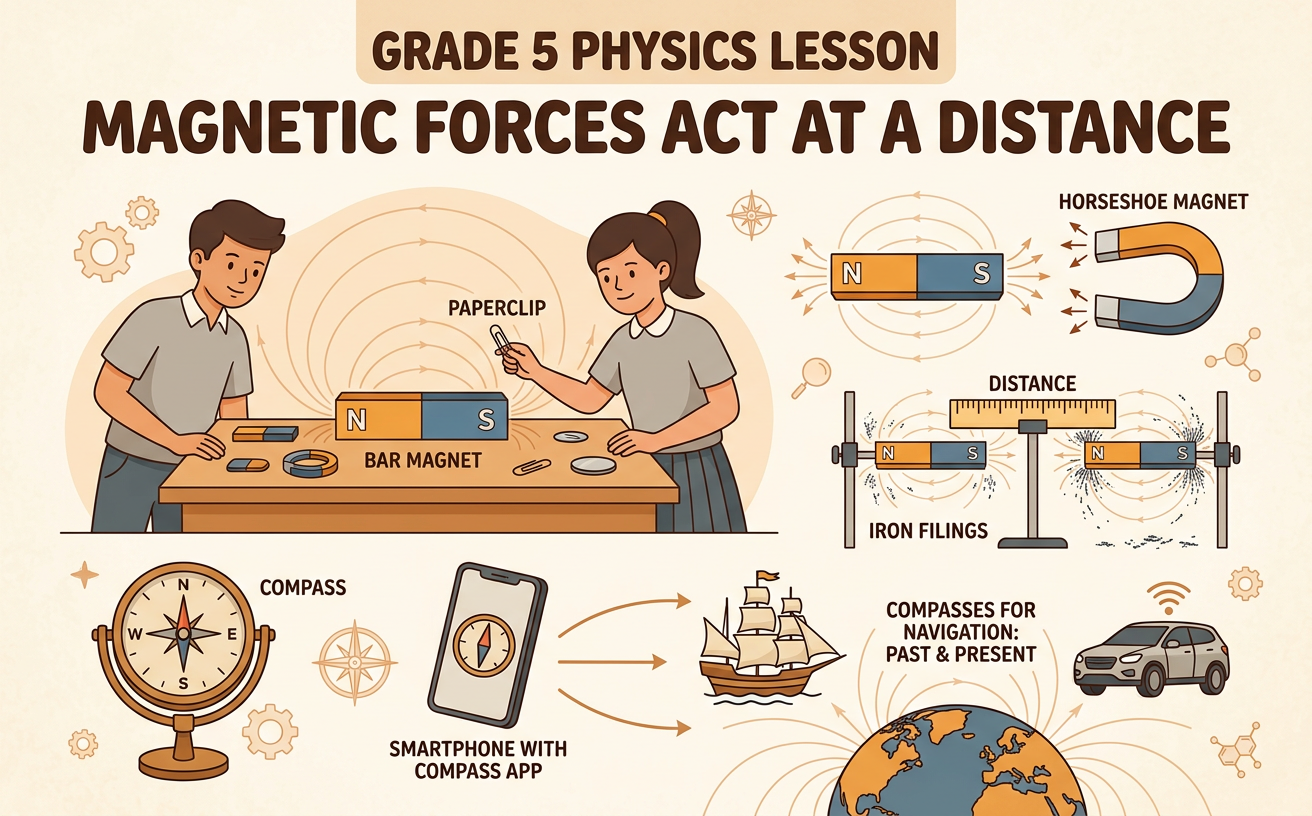
Illustrations are auto-generated and may be placeholders. They can be refreshed to match the narration.
Observing Magnetic Attraction and Repulsion
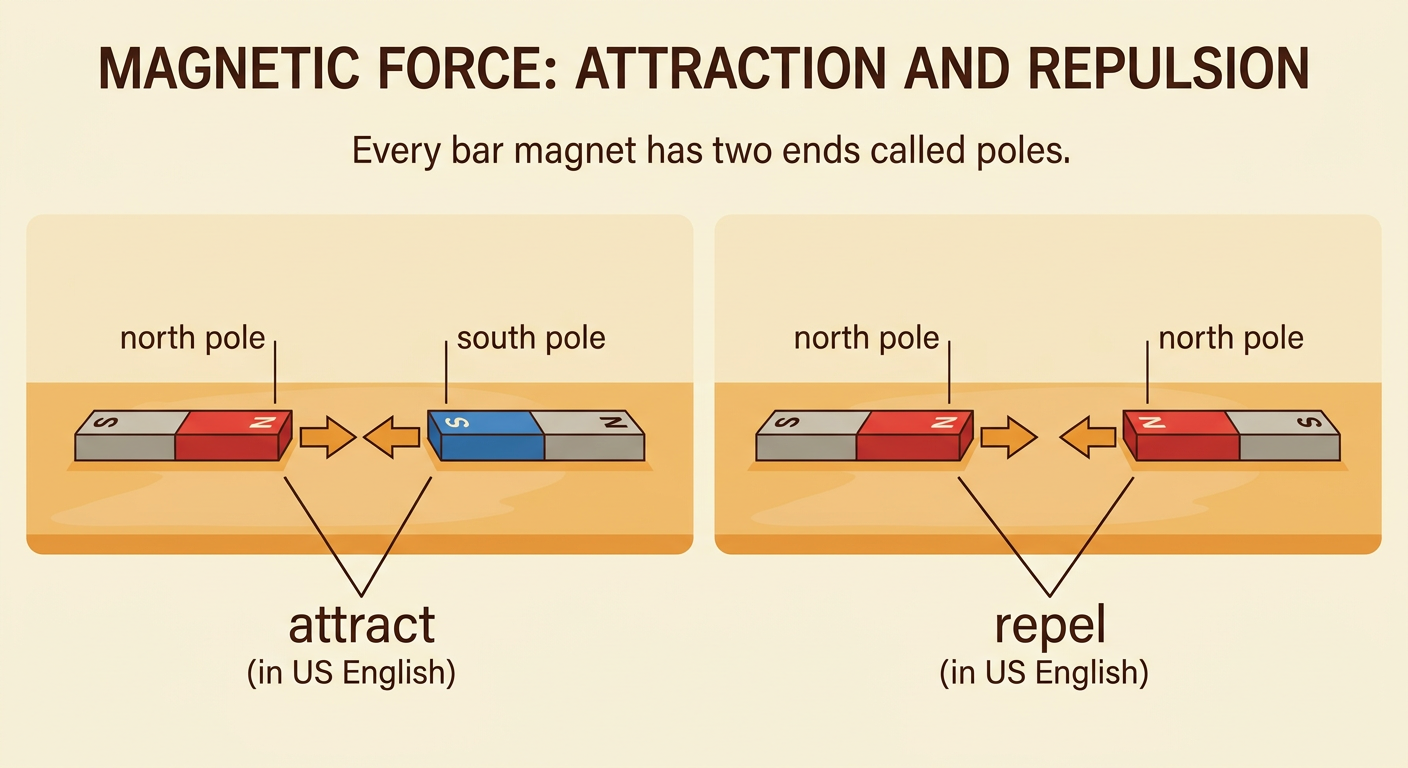
Magnets can exert forces without touching. Every bar magnet has two poles, called north and south. When the north pole of one magnet faces the south pole of another, the magnets attract and move toward each other. When two north poles or two south poles face each other, the magnets repel and move apart. The direction of the poles causes the different motion. For example, place two bar magnets on a smooth table. Turn one magnet around and observe whether the magnets come together or separate. Ask, “What changed, and what effect did that change have?” The magnets are strongest near their poles, but the whole magnet is part of the interaction. Not every metal is attracted to a magnet. Iron and many kinds of steel are magnetic, while aluminum and copper are not strongly attracted.
Testing Force Through Space
A magnetic force can act across an empty gap or through some materials. To test this, place a paper clip on top of a thin piece of cardboard and hold a magnet beneath it. Move the magnet slowly. The paper clip follows even though the magnet never touches it. This shows that the magnetic interaction acts through the space and cardboard between the objects. The cardboard does not create the force; the magnet causes the motion. A fair test changes only one factor at a time. You might compare one, two, and three layers of the same cardboard while keeping the magnet, paper clip, and starting positions the same. Ask, “Does adding distance cause the interaction to become weaker?” Record whether the paper clip moves each time. Thick barriers may increase the distance enough that the magnet can no longer move the clip.

Measuring the Effect of Distance
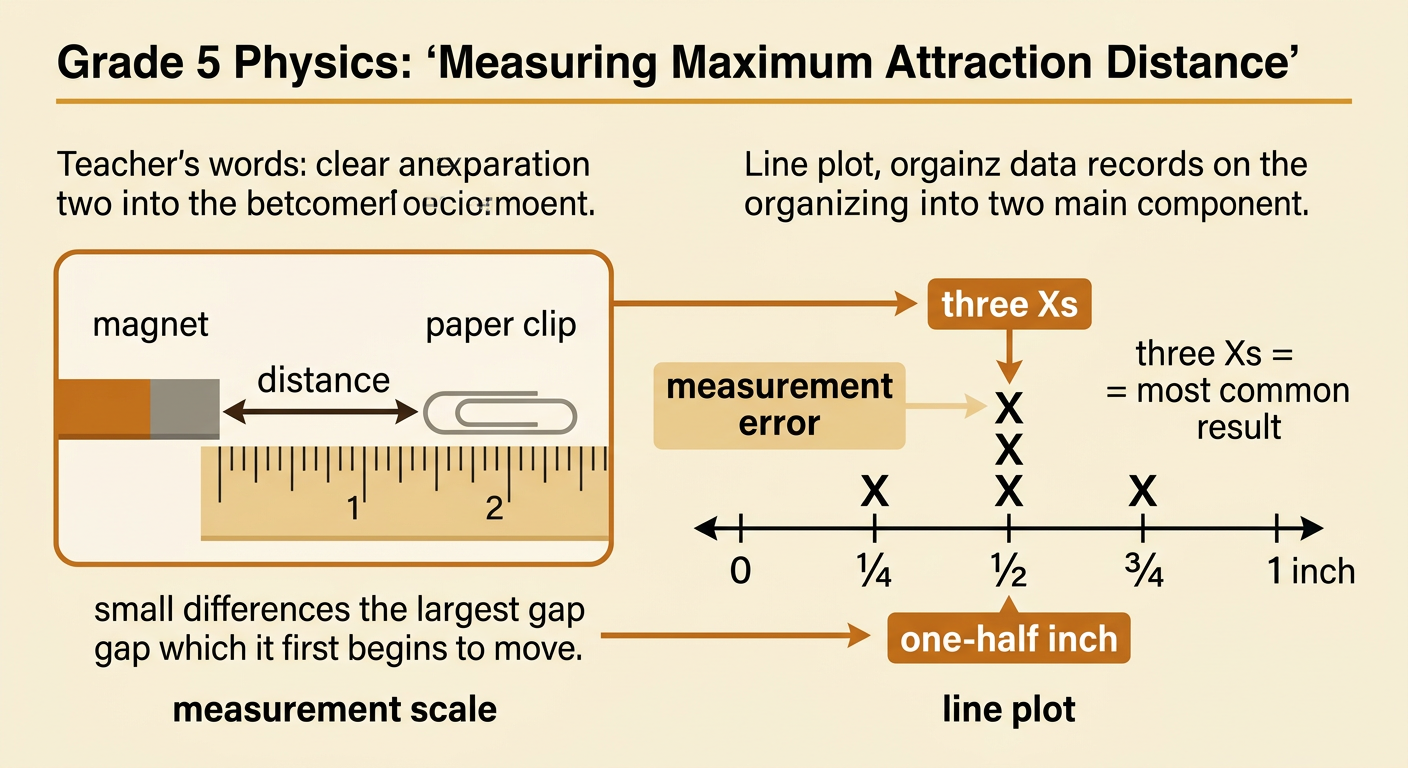
Distance affects the strength of a magnetic interaction. In general, magnetic effects become weaker as the distance between objects increases. You can investigate this relationship by slowly moving a magnet toward a paper clip and measuring the largest gap at which the clip begins to move. Measure to the nearest one-fourth inch and repeat several trials. Suppose five trials give distances of 1/2, 3/4, 1/2, 1/4, and 1/2 inch. Make a line plot with distances along a number line. Place one X above a distance for each result. The stack of three Xs above 1/2 inch shows that this result occurred most often. Small differences may happen because of measurement error or slight changes in the setup. Use the same magnet and paper clip each time so that distance is the main variable being tested.
How a Compass Uses Magnetism
A compass contains a small magnetized needle that can turn freely. Earth acts somewhat like a giant magnet and produces a magnetic field around the planet. The needle lines up with that field. The marked, north-seeking end points approximately toward geographic north when the compass is held flat and away from nearby magnets or large metal objects. Once a traveler finds north, the other directions can be identified: east, south, and west. For example, if a trail map says to walk east, a hiker can rotate until east on the compass matches the needle’s direction guide. A phone, speaker, steel table, or another magnet can pull the needle away from its usual position and cause an incorrect reading. A compass does not point toward a destination by itself. It provides direction, which a navigator combines with a map and observations.

Comparing Navigation Past and Present
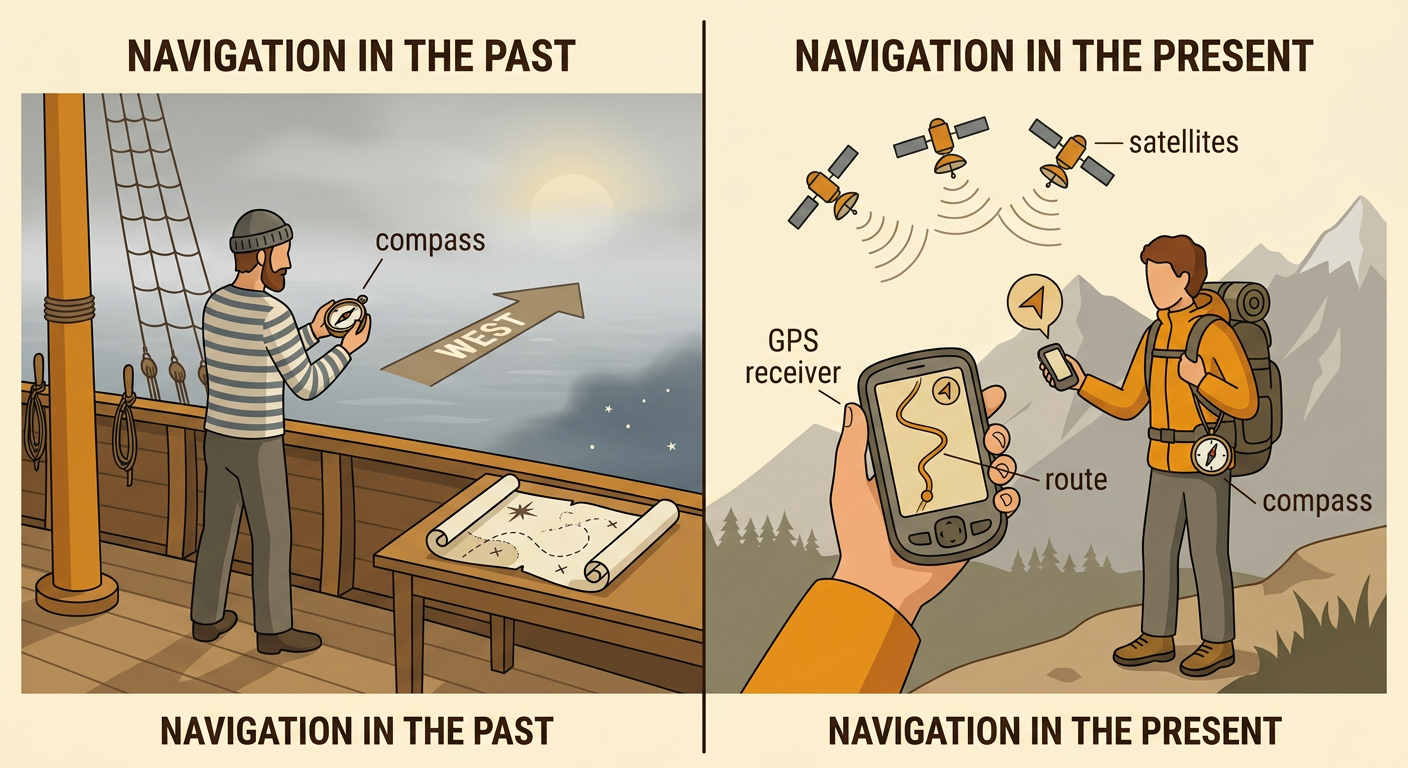
In the past, sailors and other travelers used compasses along with maps, landmarks, the Sun, and stars. A compass was especially useful at sea because there might be no road or nearby landmark. For example, a sailor crossing foggy water could use a compass to keep the ship moving west even when the shoreline was hidden. Early compasses were simpler than many modern ones, and navigators had to estimate speed and carefully record direction. Today, people still use magnetic compasses, but they may also use GPS receivers, digital maps, satellites, and electronic sensors. GPS can show a person’s location and suggest a route, while a basic compass mainly shows direction. Modern tools are often faster and provide more information, but they require power and working equipment. A magnetic compass remains a valuable backup because it needs no battery and works in many remote places.