Magnetic Forces at a Distance
Students investigate how magnets attract or repel without touching and use observations as evidence to explain magnetic interactions.
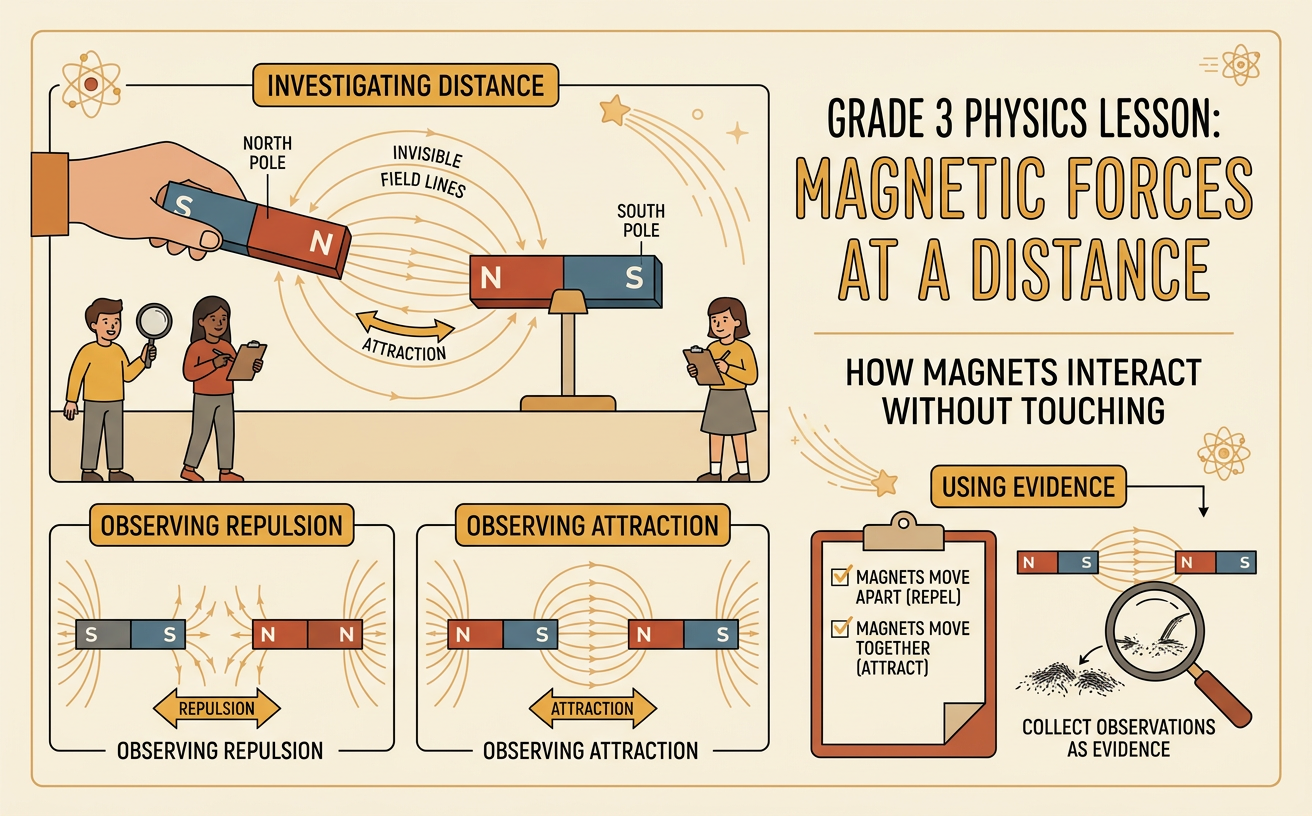
Illustrations are auto-generated and may be placeholders. They can be refreshed to match the narration.
Observe Magnets Without Touching
A magnet can push or pull another magnet even when the magnets are not touching. This is called a magnetic force at a distance. To observe it, place one bar magnet on a smooth table. Slowly move a second bar magnet toward it without letting them touch. The magnet on the table may slide closer or move away. Ask: What caused the resting magnet to move? Your hand did not touch it, and the second magnet did not touch it. The magnetic force acted across the space between them. For example, one end of the moving magnet may pull the resting magnet across the table. Watch closely, describe only what you observe, and discuss your observations with a partner before suggesting an explanation.

Predict Attraction or Repulsion
Before testing two magnets, predict what will happen when their ends move close together. The magnets might attract, which means pull toward each other. They might repel, which means push away from each other. State your prediction clearly: “I predict the magnets will attract,” or “I predict the magnets will repel.” Then give a reason based on an earlier observation. For example, you might say, “I predict these ends will repel because the same marked ends pushed apart in our first test.” Listen to your classmates’ predictions and ask what evidence supports their ideas. Different predictions are acceptable because the test will provide evidence. Keep the magnets slightly apart as you test so you can observe a force acting without contact.

Test Magnet Pole Combinations
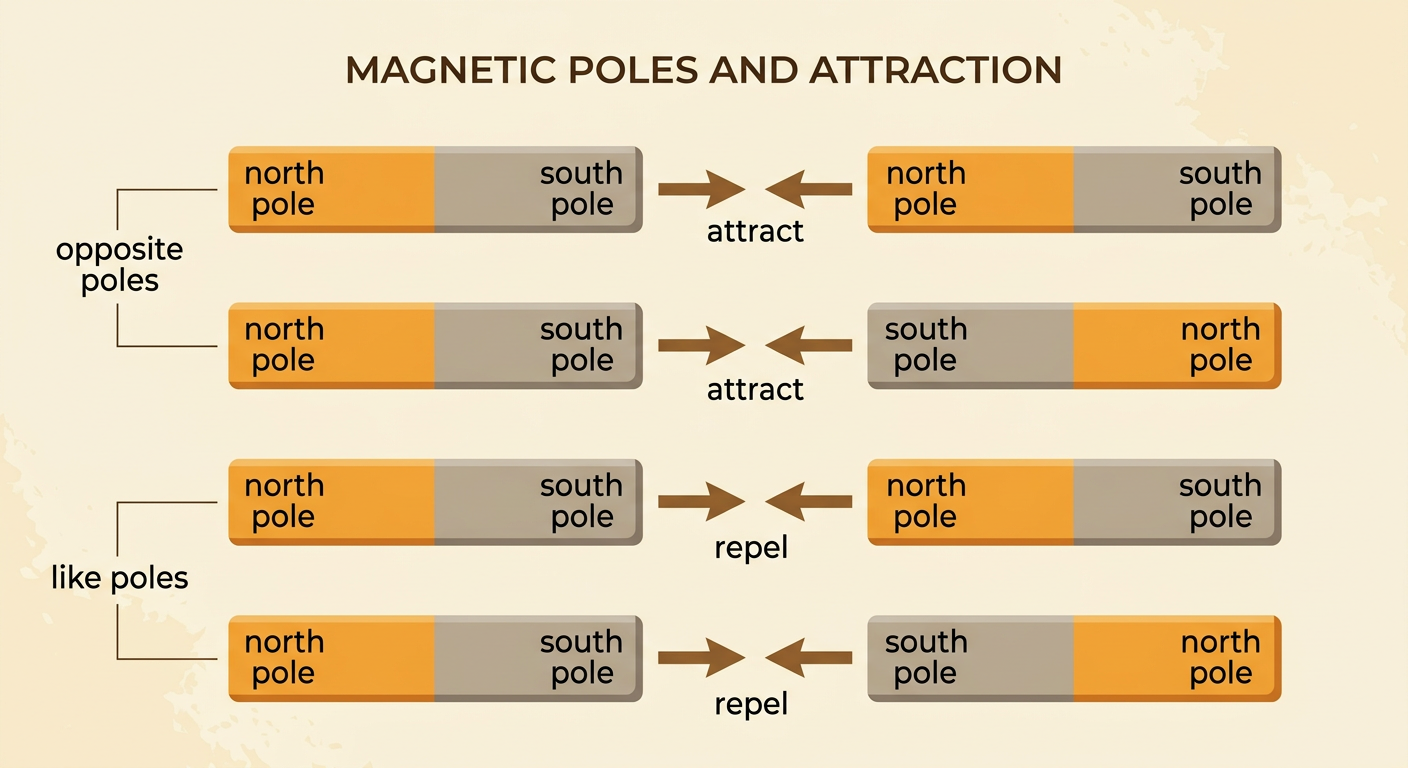
Every bar magnet has two poles: a north pole and a south pole. Test different pole combinations by bringing two magnets close without allowing them to touch. North facing south will attract. South facing north will also attract. North facing north will repel, and south facing south will repel. This pattern can be summarized as opposite poles attract and like poles repel. For example, if two north poles face each other, you may feel a push as you try to move them closer. Work with a partner: one person holds the magnets while the other records the result. Switch roles so both students can observe. Test each combination more than once to check whether the result is consistent.
Explore the Effect of Distance
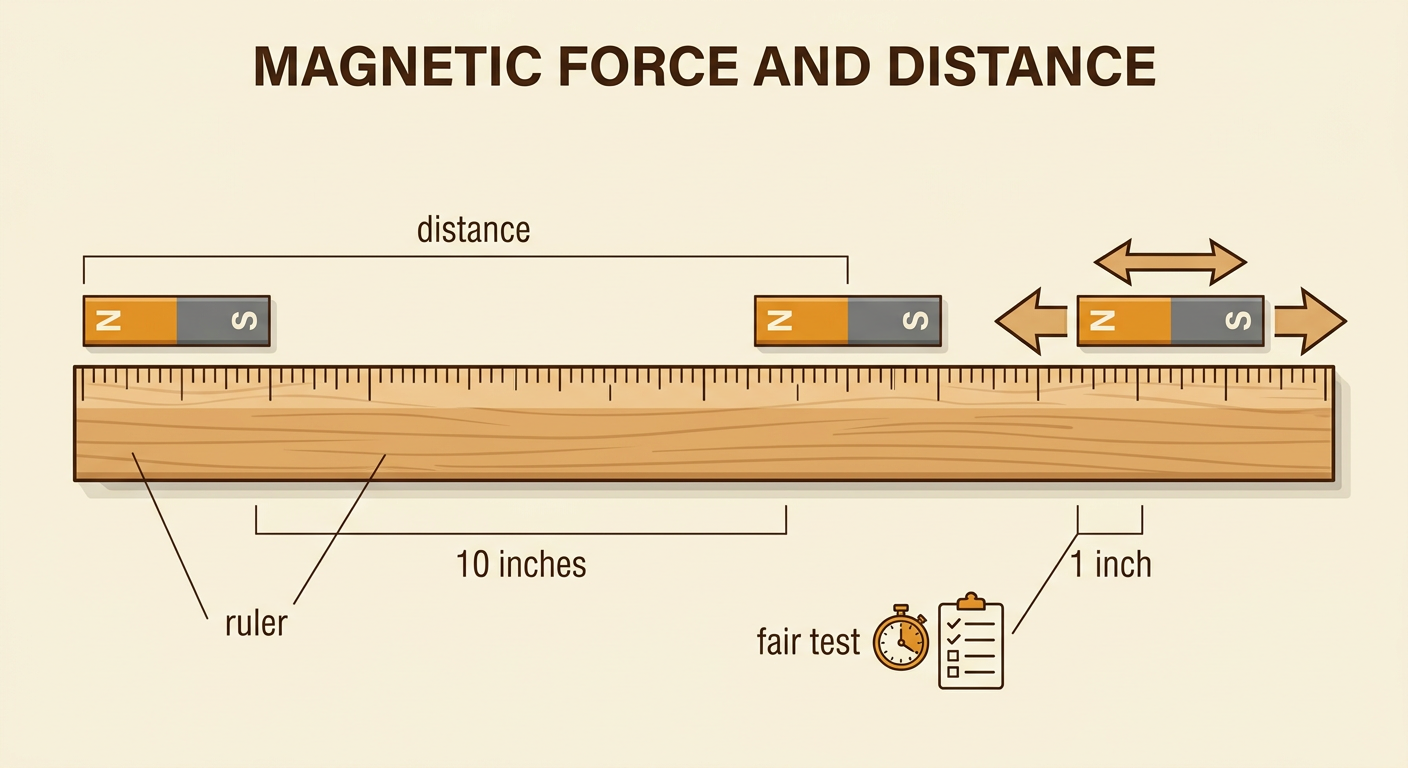
Magnetic force changes as the distance between magnets changes. Place one magnet on a table beside a ruler. Hold a second magnet far away, then slowly move it closer. Observe when the first magnet begins to move. In general, the magnetic effect is easier to notice when the magnets are closer together and harder to notice when they are farther apart. For example, a magnet might not move when the other magnet is 10 inches away, but it might slide when the gap becomes 1 inch. Repeat the test at several distances and keep the same poles facing each other. Change only the distance so the comparison is fair. Never force magnets together, and keep them away from electronic devices and anyone with a medical implant.
Record and Compare Evidence
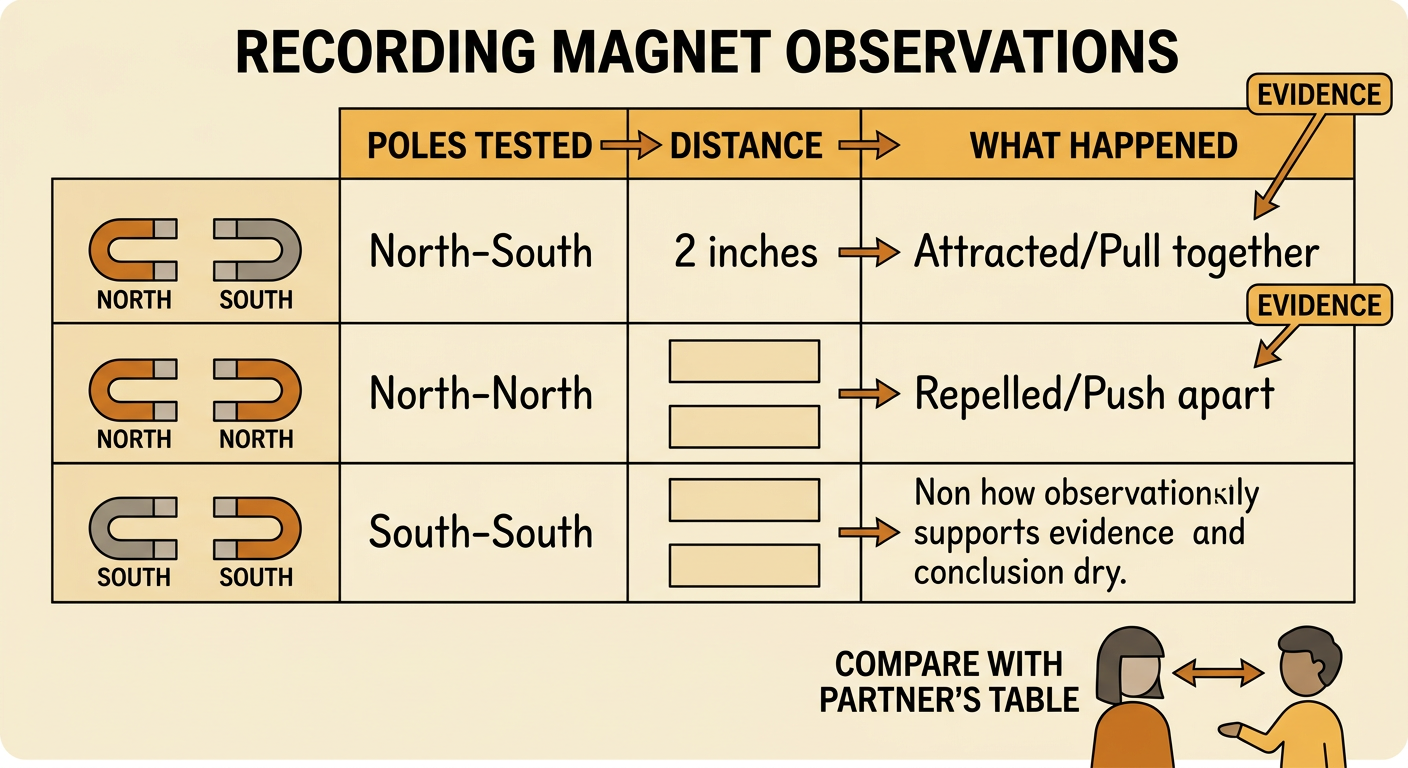
Scientists record observations so they can compare results and find patterns. Create a table with columns for the poles tested, the distance, and what happened. Use words such as attract, repel, moved, or did not move. You may also measure the distance at which a magnet first begins to slide. For example, your table might show that north facing south attracted at 2 inches, while north facing north repelled at the same distance. Repeat each test and record every result, even if one result is unexpected. Then compare your evidence with a partner’s data. Ask whether the results show the same pattern. Careful records help the group decide which claims are supported by observations rather than by guesses.
Explain Magnetic Forces
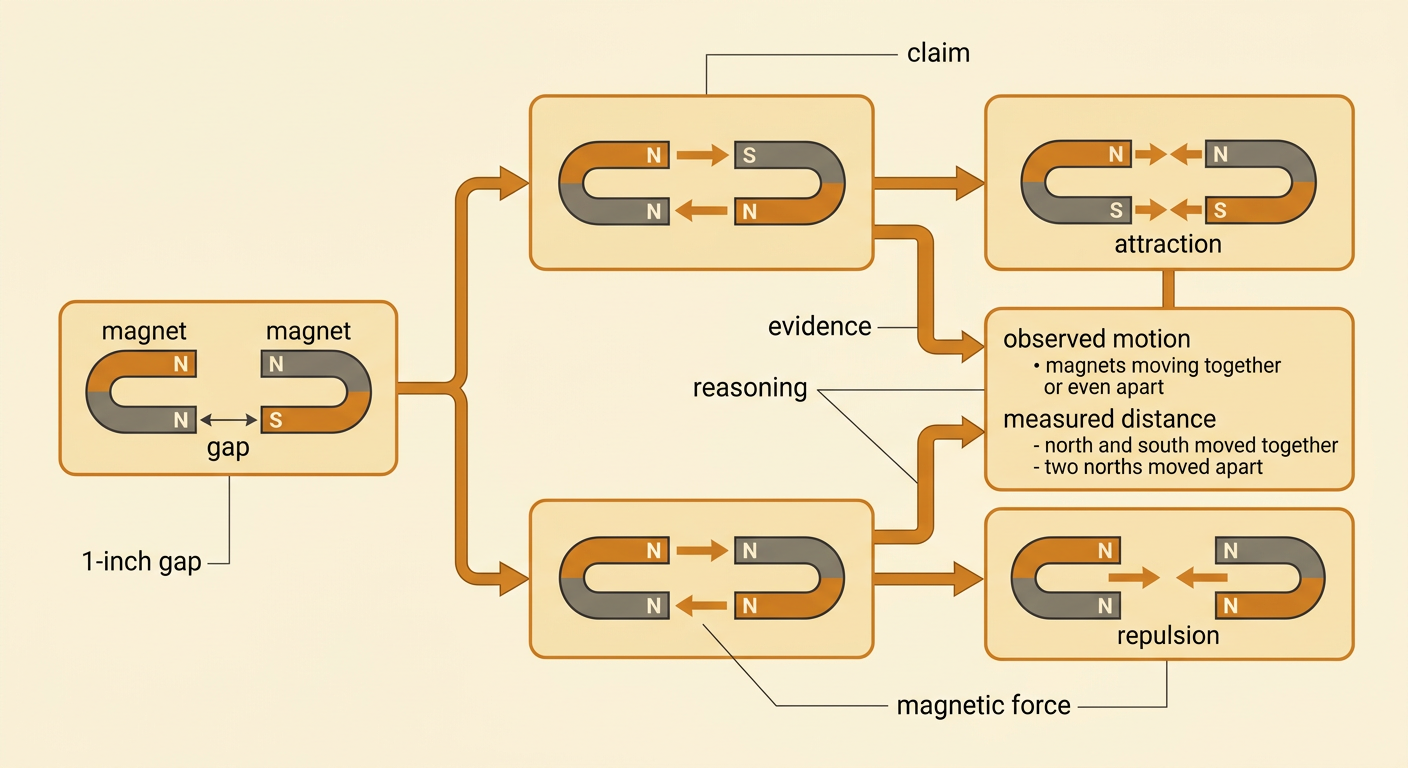
Use your observations as evidence to explain magnetic forces. Begin with a claim that answers the question. Then give evidence from your tests and explain how the evidence supports the claim. For example: “Magnets can exert forces without touching. When the north pole faced the south pole across a 1-inch gap, both magnets moved together. When two north poles faced each other, they moved apart. These observations show that opposite poles attract and like poles repel across empty space.” Include measured distances or repeated results when possible. Discuss your explanation with classmates, listen to their ideas, and revise your statement if new evidence improves it. A strong explanation connects the cause, the pole arrangement and distance, to the observed effect, attraction or repulsion.