Magnetic Forces: Attraction, Repulsion, and Distance
Students use observations and data to explain how magnetic pole orientation and distance affect the strength and direction of magnetic forces.
Illustrations are auto-generated and may be placeholders. They can be refreshed to match the narration.
Magnetic Forces at a Distance
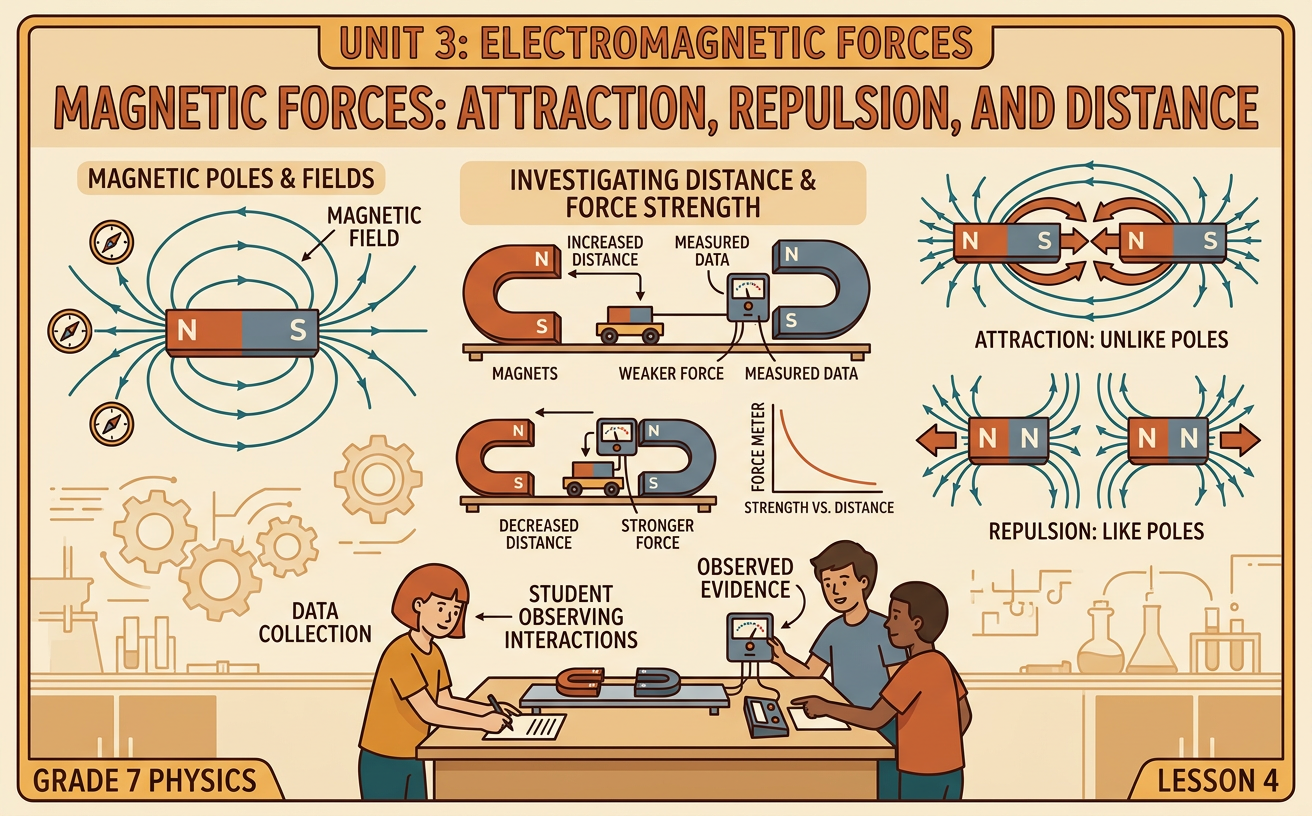
A magnetic force can act without two objects touching, so it is called a noncontact force. A magnet creates a magnetic field in the space around it. When another magnet or certain magnetic materials, such as iron, enter that field, they may experience a push or pull. The force has both strength and direction. It is generally stronger close to the magnet and weaker farther away. For example, hold a bar magnet near a steel paper clip without touching it. The paper clip may slide toward the magnet because the magnetic force pulls it across the gap. A compass provides another example: its magnetic needle turns when a magnet is brought nearby. These observations provide evidence that magnetic fields can exert forces through empty space and sometimes through thin materials, such as paper.

Attracting and Repelling Poles
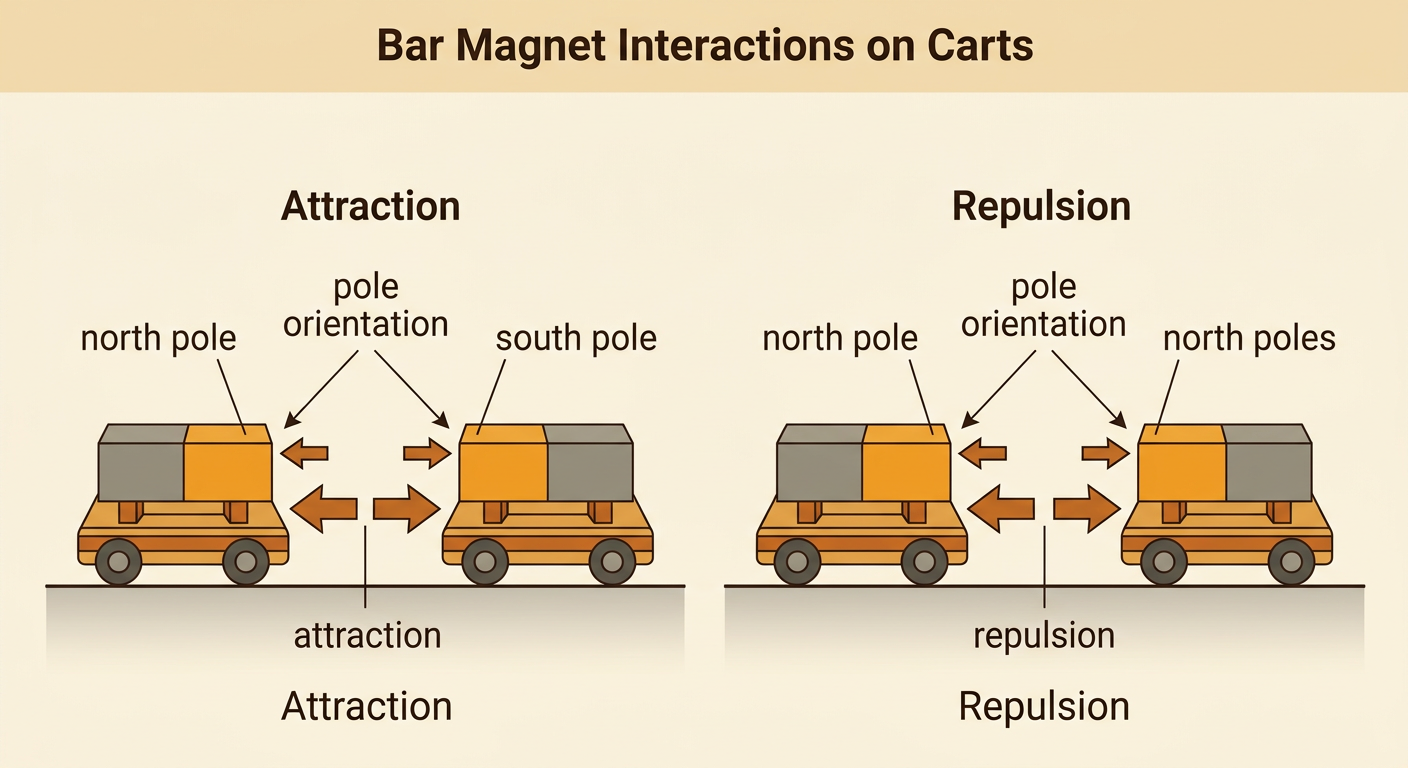
Every bar magnet has a north pole and a south pole. Pole orientation determines the direction of the force between two magnets. Opposite poles attract: a north pole facing a south pole causes the magnets to pull toward each other. Like poles repel: two north poles or two south poles facing each other cause the magnets to push apart. For example, place two bar magnets on small, low-friction carts. If north faces south, the carts roll together. Turn one magnet around so north faces north, and the carts roll apart. The magnets have not changed, but their orientation has changed the force direction. A useful question is, “What evidence shows that orientation, rather than magnet size, caused the different motions?” Comparing trials in which only pole orientation changes helps answer that question.
Testing the Effect of Distance
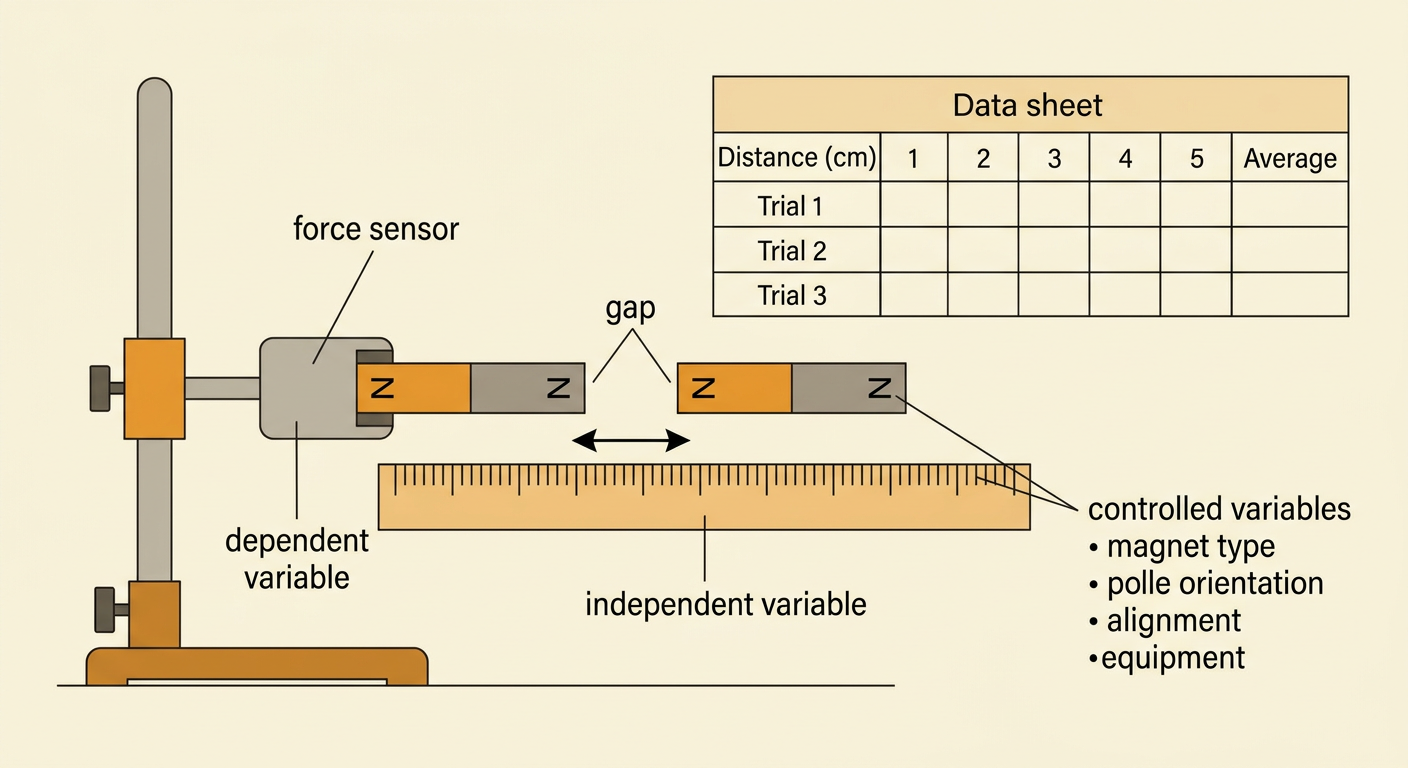
A fair test changes one factor at a time. To investigate distance, attach one magnet to a force sensor and place a second identical magnet directly in front of it. Keep the same poles facing, keep the magnets aligned, and change only the gap between their nearest faces. Test gaps of 1, 2, 3, 4, and 5 centimeters. At each distance, allow the reading to settle, record the force, and repeat the trial three times. Calculate the average to reduce the effect of small measurement differences. The independent variable is distance, and the dependent variable is measured force strength. Magnet type, pole orientation, alignment, and equipment are controlled variables. Before testing, students might ask, “How will doubling the distance affect the force?” The collected measurements can support an answer instead of relying only on what the force feels like.
Recording Patterns in Force Strength
Organized data make patterns easier to identify. Suppose a class measures repulsion between the same two magnets and finds average forces of 1.8 newtons at 1 centimeter, 0.9 newton at 2 centimeters, 0.5 newton at 3 centimeters, 0.3 newton at 4 centimeters, and 0.2 newton at 5 centimeters. A table preserves the exact measurements, while a graph shows the overall trend. Distance belongs on the horizontal axis, and force strength belongs on the vertical axis. The plotted points drop as distance increases, showing that the repulsive force became weaker. Students should ask questions about unusual points, repeated measurements, and possible sources of error. These sample values support a decreasing pattern, but they do not prove that every pair of magnets will produce the same numbers. Different magnets may have different strengths.

Explaining Results with Evidence
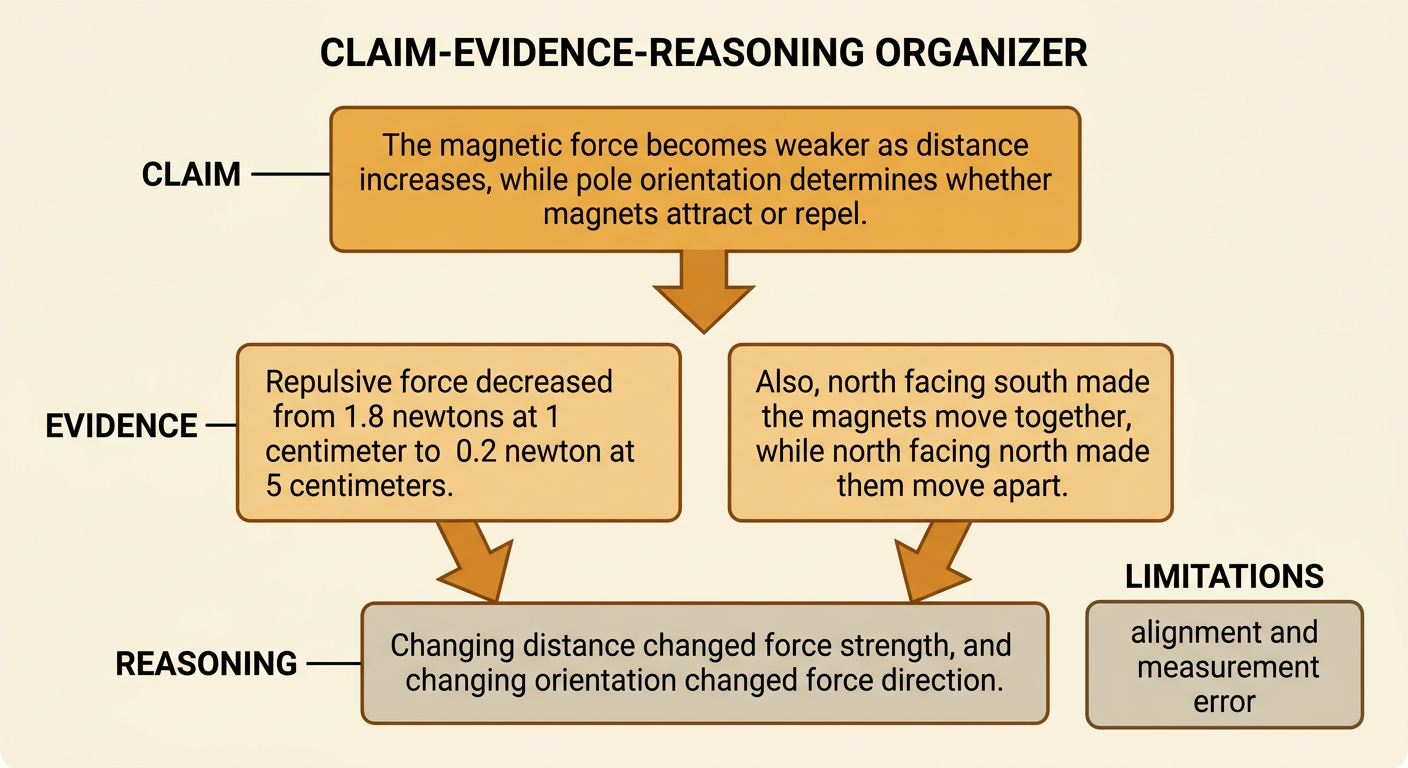
A strong scientific explanation includes a claim, specific evidence, and reasoning. A claim might state, “Magnetic force becomes weaker as the distance between two magnets increases, while pole orientation determines whether the force attracts or repels.” Evidence should cite observations or measurements. For example, the repulsive force decreased from 1.8 newtons at 1 centimeter to 0.2 newton at 5 centimeters. In another test, north facing south made the magnets move together, while north facing north made them move apart. The reasoning connects this evidence to the claim: changing distance changed force strength, and changing orientation changed force direction. Students should also consider alternative explanations by asking whether alignment, magnet type, or measurement error affected the results. An evidence-based argument uses the available data, acknowledges limitations, and avoids claiming more than the investigation demonstrates.