
Making Inferences from Literary Texts
Students combine explicit details from a literary text with background knowledge to make and support logical inferences.

Illustrations are auto-generated and may be placeholders. They can be refreshed to match the narration.
Explicit Details and Inferences
An explicit detail is information the author states directly. An inference is a logical idea you form by using details from the text. Authors do not always explain everything about a character, setting, or event, so readers look for clues. For example, a story says, “Maya pulled her sleeves over her hands. Her teeth chattered as she waited for the bus.” The explicit details are that Maya covers her hands and her teeth chatter. You can infer that Maya feels cold, even though the author never says, “Maya was cold.” A strong inference must fit all the available details. It should not be a random guess or depend only on personal opinion. Careful readers ask, “What does the text clearly say?” and then, “What reasonable conclusion can I draw from those details?”

Combining Evidence with Background Knowledge
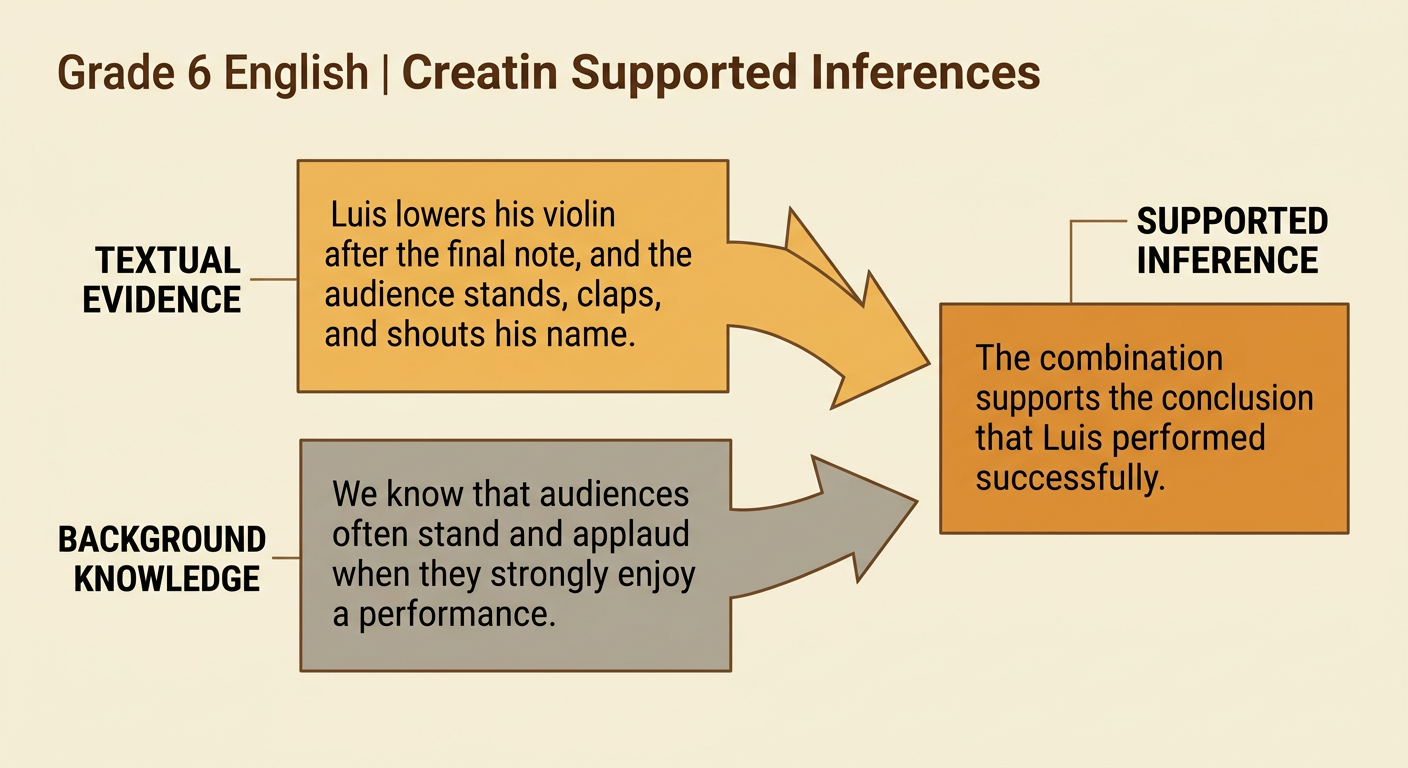
Readers make inferences by combining textual evidence with relevant background knowledge. Background knowledge includes facts and experiences you already understand, but it must be used carefully. Begin with the text rather than forcing your own ideas onto the story. Suppose a story says, “After the final note, Luis lowered his violin. The audience rose, clapped, and shouted his name.” You know from experience or general knowledge that audiences often stand and applaud when they strongly enjoy a performance. Combining that knowledge with the details in the story supports the inference that Luis performed successfully. However, you should not infer that he won a contest because the text gives no information about a competition. A useful formula is: textual evidence plus relevant background knowledge equals a supported inference. Both parts help make the conclusion reasonable.
Finding Relevant Textual Evidence
Textual evidence is a word, phrase, sentence, or event from the text that supports an analysis. Relevant evidence connects directly to the inference you are making. Imagine that you infer that a character named Tessa is nervous before a speech. The strongest evidence might be, “Tessa reread her note cards, wiped her damp palms on her jeans, and took three slow breaths.” Each action suggests nervousness. A detail such as “Tessa wore blue jeans” is explicit, but it does not strongly support the inference because clothing color is unrelated to her feelings. To find useful evidence, reread the lines before and after the important event. Look for actions, dialogue, thoughts, descriptions, and changes in behavior. Then choose the details that most clearly support your conclusion. When possible, cite the author’s exact words and explain where they appear.

Explaining the Inference-Evidence Connection
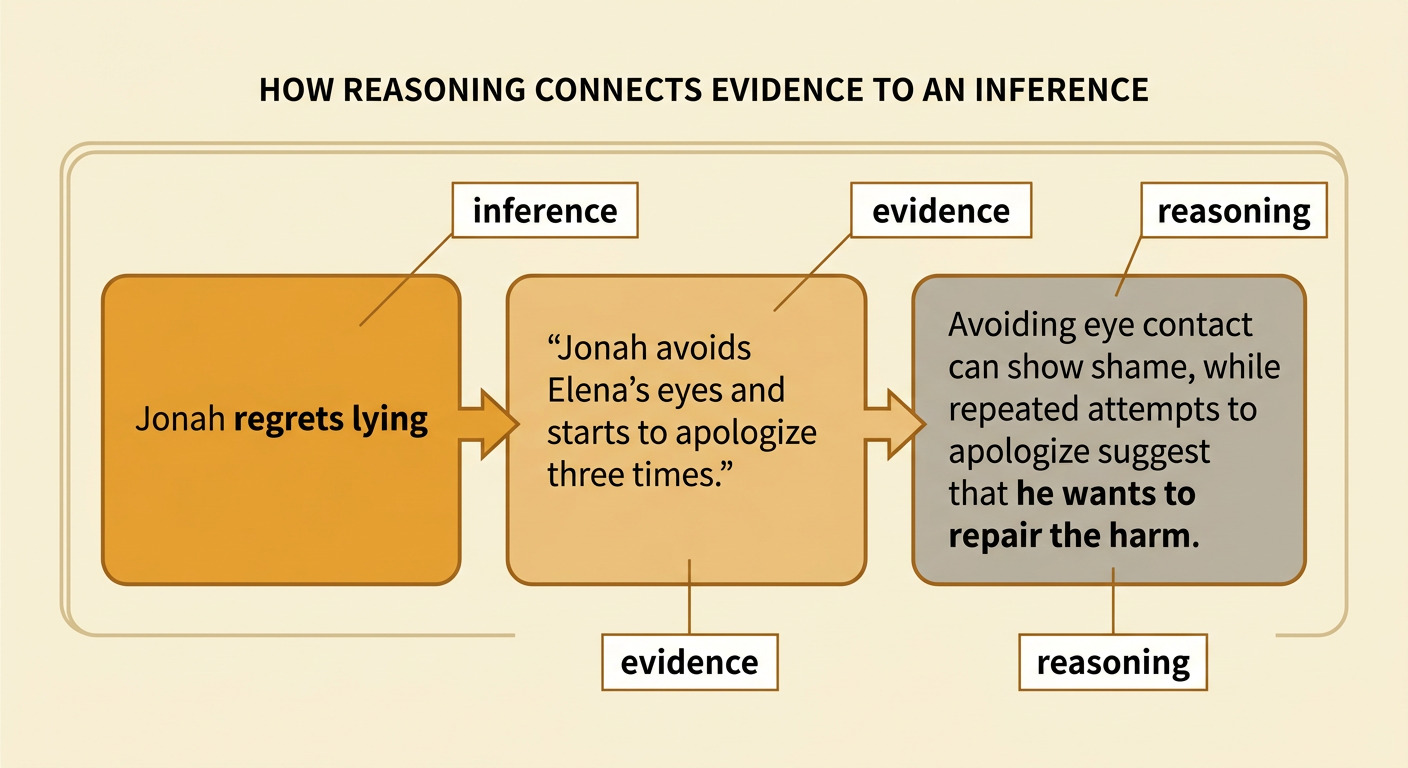
Citing evidence is only part of a strong response. You must also explain how the evidence supports your inference. A clear explanation links the author’s words to your reasoning. For example, you might write, “I infer that Jonah regrets lying to his friend. The text says that he ‘avoided Elena’s eyes and started to apologize three times.’ Avoiding eye contact can show shame, and his repeated attempts to apologize suggest that he wants to repair the harm.” This response names the inference, cites specific evidence, and explains the connection. Without the final explanation, a reader may not understand why the quotation matters. Helpful sentence frames include “This shows that…” and “This detail suggests…because….” Check that your explanation does not simply repeat the quotation. Instead, tell what the detail reveals about the character, conflict, setting, or theme.
Independent Inference Practice
When making an inference independently, follow a repeatable process. First, read the passage closely and identify what it states explicitly. Next, ask what the details suggest. Form a logical inference, select the strongest evidence, and explain the connection. Practice with this example: “Nora stepped onto the porch and saw the empty bowl. Muddy paw prints crossed the steps. She smiled, filled the bowl again, and placed an old blanket beside it.” You might infer that Nora has been caring for an animal that visits her porch. The empty bowl and paw prints show that an animal was there, while refilling the bowl and adding a blanket show that Nora expects it to return and wants to help it. Another inference may be possible if it fits the details. Before finishing, check that your answer includes a conclusion, accurate textual evidence, and clear reasoning.
