Managing Fisheries: The Commons, Regulation, and Public Policy
Students analyze fisheries data, competing stakeholder interests, and regulatory options to determine how governments can protect shared marine resources while supporting coastal economies.
Illustrations are auto-generated and may be placeholders. They can be refreshed to match the narration.
The Tragedy of the Commons
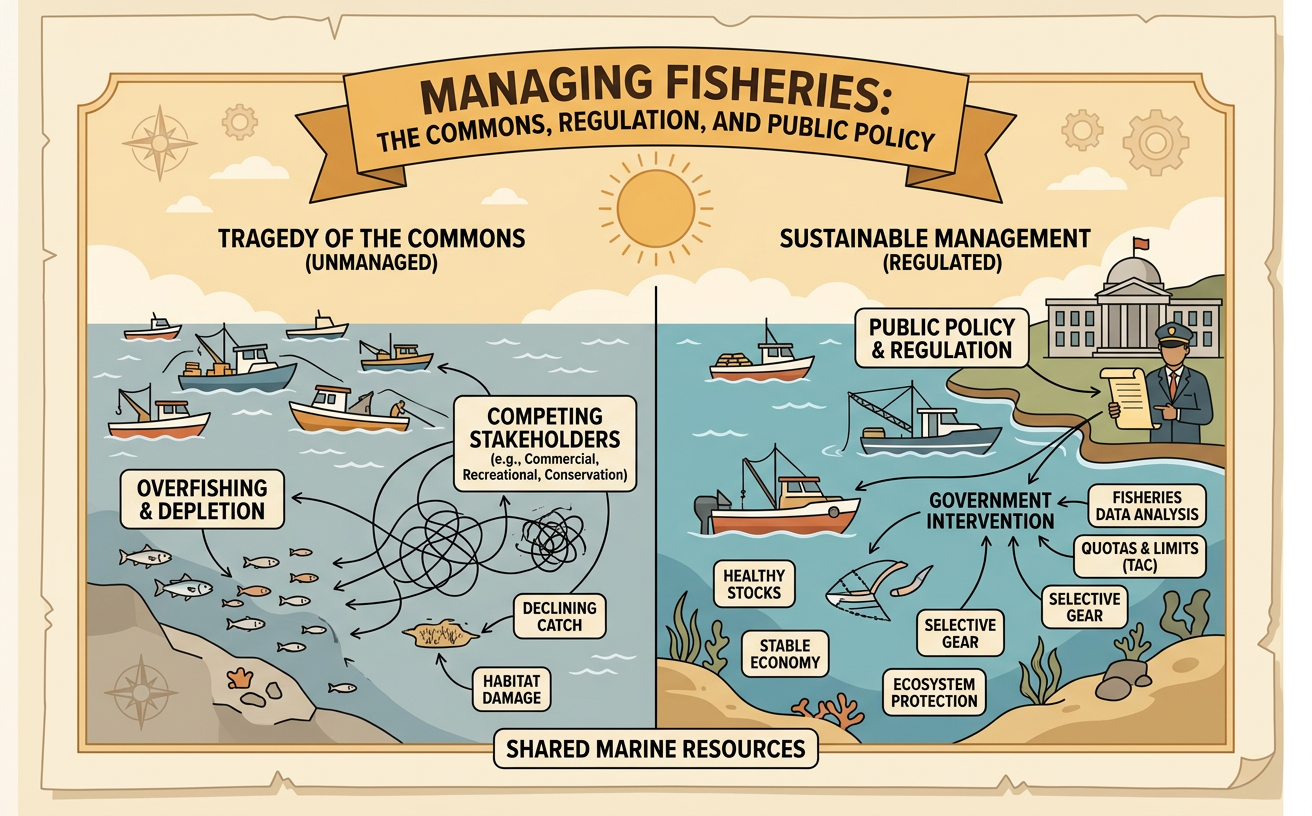
A fishery can become a tragedy of the commons when many users share access to a limited fish population. Each fishing business gains by catching more fish, but the costs of population decline are spread across everyone. This creates an incentive to harvest fish before competitors do. If total harvest exceeds the population’s ability to reproduce, the fishery may shrink or collapse. For example, imagine 20 boats fishing the same cod grounds. One captain knows that leaving mature cod in the water would support future reproduction, but cannot guarantee that other boats will do the same. The captain may therefore catch as many cod as possible now. Government rules or cooperative agreements can change these incentives by limiting total harvest, protecting breeding areas, or assigning secure fishing rights. Effective management treats fish as a renewable but finite shared resource.

Reading Fish Population and Harvest Data
Fisheries managers use several kinds of data, including estimated population size, total harvest, average fish age, and catch per unit effort. Catch per unit effort measures how many fish are caught for a standard amount of work, such as one boat-day. A falling value can indicate that fish are becoming harder to find even when total harvest remains high. Suppose annual survey estimates show a tuna population falling from 900,000 to 500,000 fish over five years while harvest stays near 180,000 fish per year. Students can plot year against population and fit a linear function to summarize the trend. A fitted model such as P(t) = 900,000 − 100,000t estimates the population after t years, although real biological change may not remain linear. The trend, data source, uncertainty, and possible alternative explanations should all be considered before drawing a policy conclusion.

Stakeholders and Competing Interests
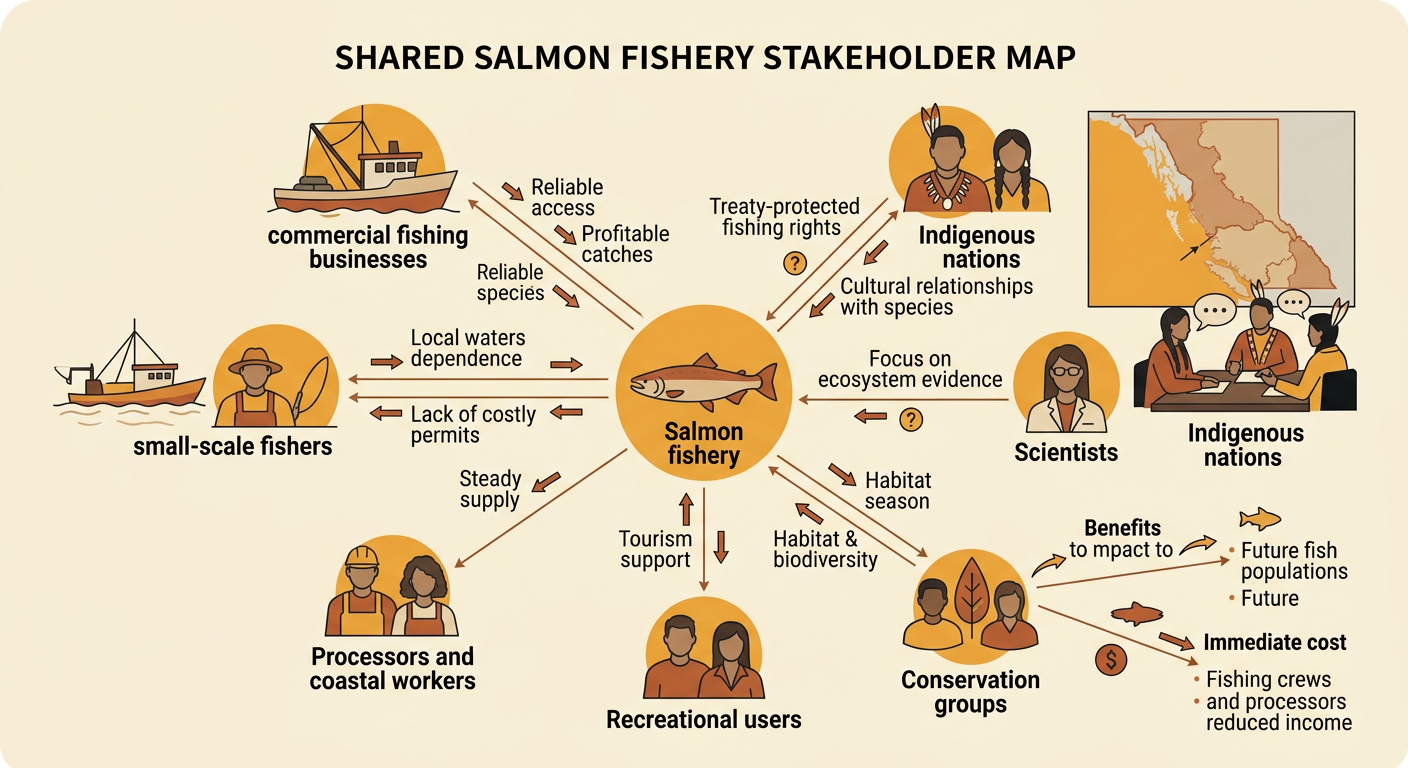
Fishery policy affects groups with different goals, resources, and levels of influence. Commercial fishing businesses may seek reliable access and profitable catches. Small-scale fishers may depend on local waters but lack the capital to buy expensive permits. Seafood processors and coastal workers need a steady supply of fish, while recreational fishers value access and tourism opportunities. Indigenous nations may hold treaty-protected fishing rights and cultural relationships with particular species. Scientists emphasize ecosystem evidence, and conservation organizations may support stronger habitat and biodiversity protections. For example, closing a salmon area during spawning season could improve reproduction but temporarily reduce income for fishing crews and processors. A complete policy analysis asks who receives benefits, who bears costs, whose legal rights apply, and who participates in the decision. Stakeholder claims should be compared with ecological data rather than treated as equally supported simply because they are strongly expressed.
Comparing Regulatory Approaches
Governments can regulate fisheries through several approaches, each with strengths and limitations. A total allowable catch caps the combined harvest but requires reliable monitoring. Individual fishing quotas assign shares of that total, reducing the race to fish, although quota ownership may become concentrated among large firms. Size limits protect young fish until they reproduce, while seasonal closures protect spawning periods. Marine protected areas restrict harvest in important habitats and can allow populations to rebuild, but fishing effort may shift elsewhere. Gear rules, such as requiring turtle-excluder devices in shrimp nets, can reduce bycatch. For example, a government responding to declining snapper might combine a science-based catch limit with a spring spawning closure and electronic reporting. Comparing options requires asking whether each rule addresses the cause of decline, can be enforced, treats stakeholders fairly, and can adjust when new data become available. Often, a policy package works better than one rule alone.

Evaluating Policy Consequences
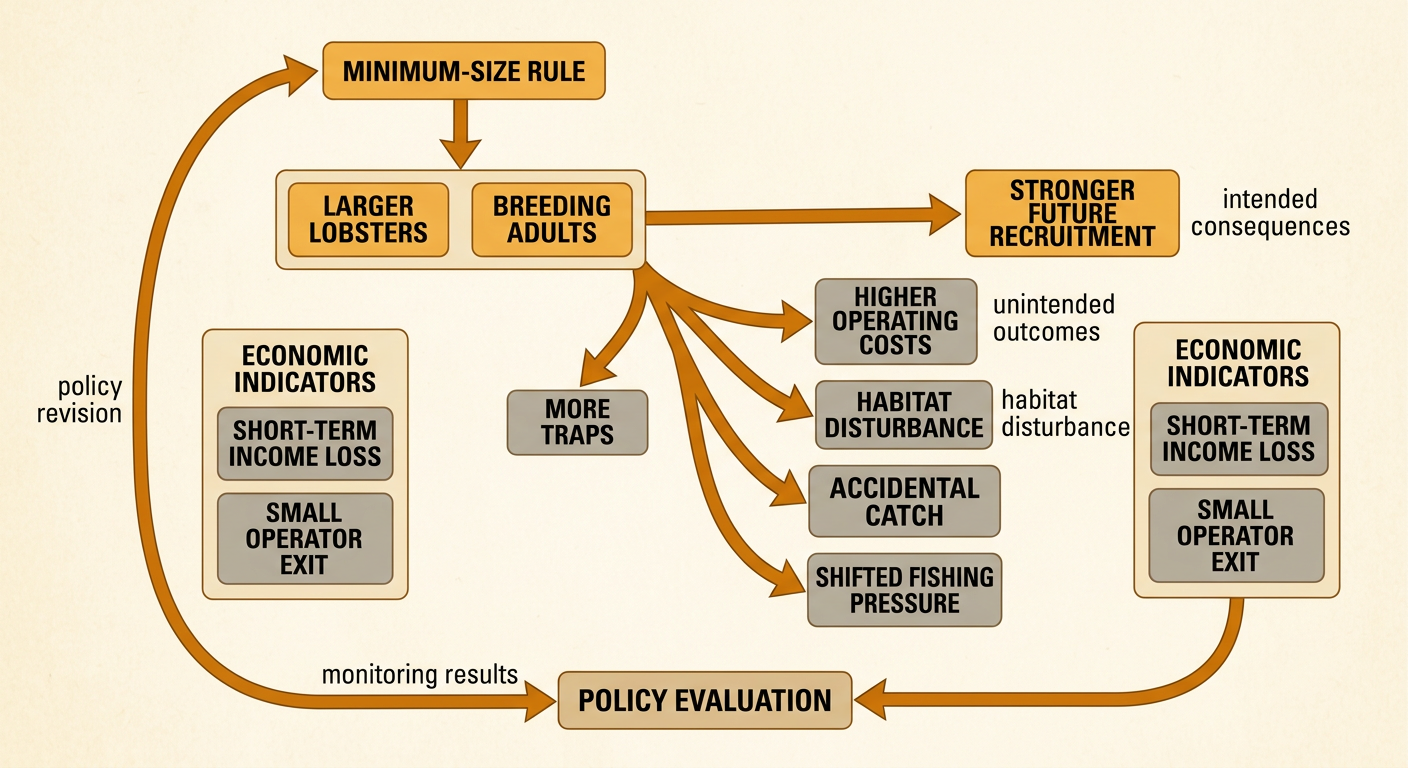
Public policies should be evaluated by both intended and unintended consequences. An intended consequence of a catch limit might be rebuilding a depleted fish population. Possible unintended consequences include lost short-term income, illegal harvest, inaccurate reporting, or increased fishing pressure on another species. Distribution also matters: a costly permit system may reduce total harvest while pushing small operators out of the industry. Time scale matters as well. A temporary closure may cause immediate hardship but support larger catches after the population recovers. For example, if a lobster minimum-size rule increases the number of breeding adults, it may improve future recruitment. However, if fishers respond by setting more traps, habitat disturbance or accidental catch could increase. Policymakers should compare baseline data with results after implementation, track ecological and economic indicators, and revise rules when evidence reveals harm. A successful policy is effective, enforceable, equitable, and responsive to new information.
Making an Evidence-Based Recommendation
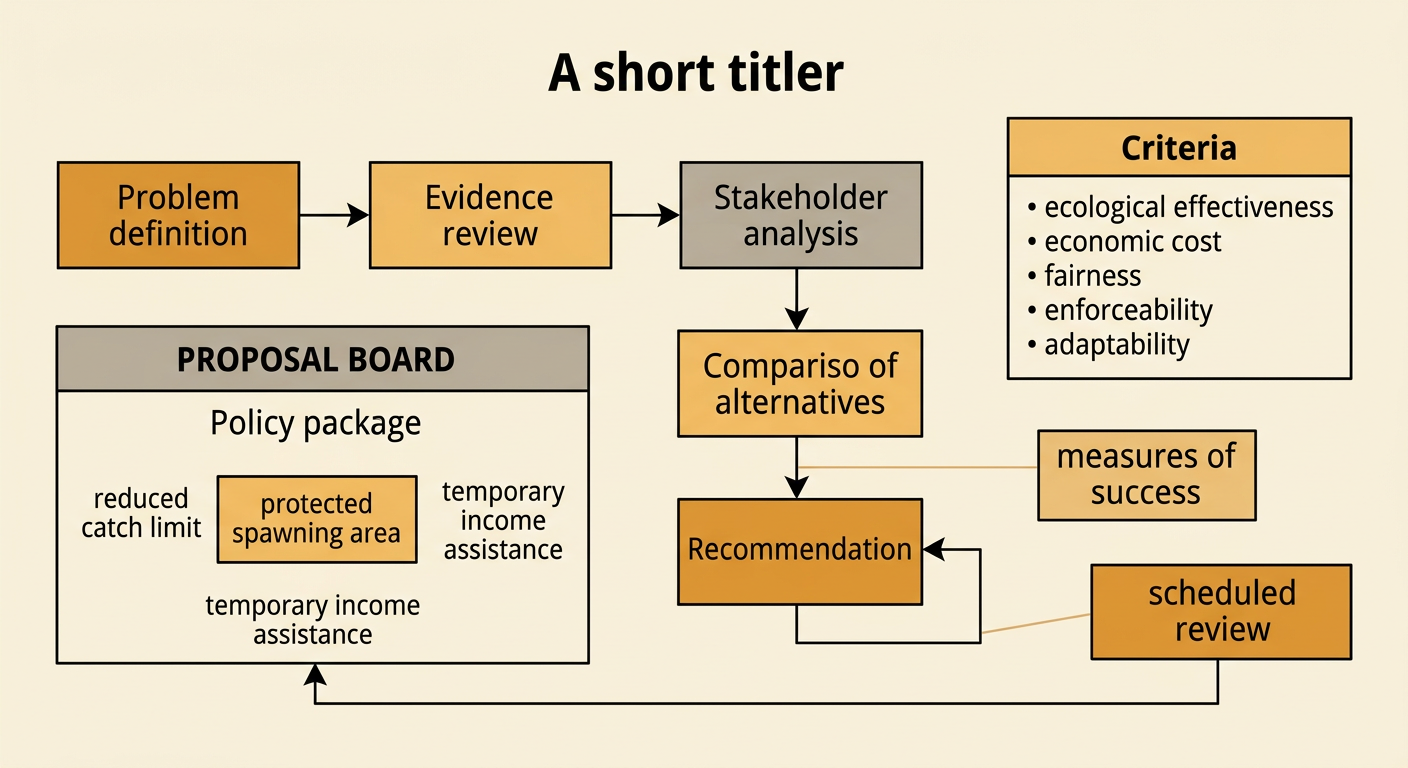
An evidence-based recommendation connects a clearly defined problem to data, stakeholder concerns, and feasible policy tools. Begin by stating the goal, such as rebuilding a fish population to a target level while maintaining a viable coastal economy. Cite relevant trends, explain what a fitted function suggests, and acknowledge uncertainty. Then compare alternatives using consistent criteria: ecological effectiveness, economic cost, fairness, enforceability, and adaptability. For example, if survey data show a persistent decline in grouper and interviews reveal that small boats depend on the fishery, a recommendation might combine a reduced catch limit, a protected spawning area, and temporary income assistance. The proposal should explain why this package is preferable to a complete closure or no action. It should also identify measures of success, such as population estimates, catch per unit effort, bycatch rates, business income, and compliance. A scheduled review allows officials to adjust the policy as evidence changes.