Mass Stays the Same During Melting
Students measure a sealed sample before and after ice melts, graph the results, and use the evidence to explain that heating changes matter without changing its total mass.

Illustrations are auto-generated and may be placeholders. They can be refreshed to match the narration.
Predict the Mass After Melting
Before measuring, make a prediction about what will happen to the mass when the ice melts. Melting changes ice from a solid to liquid water, but it does not remove the water from a sealed container. Think of the container and everything inside it as one system. Because no matter can enter or leave this closed system, its total mass should stay the same. For example, if a sealed bag containing ice has a mass of 125 grams before melting, predict that it will have a mass of about 125 grams after melting. Record both your predicted mass and your reasoning. Do not predict based only on how much space the ice or water appears to take up. Volume may change during melting even though mass stays constant.

Measure the Sealed Ice Sample
Use a balance to measure the ice sample before it melts. First, check that the container is completely sealed and dry on the outside. Place the whole sample, including the container, on the center of the balance. Wait for the number to stop changing, and record the mass in grams. Always use the same balance and the same unit for both measurements. For example, a sealed container holding several ice cubes might have a total mass of 125 grams. This measurement includes the mass of the ice and the container. In another standard unit, 125 grams equals 0.125 kilogram because 1,000 grams equals 1 kilogram. Keep the sample sealed so that water cannot leak out and no matter is added or removed.

Observe the Change of State
Leave the sealed sample at room temperature and observe it without opening the container. As thermal energy moves from the warmer surroundings into the colder ice, the ice melts. The solid pieces become smaller, and liquid water collects in the container. Eventually, the sample may contain only liquid water. This is a change of state from solid to liquid, not the creation of a new substance. The water particles are still inside the sealed container before and after melting. For example, one large ice cube may become a shallow pool of water that looks smaller or takes a different shape. That visual change does not show a loss of matter. If moisture forms on the outside of the container, gently dry it before measuring again so it is not added to the sample’s mass.

Measure and Graph Again
After all the ice has melted, make sure the container is still sealed and dry on the outside. Place it on the same balance and record the final mass in grams. Then create a bar graph with two bars labeled Before Melting and After Melting. Label the vertical axis Mass in Grams, begin the scale at zero, and use equal intervals. For example, if the initial mass was 125 grams and the final mass is 125 grams, the bars will be the same height. A reading may sometimes differ by one gram because of the balance’s precision, moisture on the container, or a recording error. Check the setup and repeat the measurement. Use the measured data, rather than the sample’s changed appearance, to decide whether the total mass stayed the same.

Explain Conservation of Matter
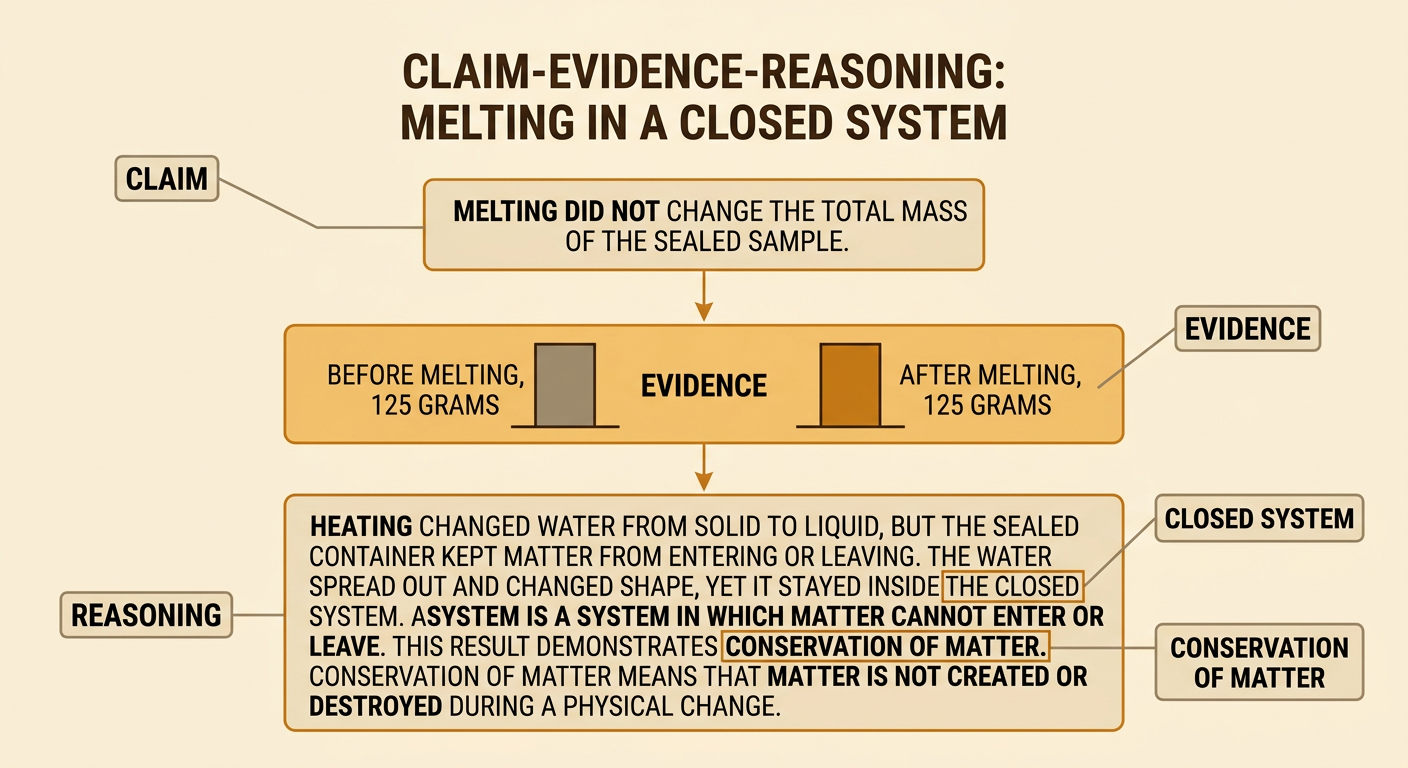
Use a claim, evidence, and reasoning to explain the results. Your claim can state that melting did not change the total mass of the sealed sample. Your evidence should include the actual measurements and graph. For example, the sample had a mass of 125 grams before melting and 125 grams after melting, and both graph bars were equal in height. Your reasoning should connect the evidence to conservation of matter: heating changed the water’s state from solid to liquid, but the sealed container prevented matter from entering or leaving. The water spread out and changed shape, yet it remained part of the measured system. Therefore, the total amount of matter stayed the same. This reasoning applies to a closed system during heating, cooling, and many kinds of mixing.