
Match Uppercase and Lowercase Letters
Students identify letters by matching uppercase forms with their corresponding lowercase forms.

Illustrations are auto-generated and may be placeholders. They can be refreshed to match the narration.
Alphabet Warm-Up
Let us wake up our letter brains! Sing or say the alphabet together from A to Z. As each letter is named, look at an alphabet chart and point to it. Notice that every letter has a name and can be written in two forms: uppercase and lowercase. Hold your arms wide when you see an uppercase letter and bring your hands close together when you see a lowercase letter. For example, point to uppercase B and then lowercase b. Say, “Uppercase B, lowercase b. They are the same letter.” Continue with C and c, M and m, and S and s. Listen carefully to each letter name, and remember that the two forms belong together.

Uppercase and Lowercase Review
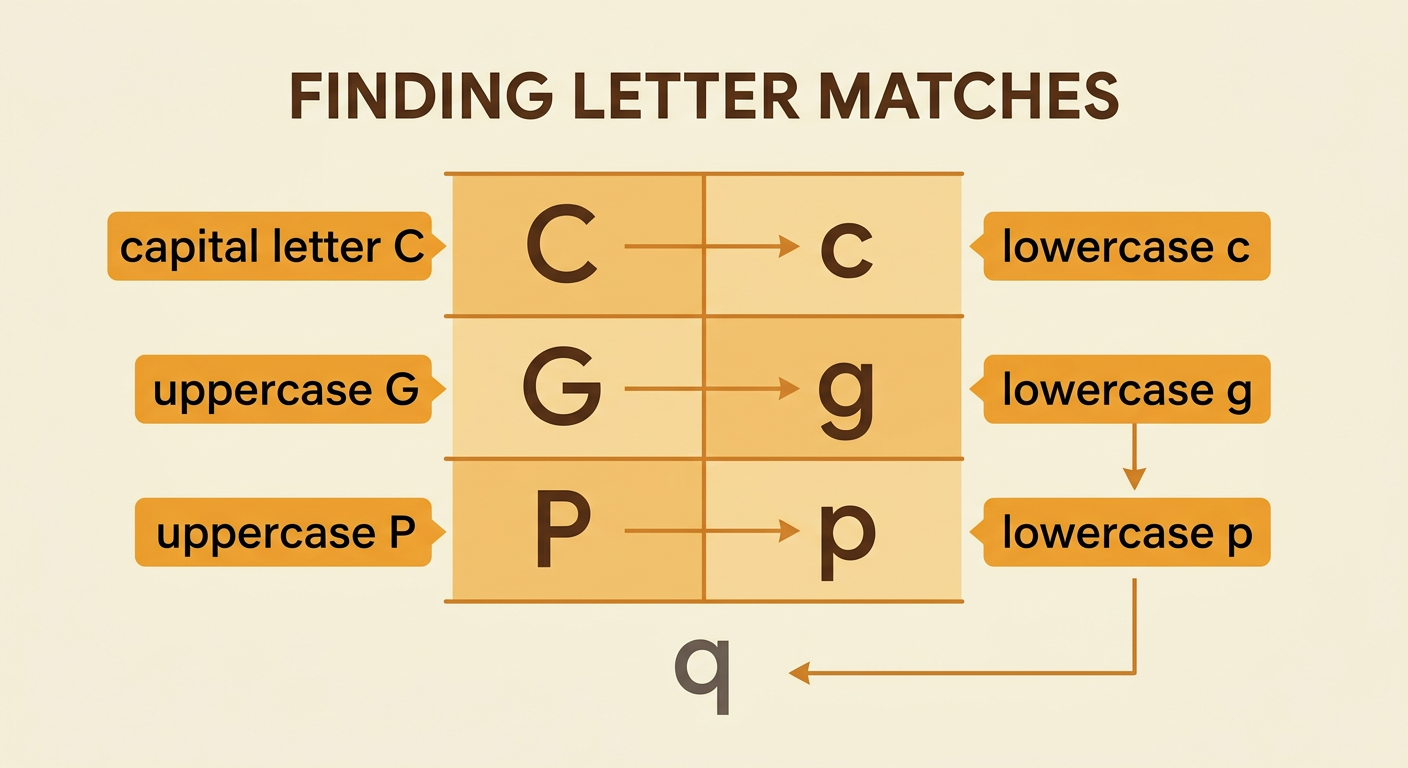
Uppercase letters are also called capital letters. They are often used at the beginning of a sentence and at the beginning of a person’s name. Lowercase letters are used for many other letters in words. An uppercase letter and its matching lowercase letter have the same name. Sometimes the two forms look alike, such as C and c. Sometimes they look different, such as G and g. Say each pair aloud: “C and c are C. G and g are G.” Look closely at lines, curves, and circles to tell letters apart. Do not match letters only because they look similar. Match them because they have the same letter name. For example, uppercase P matches lowercase p, not lowercase q.
Teacher Modeling
Watch as the teacher matches one uppercase letter card with one lowercase letter card. The teacher picks uppercase D and says, “This letter is D. I need to find lowercase d.” Next, the teacher looks at the lowercase choices b, d, and p. The teacher names each letter instead of guessing by shape: “b, d, p.” Then the teacher chooses d and places it beside D. The teacher checks the match by saying, “Uppercase D and lowercase d are both D.” Use the same steps for every match: name the uppercase letter, name the lowercase choices, choose the letter with the same name, and check the pair aloud. Careful letter naming helps when lowercase letters have similar shapes.

Partner Letter Match
Work with a partner to match letter cards. Place the uppercase cards faceup in one row and the lowercase cards faceup in another row. Partner one chooses an uppercase card, names it, and looks for its lowercase match. For example, if the card is uppercase R, the partner says, “I have R. I am looking for lowercase r.” The partner places R and r together. Partner two checks the pair and says, “Yes, both letters are R,” or kindly helps correct the match. Then switch jobs. Take turns until every card has a partner. If you are unsure, use an alphabet chart and compare the letter names. Speak clearly, listen to your partner, and check each completed pair together.

Independent Practice
Now show what you can do on your own. Look at each uppercase letter on the left side of the page. Find the matching lowercase letter on the right side, and draw a line between them. Name both letters quietly as you work. For example, if you see uppercase H, look through the lowercase choices and find h. Draw a line from H to h, and say, “H matches h.” Work one row at a time so your lines stay clear. Check that each uppercase letter has exactly one lowercase partner. Pay special attention to pairs that look different, such as A and a, E and e, and Q and q. When you finish, point to each pair and say its letter name.

Quick Letter Check
Let us do a quick check before the lesson ends. The teacher will show one uppercase letter. Say its name, and then point to or hold up the matching lowercase letter from three choices. For example, the teacher shows uppercase N. The choices are lowercase h, n, and m. Say, “That is N,” and choose n. Check by saying, “Uppercase N matches lowercase n.” Try several letters, including ones that look very different in their two forms, such as A and a or G and g. If you choose the wrong letter, name the choices again and try once more. Finish by explaining the rule: uppercase and lowercase forms match when they have the same letter name.
