
Match Uppercase and Lowercase Letters
Students recognize, name, and match uppercase letters with their lowercase partners.
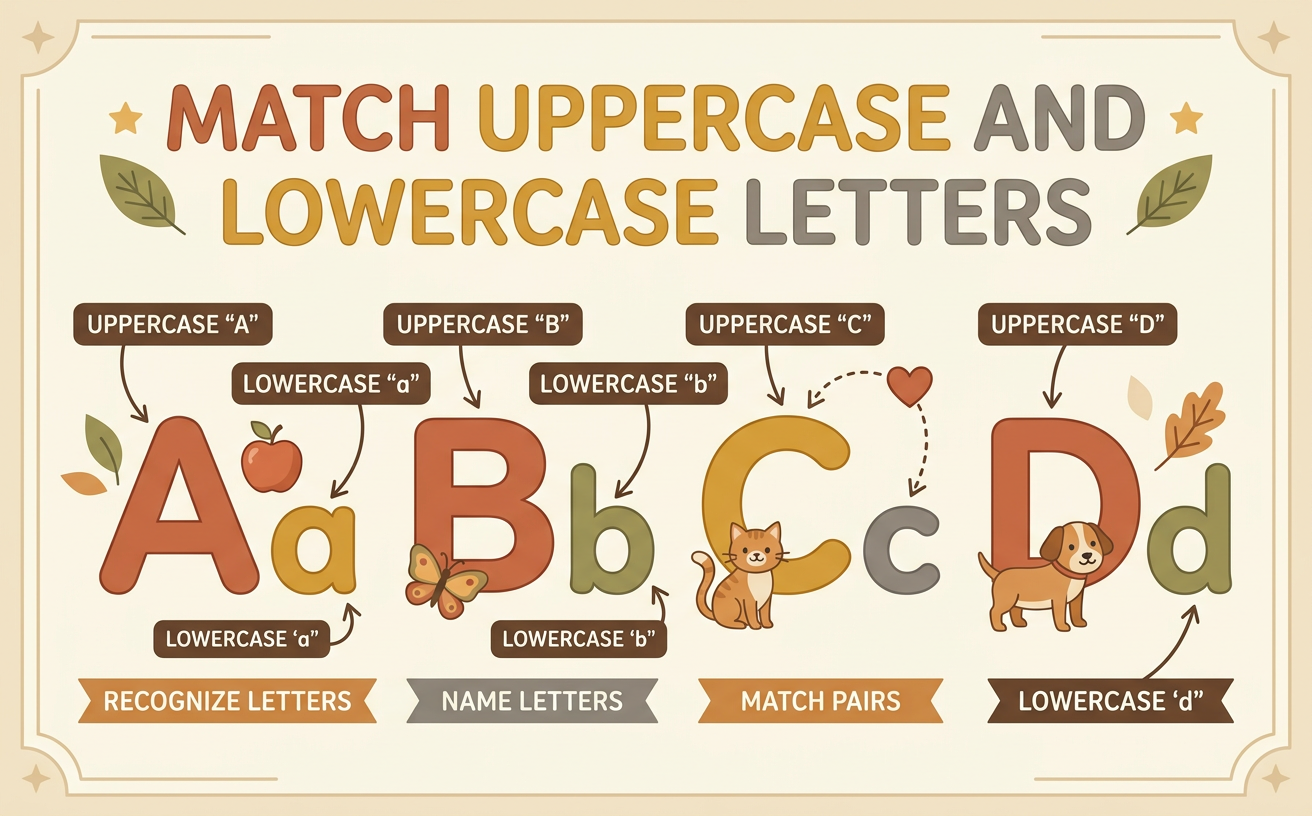
Illustrations are auto-generated and may be placeholders. They can be refreshed to match the narration.
Alphabet Warm-Up
Let’s warm up by saying the alphabet together. Each letter has a name. Point to each letter as you say its name: A, B, C, D, and E. Continue through the alphabet until you reach Z. Now look closely at the letters. Some are tall, some are short, and some have curves or straight lines. For example, uppercase A has two slanted lines and a line across the middle. Lowercase a is smaller and has a different shape, but both letters are named A. Try saying this pair aloud: “uppercase A, lowercase a.” Knowing letter names and noticing letter shapes will help you find letter partners.
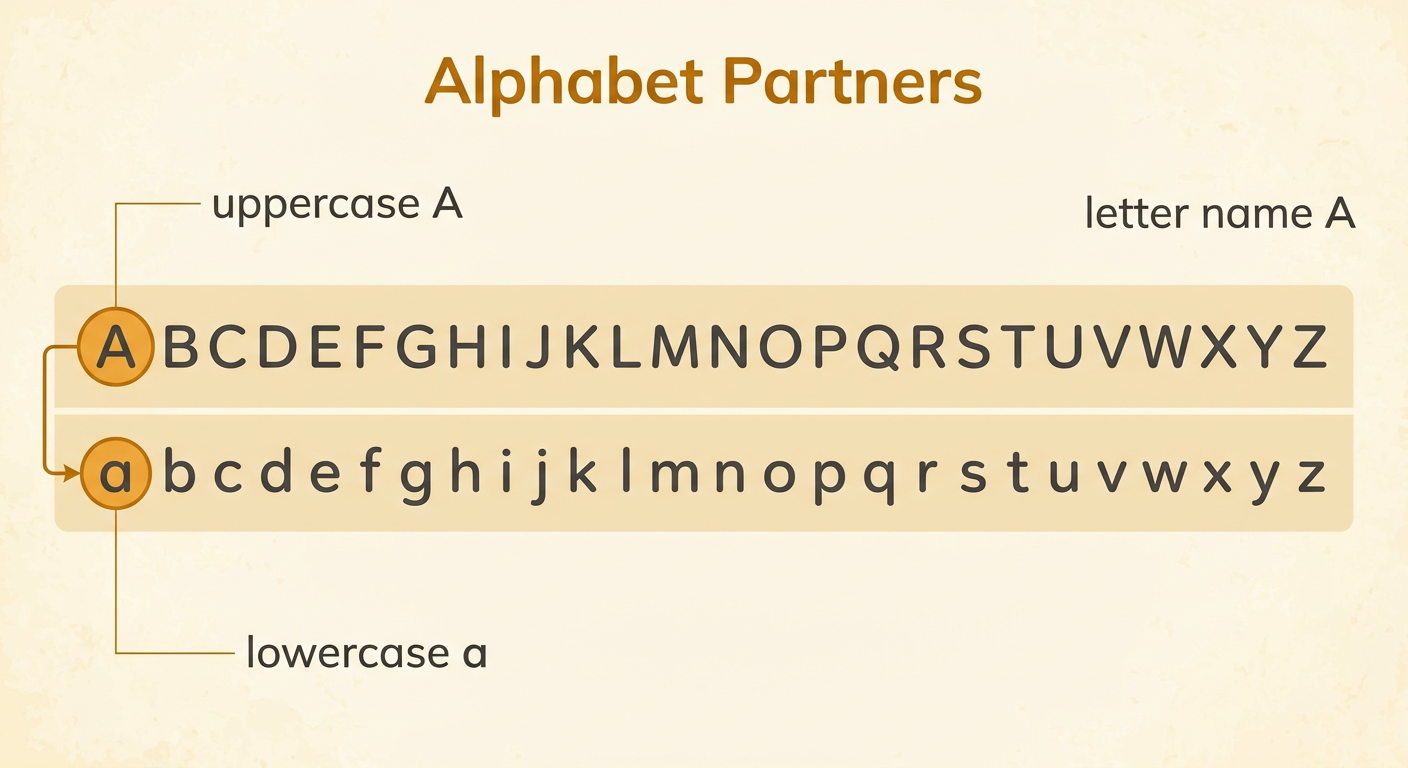
Uppercase and Lowercase Letter Model
Every alphabet letter can be written in an uppercase form and a lowercase form. Uppercase letters are also called capital letters. An uppercase letter is often used at the beginning of a sentence or a name. Lowercase letters are used for many other letters in words. Look at B and b. Uppercase B has one tall straight line and two rounded bumps. Lowercase b has one tall line and one rounded part. They do not look exactly the same, but they have the same name and make the same letter sound. Say, “B and b are partners.” Remember that size alone does not always show the difference. Look carefully at each letter’s complete shape.

Match Letter Partners
To match letter partners, begin with one uppercase letter. Say its name, and then search for the lowercase letter with the same name. Suppose you see uppercase M. Say, “This is M.” Now look at the lowercase choices m, s, and t. Lowercase m has the same letter name as uppercase M, so M and m are partners. Draw an imaginary line from M to m. Do not match letters only because they look similar in size or shape. Uppercase S and lowercase s look much alike, but uppercase G and lowercase g can look different. Use the letter name to help you decide. Try another example: uppercase T matches lowercase t, not lowercase f or lowercase l.

Name the Matched Letters
After you match two letters, say their shared letter name aloud. Point to the uppercase letter first and then point to the lowercase letter. For the pair R and r, say, “Uppercase R, lowercase r. The letter name is R.” This helps you remember that both forms belong to one letter. Next, try P and p. Say each form clearly: “Uppercase P, lowercase p.” You can also use a word to help you remember the letter, such as “P is for pig.” Be careful to name the letter, not only the picture or word. Practice with several pairs. Name C and c, H and h, and N and n. Each pair has one shared letter name.

Quick Letter Check
Now show what you know with a quick letter check. Look at uppercase Q and three lowercase choices: p, q, and g. Say the uppercase letter name first: “Q.” Then find the lowercase letter with the same name. The correct partner is lowercase q. Point to q and say, “Uppercase Q matches lowercase q.” Next, look at lowercase d. Which uppercase letter is its partner: B, D, or P? The answer is uppercase D. Say, “D and d are partners.” Check your choice by naming both letters. If you are unsure, look again at the shapes and say each letter name slowly. Keep practicing until you can recognize and name uppercase and lowercase partners from A to Z.
