
Material Detectives: Describe the Mystery Material
Students safely observe classroom material samples and use words such as smooth, rough, soft, hard, shiny, dull, heavy, and light to describe their properties.

Illustrations are auto-generated and may be placeholders. They can be refreshed to match the narration.
Meet the Mystery Materials
Today you are a material detective. A material is what an object is made from. Wood, metal, fabric, plastic, and rock are materials. Each material has properties, or features we can observe. A property might tell how something looks, feels, or compares with something else. Your teacher will show safe samples in separate trays. Do not guess the object they came from yet. First, notice each sample carefully. For example, a small piece of aluminum foil looks shiny and feels smooth. A piece of tree bark looks dull and feels rough. Bark is a natural material that can be found in a wooded place. Use your eyes and hands to gather clues. These clues will help you name and describe each mystery material.

Review Safe Observation Skills
Scientists follow safety rules when they investigate materials. Wait until your teacher says to begin. Keep every sample on its tray or work mat. Look with your eyes, and touch gently with one or two fingers. Never taste a sample or put it near your mouth, nose, or eyes. Do not throw, bend, or break materials. Take turns so everyone in your group can observe. Use a calm voice and listen when a classmate speaks. If a sample spills, breaks, or has a sharp edge, stop and tell the teacher. For example, if you see a crack on a plastic piece, leave it on the tray and raise your hand. Wash your hands when the investigation is finished. Safe actions protect you, your classmates, and the materials.

Look, Touch, and Compare
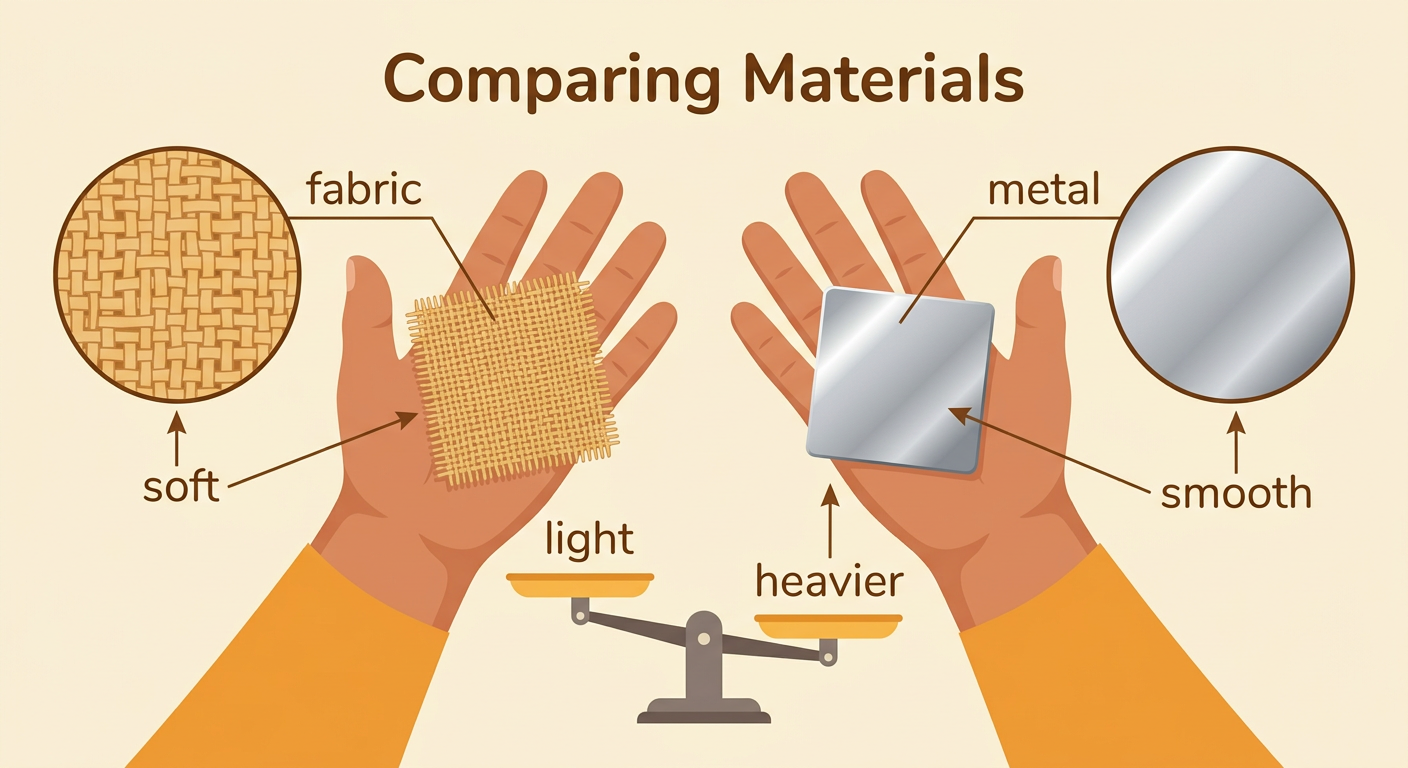
Now investigate two samples at a time. First, look at them. Does each one look shiny or dull? Next, touch each sample gently. Does it feel smooth or rough? Is it soft enough to press, or is it hard? Then compare how heavy or light the samples feel. Your teacher may ask you to hold one sample in each hand. Use samples that are about the same size so the comparison is fair. For example, a fabric square may feel soft, light, and a little rough. A metal piece of similar size may feel hard, smooth, shiny, and heavier. Tell your partner what you notice. Say, “The metal feels heavier than the fabric.” Your partner can share another clue. Careful comparisons help detectives find ways materials are alike and different.
Describe Each Material
Record words that match what you observe. You can draw each sample and ask an adult to help write your describing words. Choose only words supported by evidence. Smooth means the surface has few bumps. Rough means it has many bumps or uneven parts. Shiny means it reflects bright light, while dull means it reflects little light. Soft materials can be pressed or bent easily. Hard materials resist being pressed. Heavy and light are comparison words, so tell what you compared. For example, you might record, “The pebble is smooth, hard, and dull. It is heavier than the cotton ball.” A pebble is a natural material often found near rivers, beaches, or paths. Different pebbles can have different properties, so describe the sample in front of you rather than every pebble.

Share Evidence and Reflect
Gather with your group to share what you discovered. Take turns speaking and listening. Hold up one safe sample or point to its picture. Name the properties you observed and give evidence. You might say, “I think this is fabric because it is soft, light, and easy to bend.” A classmate may add, “I noticed it looks dull.” It is fine if you noticed different clues. Look at the sample again and discuss your ideas kindly. Then think about where materials may be found. Wood can come from trees in forests, and smooth stones may be found near water. People also use materials to make classroom objects. Reflect by finishing this sentence: “One property I can observe is _____.” Your evidence helps the class understand how materials can be sorted, compared, and used.
