
Material Detectives: Sorting Solids by Their Properties
Students observe, test, sort, and graph solid materials based on properties such as color, texture, hardness, and flexibility.

Illustrations are auto-generated and may be placeholders. They can be refreshed to match the narration.
Meet the Mystery Materials
Scientists study materials to learn what they are like and how they can be used. Imagine a tray holding a wooden craft stick, a rubber eraser, a cotton ball, aluminum foil, a plastic spoon, and a metal paper clip. These are all solids because each one keeps its own shape unless someone pushes, bends, or changes it. Begin with a question: How can we sort these mystery materials by their observable properties? Look at each sample without guessing what it should be used for. Record its name or draw a simple picture. Handle every sample carefully and follow safety rules. By observing and testing the same set of materials, the class can gather evidence and answer the investigation question.
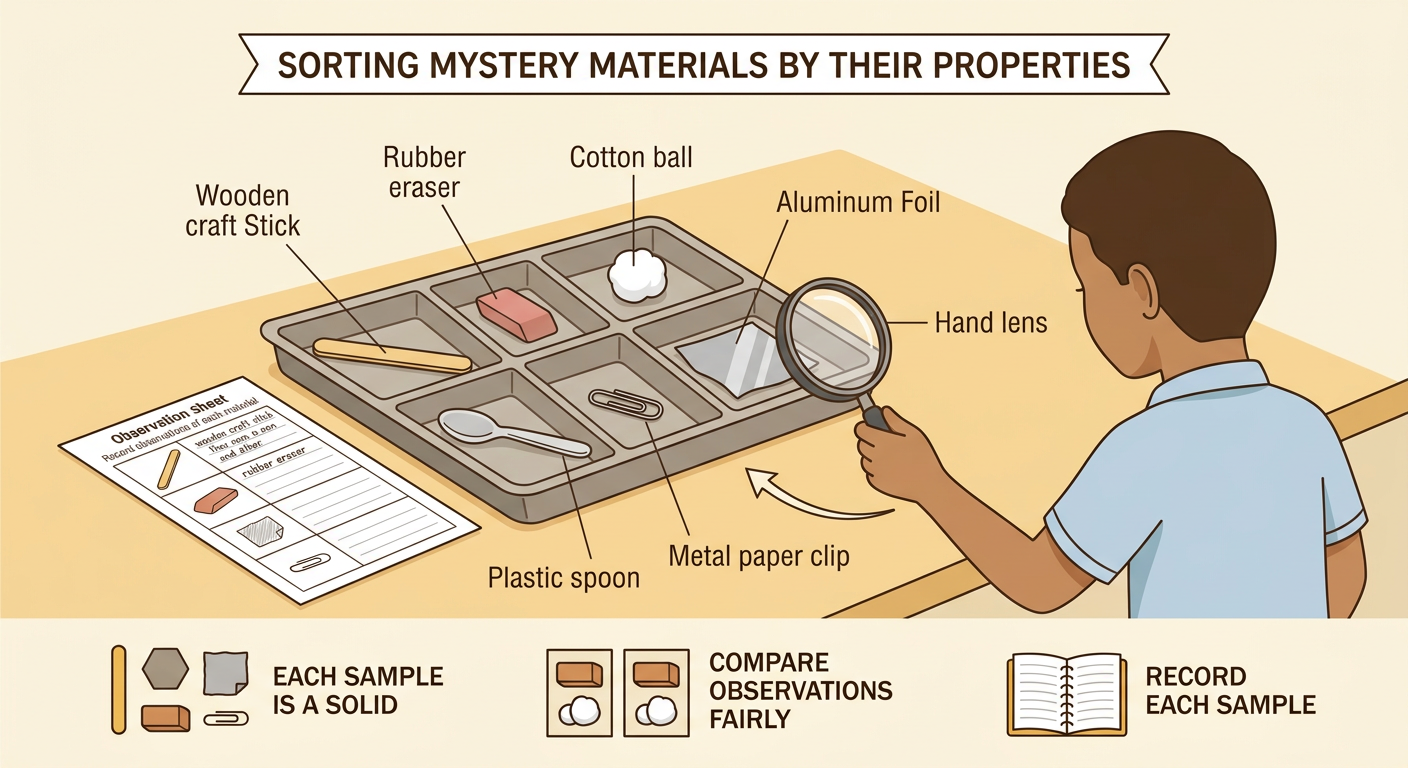
Observe and Describe Properties
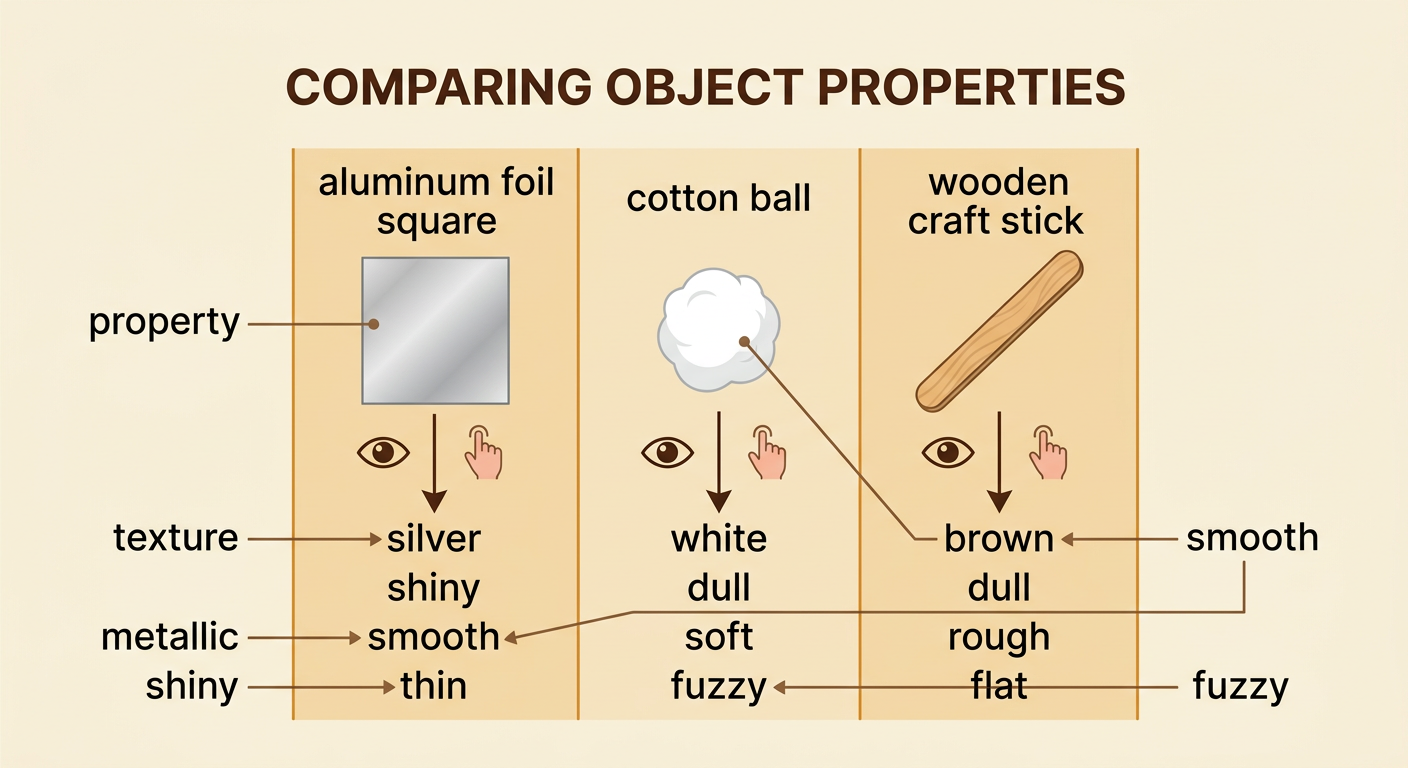
A property is a feature that can be observed or measured. First, use your eyes to notice color, shape, size, and shine. Then gently touch each sample to observe its texture. A texture might feel smooth, rough, soft, fuzzy, or bumpy. Use clear property words instead of opinion words. For example, write, “The aluminum foil is silver, shiny, smooth, and thin,” rather than, “The foil is nice.” The cotton ball is white, dull, soft, and fuzzy. Two objects can share one property but differ in another. Both the foil and plastic spoon may feel smooth, but only the foil looks metallic and shiny. Record observations with words and drawings so you can use the information later to classify the samples.
Test Hardness and Flexibility
Some properties are easier to describe with a simple test. Hardness tells how well a material resists being scratched, pressed, or dented. Flexibility tells how easily a material bends without breaking. To make a fair comparison, test every sample in the same gentle way. Press each sample once with the same finger pressure and look for a dent. Then carefully try to bend it the same small amount. Do not force or break anything. For example, a cotton ball changes shape easily, while a wooden craft stick resists pressing. Aluminum foil bends easily and stays bent. A plastic spoon may bend only a little and return toward its original shape. Record each result right away using agreed words such as hard, soft, flexible, or stiff.

Sort Materials into Groups
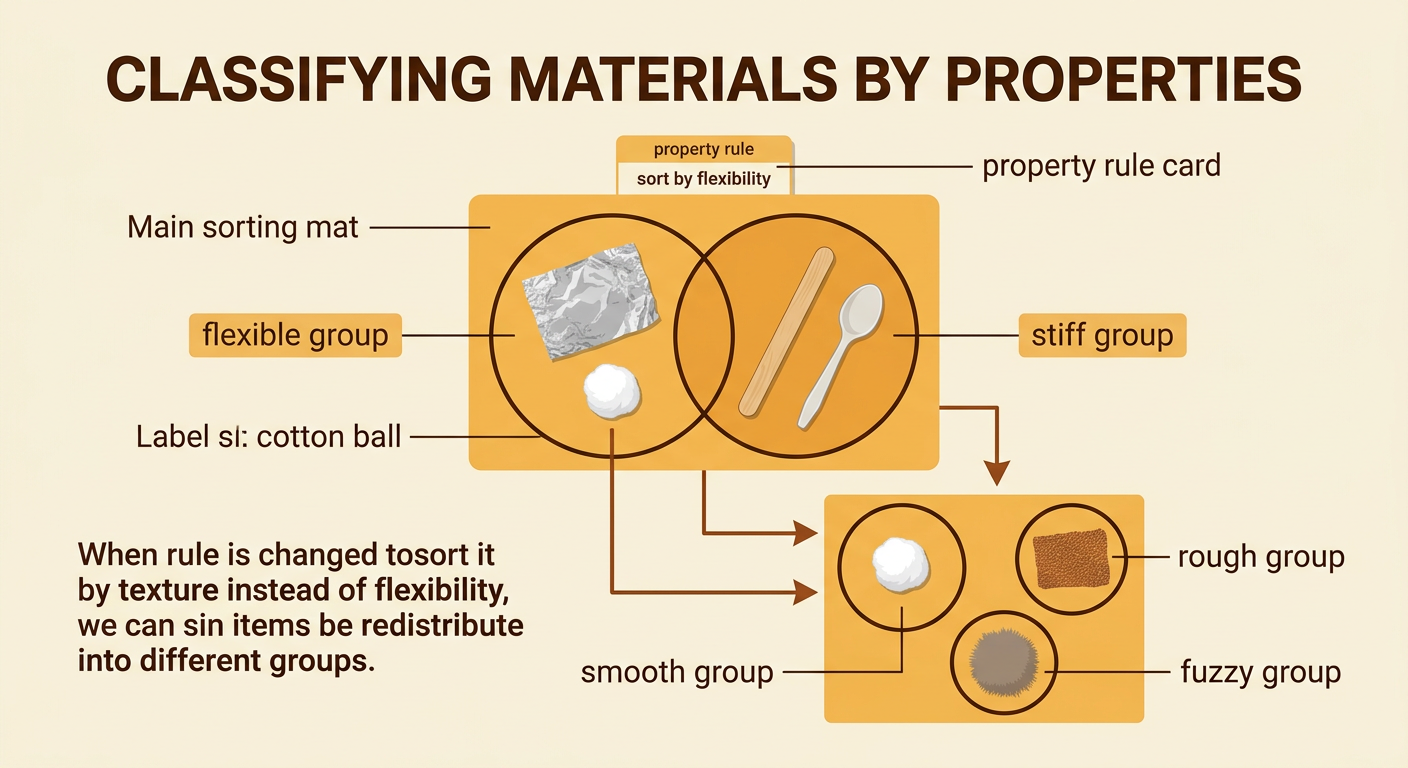
To classify means to place things into groups based on shared properties. Choose one property rule before sorting. For example, sort the samples into flexible and stiff groups. The foil and cotton ball can go in the flexible group because they change shape easily. The wooden craft stick can go in the stiff group because it does not bend easily. Another sort could use texture groups such as smooth, rough, and fuzzy. A sample may belong in different groups when the sorting rule changes. Always explain your evidence: “I placed the cotton ball in the fuzzy group because I felt many soft fibers.” Materials are limited, so people must choose carefully. If only one small piece of foil is available, its flexibility may make it a better choice for wrapping than for building a stiff support.
Graph and Explain the Results
A graph helps the class compare how many samples are in each group. First, count the materials in no more than four categories and record a tally for each one. Then draw a picture graph or bar graph. Suppose the class tested eight samples and found three flexible, two slightly flexible, and three stiff. On a picture graph, one material symbol can represent one sample. On a bar graph, each bar should reach the correct number. Add a title and label the categories and number scale. Use the graph to write an evidence-based conclusion, such as, “Flexible and stiff were tied because each group had three samples.” The results can also guide choices when materials are limited. A builder who has only a few stiff pieces should save them for parts that must hold their shape.
