Matter Is Conserved During Changes
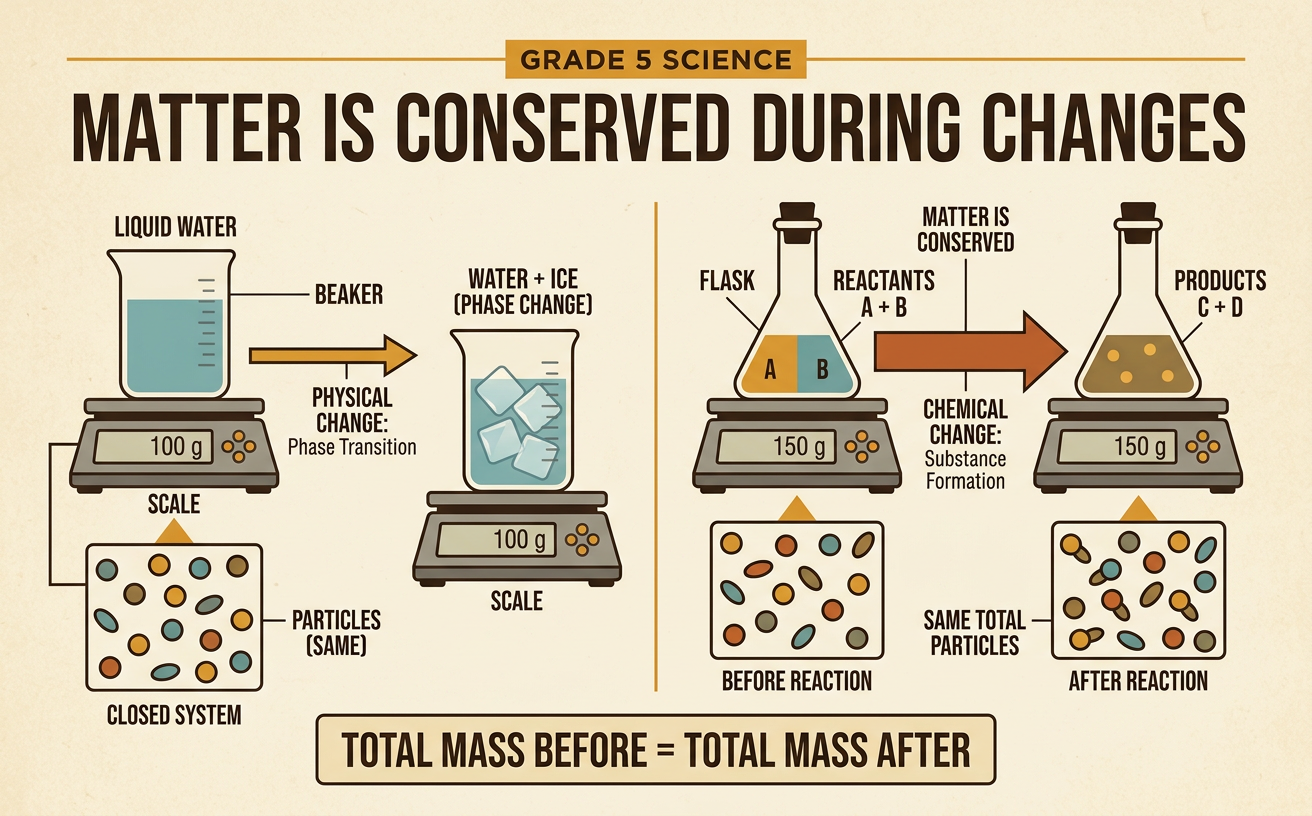
Students analyze mass data and particle models to explain why the total amount of matter remains the same when substances change in a closed system.
Illustrations are auto-generated and may be placeholders. They can be refreshed to match the narration.
Observe a Change in a Closed System
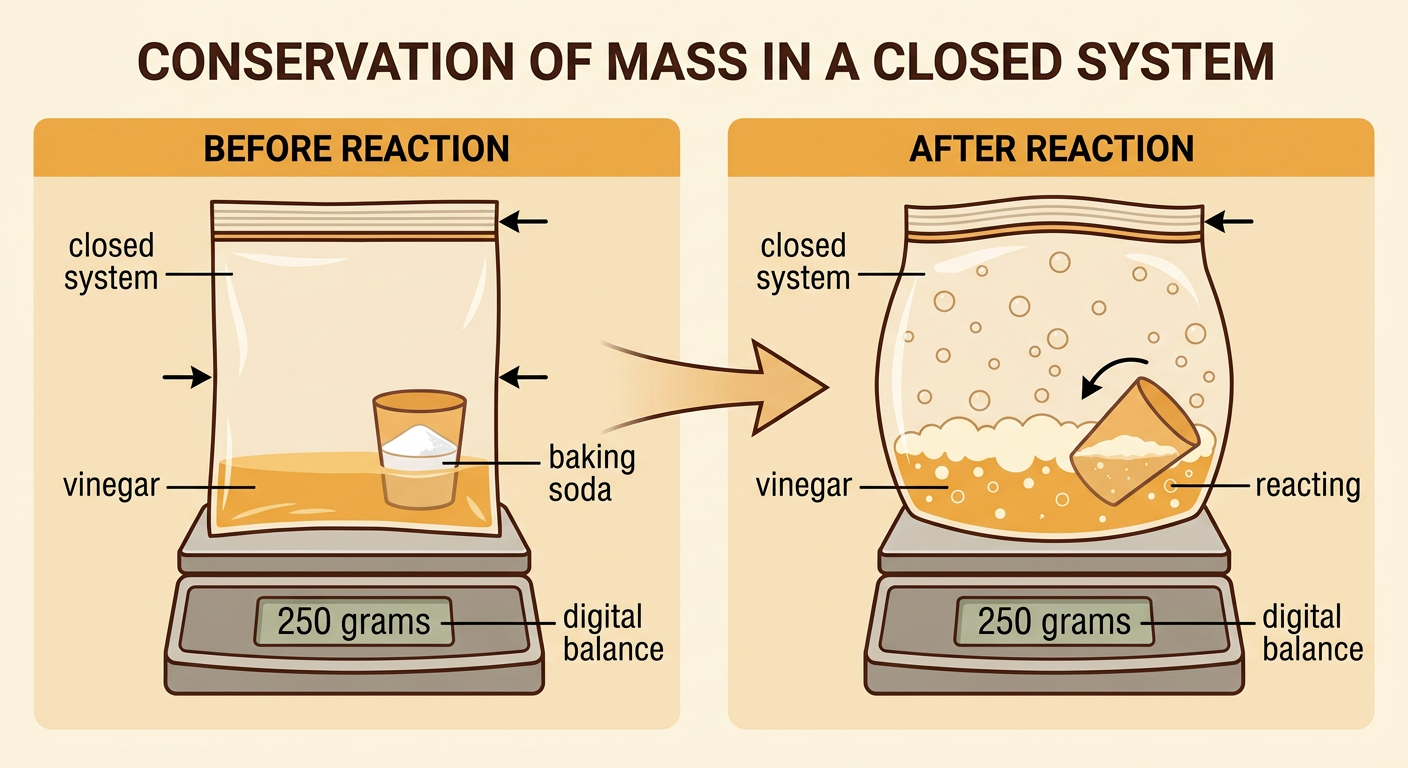
A closed system does not allow matter to enter or leave. Imagine a teacher placing vinegar in a sturdy, sealed plastic bag and baking soda in a small cup inside the bag. Before mixing, the sealed bag and everything in it have a mass of 250 grams. When the cup tips, the substances mix, bubble, and produce a gas. The bag expands, but it stays sealed. After the reaction finishes, the entire sealed system still has a mass of 250 grams. The bubbles and inflated bag show that a change occurred. However, no matter escaped, and no new matter entered. Measuring the complete system before and after the change lets us test whether its total amount of matter stayed the same.
Review Matter and Particle Models
Matter is anything that has mass and takes up space. Solids, liquids, and gases are all matter. Scientists use particle models to represent pieces of matter that are too small to see. In a model of vinegar and baking soda before mixing, different colors or shapes can represent particles of each substance. After mixing, the same particles are rearranged into new groupings, including particles of a gas. No particles disappear, and none appear from nowhere. In a closed system, every particle remains somewhere inside, even if it becomes part of a different substance. For example, gas particles spread out and push against the bag, causing it to expand. The gas may be hard to see, but it still has mass and takes up space.

Compare Before-and-After Mass Data
Mass data provide numerical evidence about matter. Suppose three sealed systems are measured before and after a change. System A measures 250 grams both times. System B measures 475 grams both times. System C measures 1.2 kilograms both times. To compare all results in grams, convert 1.2 kilograms to 1,200 grams because 1 kilogram equals 1,000 grams. A bar graph can display a before bar and an after bar for each system. The paired bars should have equal heights. Small differences, such as 250 grams before and 249 grams after, may result from measurement error or an imperfect seal. Repeated measurements help scientists decide whether a pattern is reliable. When accurate measurements of closed systems match, the data support the idea that total mass is conserved.

Explain Conservation of Matter
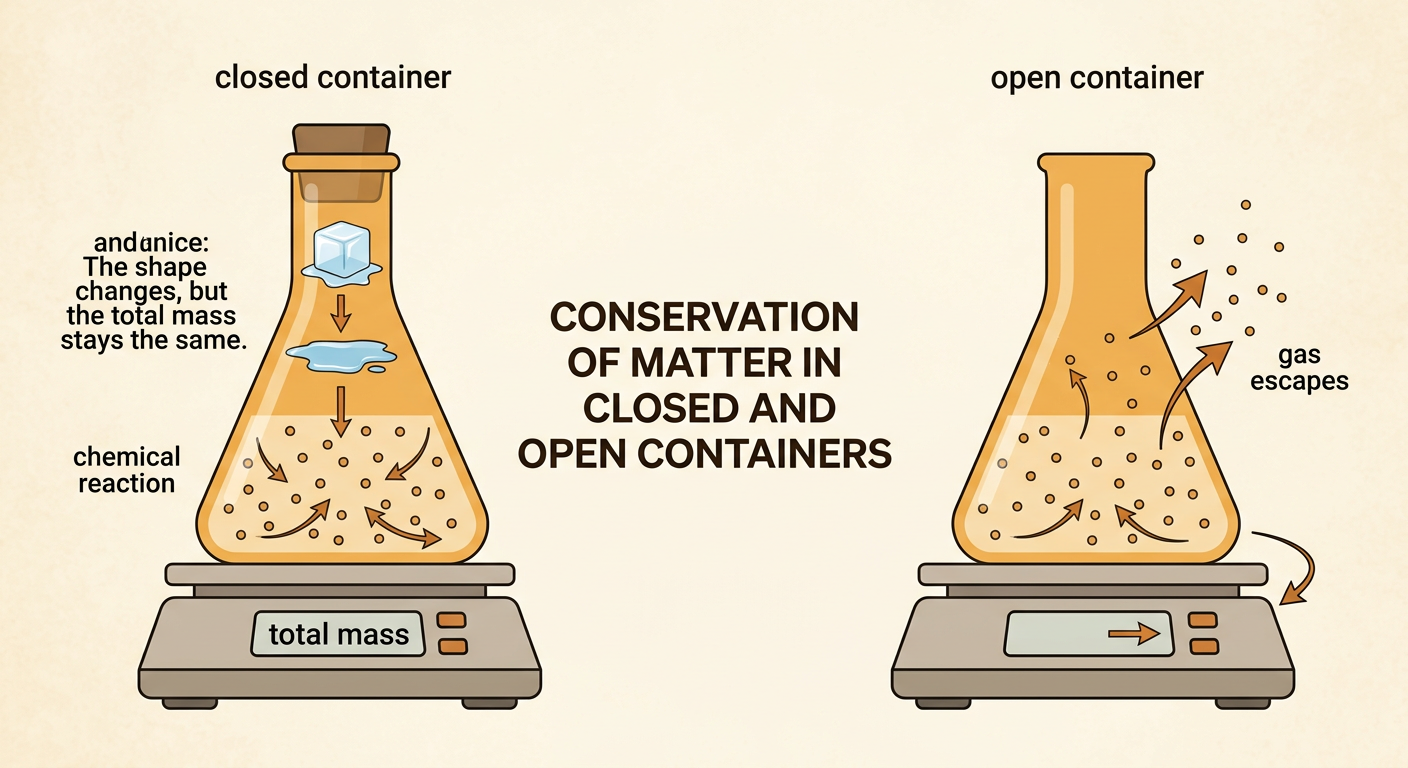
Conservation of matter means that the total amount of matter remains the same during a physical or chemical change. Matter may change form, move to a different place, or become part of a new substance. For example, when an ice cube melts inside a sealed container, solid water becomes liquid water, but the total mass does not change. During the vinegar and baking soda reaction, some matter becomes a gas. If the container is open, the gas can escape, and the measured mass left on the balance may decrease. That does not mean matter was destroyed. It means part of the matter left the system being measured. To test conservation fairly, scientists measure every substance in a closed system before and after the change.
Write a Claim Supported by Evidence
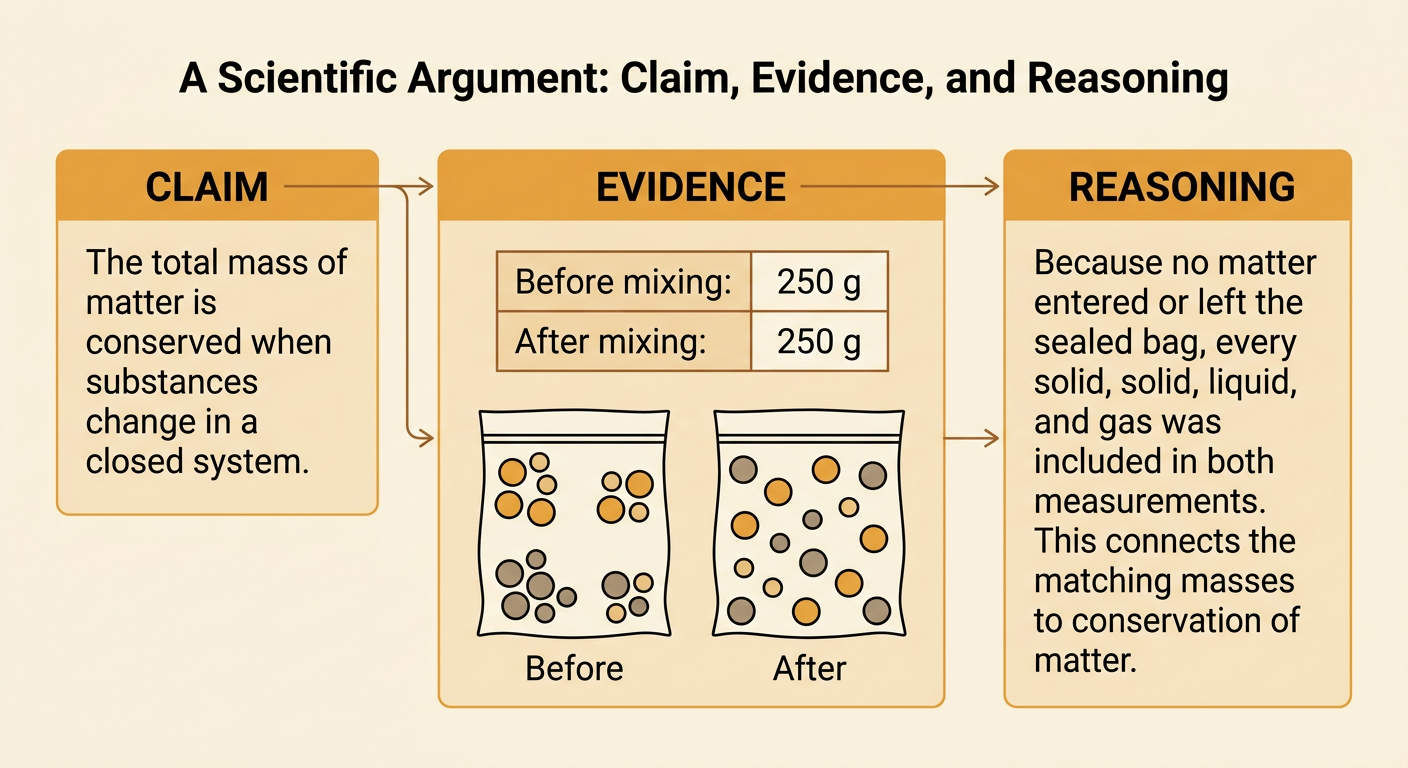
A scientific argument includes a claim, evidence, and reasoning. A clear claim might state, “The total mass of matter is conserved when substances change in a closed system.” Evidence should include specific observations, measurements, particle models, or facts from an informational text. For example, the sealed bag measured 250 grams before mixing and 250 grams after mixing. The particle model also showed the same particles before and after, although they were arranged differently. Reasoning connects the evidence to the claim: because no matter entered or left the sealed bag, all solids, liquids, and gases were included in both measurements. When reviewing another student’s argument, ask whether the claim answers the question, the evidence is accurate and relevant, and the reasoning explains how the evidence supports the claim.