
Matter Is Made of Tiny Particles
Students use diagrams and observations of dissolving sugar in water to develop a model showing that matter is made of particles too small to see.
Illustrations are auto-generated and may be placeholders. They can be refreshed to match the narration.
What Happens When Sugar Dissolves?
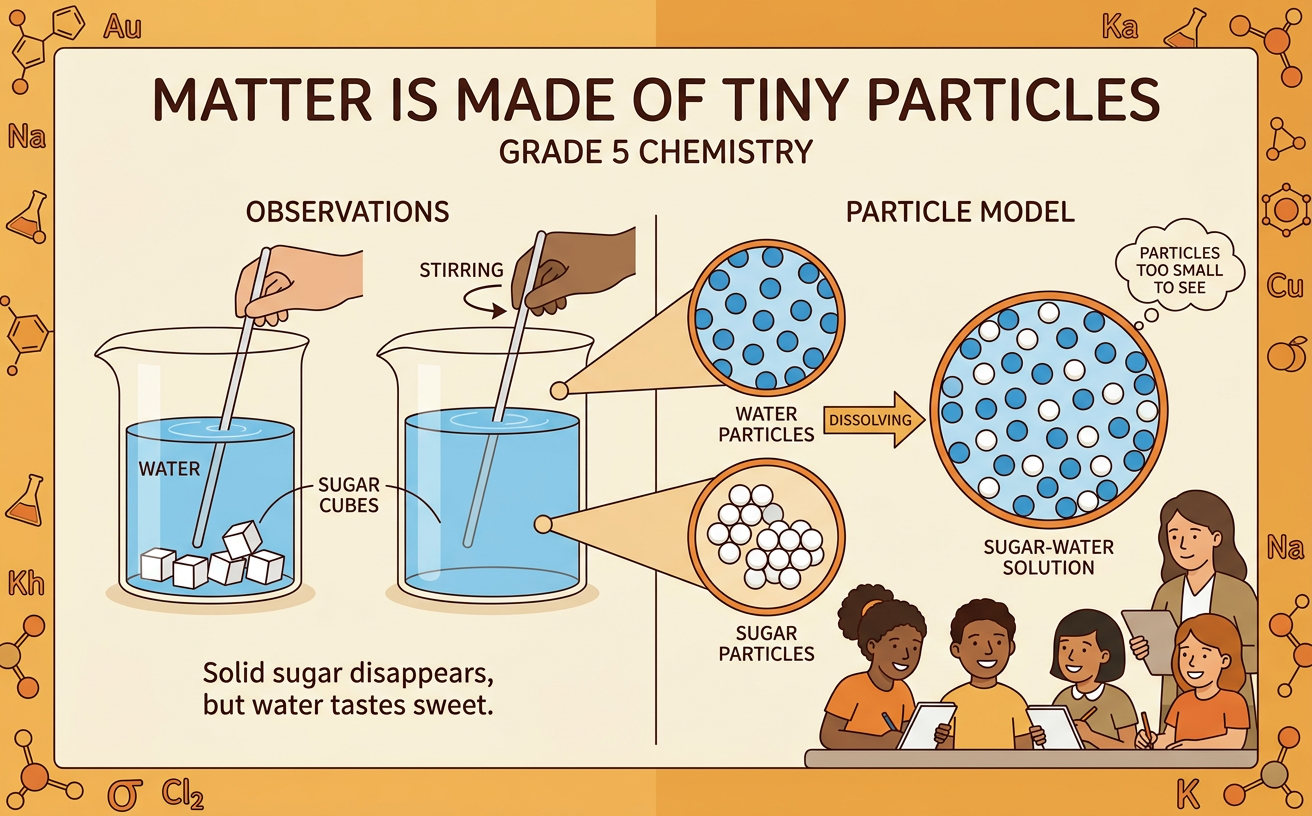
When a spoonful of sugar is stirred into water, the sugar crystals become smaller until they can no longer be seen. The sugar has not disappeared or changed into nothing. It has dissolved. Sugar particles separate from the crystal and spread throughout the water. The result is a solution, which is a mixture in which one substance is evenly spread through another. For example, if 10 grams of sugar are mixed with 100 grams of water in a covered container, the solution still has a total mass of about 110 grams. This measurement is evidence that the sugar remains present. If the water is later allowed to evaporate, sugar crystals can be recovered, providing more evidence that the dissolved sugar was in the water all along.
Matter We Cannot See
Matter is anything that has mass and takes up space. Scientists explain that all matter is made of extremely tiny particles. These particles are much too small to see with our eyes, and individual molecules cannot be seen with an ordinary classroom microscope. Water is made of water molecules, and sugar is made of sugar molecules. When sugar dissolves, its molecules fit among the moving water molecules and spread through the liquid. Air also provides an example of matter we cannot see. An inflated balloon has more mass than the same balloon when it is empty because air particles have entered it. We may not see individual particles, but we can observe their effects. Mass, volume, pressure, and dissolving provide evidence that unseen particles exist.
Building a Particle Model
A scientific model is a useful representation that explains observations. To model dissolving, first draw a sugar crystal as many sugar particles packed closely together. Draw the water as many moving water particles with small spaces between them. In the next picture, show stirring causing sugar particles to separate from the crystal. In the final picture, place the separated sugar particles throughout the water. Keep the same number of sugar particles in every picture because the sugar is not destroyed. For example, if the first drawing contains 12 sugar particles, the dissolved model should also contain 12. A model should not show the sugar particles changing into water particles. The circles in the drawing are not their real sizes or colors; they are symbols that make an invisible process easier to understand.
Particle Ideas Then and Now
Ideas about matter have changed as people have gathered new evidence. More than 2,000 years ago, the Greek thinker Democritus suggested that matter was made of tiny pieces that could not be divided. Other thinkers, including Aristotle, believed matter was continuous and not made of separate particles. These early ideas were mainly based on reasoning rather than controlled experiments. In the early 1800s, John Dalton used measurements from chemical reactions to develop an evidence-based atomic theory. Scientists today use results from many experiments and advanced instruments to study atoms and molecules. They know that atoms can join to form molecules, including water and sugar molecules. Unlike early thinkers, modern scientists can test particle models against precise evidence. Our model of dissolving sugar builds on this long history of asking what matter is made of.
Explain with Evidence
A scientific explanation connects a claim, evidence, and reasoning. A useful claim is: Sugar is still present after it dissolves because matter is made of particles too small to see. Evidence includes the measured mass of the covered mixture and the sugar crystals left behind after the water evaporates. For example, 100 grams of water and 10 grams of sugar produce about 110 grams of solution. The reasoning is that sugar particles separate and spread among water particles, but they do not stop existing. This explains why the crystals are no longer visible even though the mass remains. When reading a science text, look for relationships among ideas: stirring helps particles spread, spreading makes the solution look uniform, and evaporation removes water so sugar crystals can form again. These linked details support the particle model.