
Matter Is Made of Tiny Particles
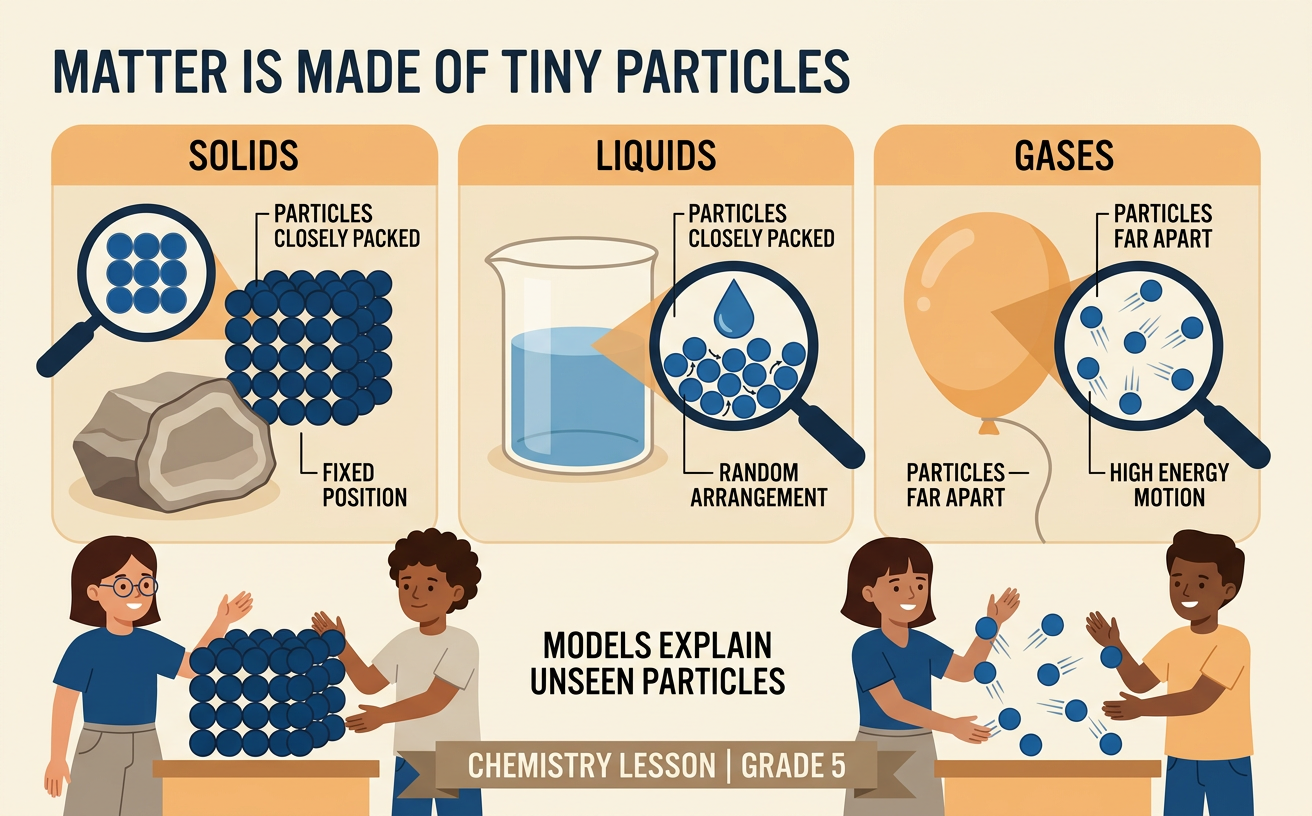
Students use visual models to explain that solids, liquids, and gases are made of particles too small to see directly.
Illustrations are auto-generated and may be placeholders. They can be refreshed to match the narration.
Matter We Can and Cannot See
Matter is anything that has mass and takes up space. A desk, a drop of water, and the air inside a balloon are all matter. We can see the desk and water, but we cannot usually see air. We know air is present because an inflated balloon becomes larger and has more mass than an empty balloon. Matter itself is made of extremely tiny particles. These particles are far too small to see with our eyes or an ordinary classroom microscope. Scientists use observations and measurements to learn about them. For example, when a drop of food coloring spreads through water, the movement suggests that tiny particles of water and coloring are moving and mixing, even though the individual particles remain invisible.
Introducing the Particle Model
A scientific model is a useful representation of something that may be difficult or impossible to observe directly. In a particle model, small circles or spheres stand for the tiny particles that make up matter. The circles are symbols; they are not the particles’ real size, color, or exact shape. The model helps us explain observations. For example, when sugar dissolves in water, it seems to disappear, but the water still tastes sweet. A particle model shows sugar particles separating and spreading among the water particles. The sugar has not stopped existing. Models can be changed when new evidence is found, and one model may show only the features needed to answer a particular question.
Particles in Solids, Liquids, and Gases
Solids, liquids, and gases are all made of particles, but their particles are arranged and move differently. In a solid, particles are packed closely in a fixed arrangement and vibrate in place. This helps a solid keep its shape. In a liquid, particles are still close together, but they move past one another, allowing the liquid to flow and take the shape of its container. In a gas, particles are much farther apart and move freely in all directions, so the gas spreads to fill its container. Consider water: ice is solid water, liquid water can be poured, and invisible water vapor is a gas. During a change of state, the water particles do not become different substances or change size; their motion and arrangement change.
Draw a Particle Model
To draw a particle model, begin with the object or process you want to explain. Draw a simple outline of each container, and use identical small circles for particles of the same substance. For a solid, place the circles close together in an orderly group. For a liquid, place them close together but irregularly arranged near the bottom of the container. For a gas, spread them far apart throughout the container. Use arrows to show motion, and include a key that explains each symbol. For example, you can draw twelve water particles as ice, liquid water, and water vapor. Keep all twelve particles in every picture to show that the particles remain present during a change of state. Do not draw gas particles larger; show greater spacing instead.
Explain the Model with Evidence
A strong scientific explanation connects a claim, evidence, and reasoning. The claim answers the question, the evidence describes an observation or measurement, and the reasoning explains how the particle model accounts for that evidence. For example, air in a sealed syringe can be pushed into a smaller space, but water in a sealed syringe is much harder to compress. This evidence supports the claim that gas particles have much more empty space between them than liquid particles. In the reasoning, explain that pushing the plunger moves gas particles closer together without shrinking the particles themselves. Point to specific features in your model, such as particle spacing and motion arrows. Use only relevant evidence, and remember that a model is an evidence-based explanation, not a direct picture of particles seen with the eyes.