
Matter, Properties, and the Particle Model
Students classify matter, distinguish physical and chemical properties, and use particle motion to explain solids, liquids, gases, and changes of state.
Illustrations are auto-generated and may be placeholders. They can be refreshed to match the narration.
What Is Matter?
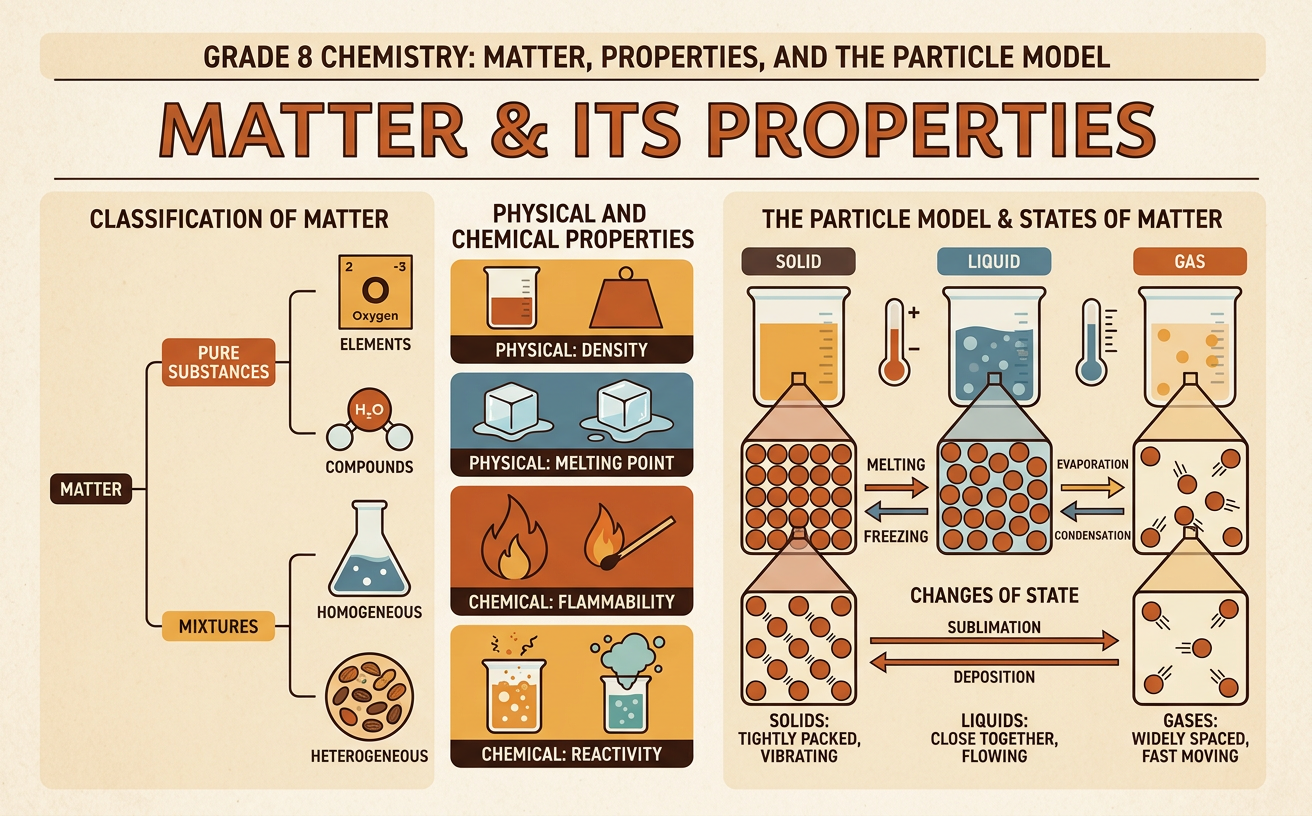
Matter is anything that has mass and takes up space. A desk, a drop of water, and the air inside a balloon are all matter. Mass measures the amount of matter in an object, while volume measures how much space it occupies. Matter can be described using observable properties such as color, texture, density, melting point, and electrical conductivity. Scientists use these properties to identify and compare substances. For example, a small steel ball may have less volume than a large foam ball but more mass because steel is denser. Light and sound are not matter because they do not have mass or occupy space. Recognizing what counts as matter is the first step toward explaining how substances behave and change.
Solids, Liquids, and Gases
The common states of matter are solid, liquid, and gas. In a solid, particles are packed closely and vibrate around fixed positions, so the material has a definite shape and volume. In a liquid, particles remain close but slide past one another, giving the liquid a definite volume but no fixed shape. In a gas, particles are far apart and move freely, so the gas expands to fill its container. An ice cube, liquid water, and water vapor are the same substance in three different states. A particle diagram can show these differences: ordered, crowded dots represent a solid; crowded but disordered dots represent a liquid; and widely spaced dots represent a gas.
Physical and Chemical Properties
A physical property can be observed or measured without changing a substance into a different substance. Examples include color, density, hardness, solubility, melting point, and boiling point. A chemical property describes a substance's ability to form new substances. Flammability, reactivity with acid, and the tendency to rust are chemical properties. For example, copper's reddish color and ability to conduct electricity are physical properties. Copper's ability to react slowly with oxygen and develop a green coating is a chemical property. Scientists often compare several properties when identifying an unknown material. One property may not be enough because different substances can share a color or texture, but a combination of density, solubility, and reactivity provides stronger evidence.
Changes of State and Energy
Matter changes state when thermal energy is transferred. Heating usually makes particles move faster, while cooling makes them move more slowly. Melting changes a solid into a liquid, freezing changes a liquid into a solid, vaporization changes a liquid into a gas, and condensation changes a gas into a liquid. The substance's chemical identity does not change during these physical changes. For example, when ice melts, its water molecules gain energy and move more freely, but they are still water molecules. During boiling, added energy helps particles overcome attractions and spread apart as a gas. A heating curve or particle diagram can connect measured temperature changes with changes in particle arrangement and motion.