
Mechanical Waves and Energy
Students model wave properties and explain how waves transfer energy and interact with different materials.
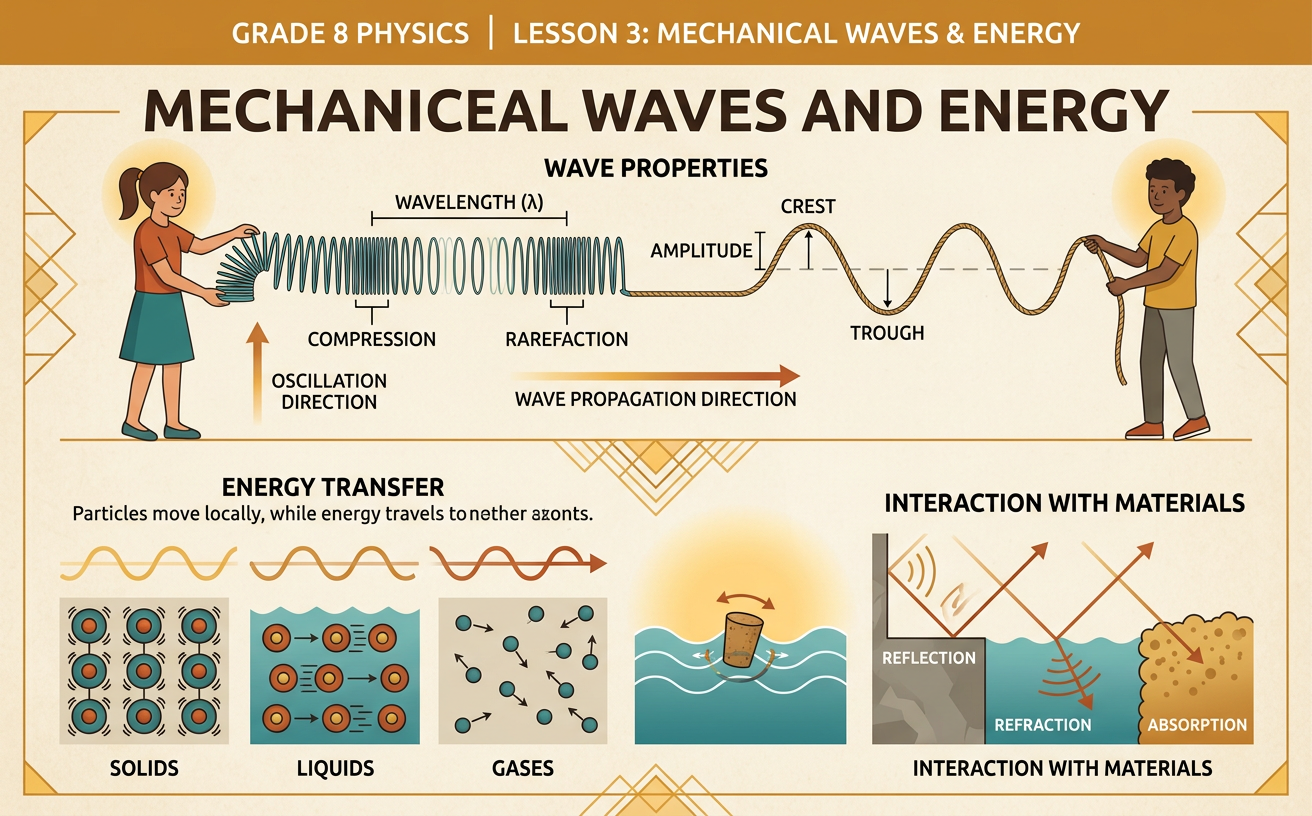
Illustrations are auto-generated and may be placeholders. They can be refreshed to match the narration.
Waves Transfer Energy
A mechanical wave is a disturbance that transfers energy through matter. The matter, called the medium, may be a solid, liquid, or gas. As the wave passes, particles of the medium vibrate around their resting positions. They transfer energy to neighboring particles, but they do not travel along with the wave over long distances. For example, when one end of a rope is shaken, a pulse travels toward the other end. Each small section of rope moves mainly up and down while the pulse and its energy move forward. Sound works similarly: vibrating air particles pass energy to nearby particles. Mechanical waves cannot travel through empty space because no particles are available to transfer the energy.
Amplitude and Energy
Amplitude is the greatest displacement of a particle from its resting position. It measures how far the medium is disturbed. For two similar mechanical waves traveling through the same medium, the wave with greater amplitude transfers more energy. In many wave models, energy is proportional to the square of amplitude. This means that doubling the amplitude produces about four times as much energy when other conditions stay the same. For example, gently shaking a rope creates a small-amplitude wave, while shaking it farther up and down creates a large-amplitude wave that carries more energy. In sound waves, greater amplitude usually produces a louder sound. Amplitude is measured from the resting position to a crest or to a trough, not from crest to trough.
Wavelength and Frequency
Wavelength is the distance between matching points on neighboring waves, such as crest to crest. Frequency is the number of complete wave cycles that pass a point each second, measured in hertz. Wave speed, frequency, and wavelength are related by the equation v = fλ, where v is speed, f is frequency, and λ is wavelength. In the same medium, wave speed is usually constant, so increasing frequency decreases wavelength. For example, suppose waves travel along a rope at 4 meters per second. If the frequency is 2 hertz, the wavelength is 4 divided by 2, or 2 meters. If the frequency increases to 4 hertz while speed remains 4 meters per second, the wavelength decreases to 1 meter. More crests then pass each second.
Reflection and Absorption
When a wave reaches a boundary, its energy may be reflected, absorbed, or both. Reflection occurs when a wave changes direction and travels back into the original medium. An echo is a reflected sound wave returning from a hard wall or cliff. Absorption occurs when a material takes in wave energy. The absorbed energy is usually changed into thermal energy through small, disorganized particle motions. Soft, porous materials such as carpet or acoustic foam absorb more sound than smooth, rigid surfaces do. For example, an empty gym produces strong echoes because its hard walls reflect much of the sound. Adding curtains and padded panels absorbs more sound, making the echoes weaker. Greater absorption leaves less wave energy available for reflection or transmission.
Transmission Through Materials
Transmission occurs when wave energy passes through a material or crosses into a new medium. At a boundary, an incoming wave is often divided: some energy is reflected, some is absorbed, and some is transmitted. The amounts depend on the materials and the wave’s frequency. When a wave enters a different medium, its speed and wavelength may change. Its frequency remains the same because the source continues producing vibrations at the same rate. For example, sound striking a glass window causes the glass particles to vibrate. Some sound reflects back into the room, some energy is absorbed by the glass, and some travels through the glass and enters the air outside. Thick or specially layered windows reduce transmission by reflecting and absorbing more sound energy.
Modeling Wave Behavior
A wave model uses drawings, arrows, measurements, and equations to represent and predict wave behavior. Arrow direction can show where energy travels, while arrow width can represent the amount of energy. A useful model must account for all incoming energy. For example, imagine that a sound wave carrying 100 energy units strikes a wall panel. Measurements show that 35 units are reflected, 45 units are absorbed, and 20 units are transmitted. The model satisfies energy conservation because 35 + 45 + 20 = 100. Students can compare models for foam, wood, and metal panels to predict which material best reduces transmitted sound. A model can be revised when measurements disagree with predictions, such as when a different sound frequency changes the percentages reflected, absorbed, and transmitted.