
Mechanical Waves and Sound
Students investigate wave properties and use mathematical models to connect wavelength, frequency, speed, amplitude, and sound behavior.
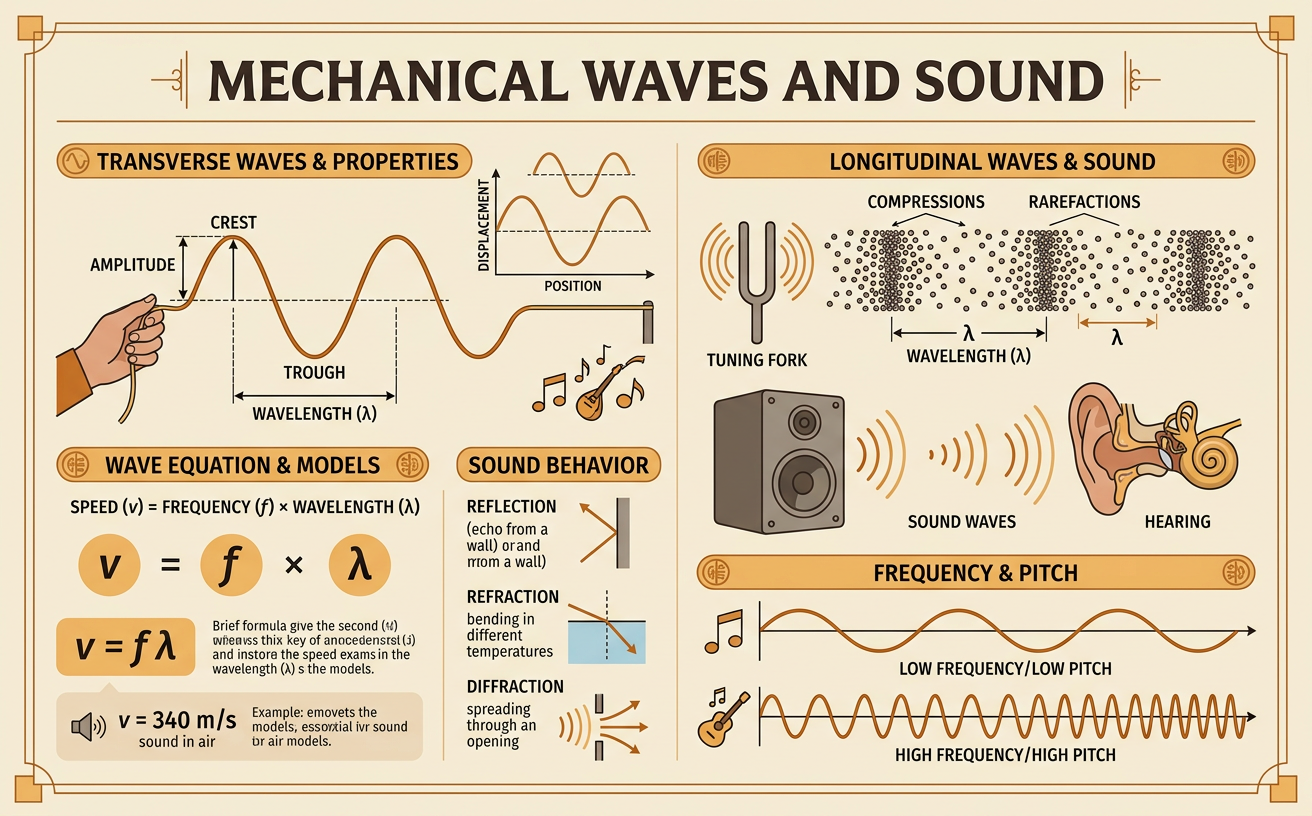
Illustrations are auto-generated and may be placeholders. They can be refreshed to match the narration.
Types of Mechanical Waves
A mechanical wave is a disturbance that transfers energy through a medium without carrying the medium along with it overall. The medium may be a solid, liquid, or gas. Mechanical waves cannot travel through a vacuum because they require particles that interact. In a transverse wave, particles move perpendicular to the direction the wave travels. A wave sent along a stretched rope is a transverse wave: the rope moves up and down while the disturbance moves sideways. In a longitudinal wave, particles move parallel to the wave’s direction. Compressing one end of a spring creates crowded regions called compressions and spread-out regions called rarefactions. Sound in air is longitudinal because air molecules vibrate back and forth as sound energy travels forward.
Amplitude, Wavelength, and Frequency
Wave properties describe both the shape and timing of a wave. Amplitude is the maximum displacement from the equilibrium position. For a water wave, it is measured vertically from the undisturbed water level to a crest or trough. Greater amplitude generally means that the wave carries more energy. Wavelength, represented by λ, is the distance between matching points on neighboring cycles, such as crest to crest. Frequency, represented by f, is the number of complete cycles passing a point each second and is measured in hertz. One hertz equals one cycle per second. For example, if 12 crests pass a buoy in 3 seconds, the frequency is 4 hertz. If the wave speed stays constant, increasing frequency produces a shorter wavelength.
The Wave-Speed Equation
Wave speed depends on how far one cycle extends and how many cycles pass each second. The mathematical relationship is v = fλ, where v is wave speed, f is frequency, and λ is wavelength. The units also support the equation: hertz means cycles per second, and multiplying by meters per cycle gives meters per second. Suppose a wave has a frequency of 5 hertz and a wavelength of 2 meters. Its speed is v = 5 × 2 = 10 meters per second. The equation can also be rearranged as f = v/λ or λ = v/f. In one unchanged medium, wave speed is usually fixed by the medium’s properties. Therefore, if frequency increases, wavelength must decrease in order for their product to remain constant.
Reflection and Interference
Reflection occurs when a wave reaches a boundary and travels back into its original medium. A sound echo is a reflected sound wave, while a pulse returning along a rope is a reflected transverse wave. Interference occurs when two or more waves overlap. According to the principle of superposition, the displacement at each point equals the sum of the individual wave displacements. When two crests meet, their amplitudes add and create constructive interference. When a crest meets an equal trough, their displacements cancel temporarily, producing complete destructive interference. For example, two identical upward rope pulses, each with an amplitude of 3 centimeters, briefly form a 6-centimeter pulse when they overlap. After interference, the original pulses continue traveling with their original shapes unless energy has been lost to the medium.
Resonance and Standing Waves
Every vibrating system has one or more natural frequencies. Resonance occurs when a repeated force drives a system at one of those frequencies, causing a large-amplitude vibration. Pushing a playground swing in rhythm with its motion is a familiar example. When waves of the same frequency and amplitude travel in opposite directions, their interference can form a standing wave. Points that remain still are nodes, while points with maximum vibration are antinodes. On a string fixed at both ends, the fundamental standing wave has nodes at the ends and one antinode in the center. The string length L equals half a wavelength, so λ = 2L. A guitar string resonates at specific frequencies determined by its length, tension, and mass per unit length, producing a fundamental tone and higher harmonics.
Physics of Sound
Sound is a longitudinal mechanical wave produced by a vibrating source. In air, it travels as alternating compressions and rarefactions. Frequency primarily determines perceived pitch: a 440-hertz tuning fork produces a higher pitch than a 220-hertz fork. Greater pressure amplitude is generally perceived as greater loudness, although human hearing sensitivity also depends on frequency. At room temperature, sound travels through air at about 343 meters per second, but its speed differs in other media and temperatures. Sound science also shaped communication technologies under specific historical circumstances. During the nineteenth century, growing cities, industries, and long-distance business created demand for rapid communication. The telephone converted sound into electrical signals that could travel farther than sound waves in air, then converted the signals back into sound. This development changed how people communicated across distance.