
Mechanical Waves and Sound
Students relate wavelength, frequency, amplitude, and wave speed while applying wave behavior to sound and other mechanical waves.
Illustrations are auto-generated and may be placeholders. They can be refreshed to match the narration.
Parts of a Wave
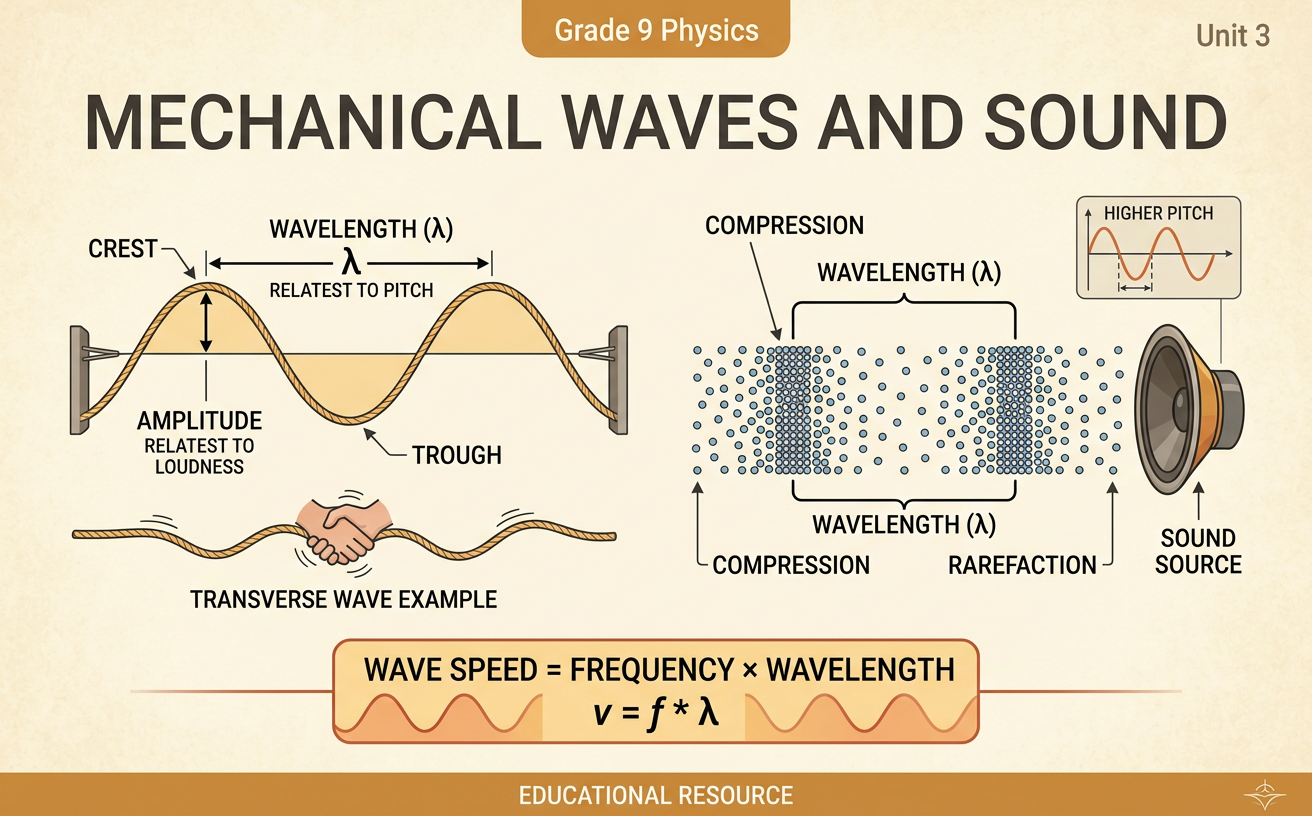
A mechanical wave is a disturbance that transfers energy through matter without carrying the matter along with it overall. In a transverse wave, particles of the medium move perpendicular to the direction the wave travels. The highest points are crests, and the lowest points are troughs. The equilibrium position is the undisturbed level of the medium. In a longitudinal wave, particles move parallel to the wave’s direction, producing compressions and rarefactions. For example, shaking one end of a stretched rope up and down creates crests and troughs that travel along the rope. Each section of rope moves mostly up and down rather than traveling to the far end. Both transverse and longitudinal waves can be described using wavelength, frequency, amplitude, period, and wave speed.
Frequency and Period
Frequency is the number of complete wave cycles that pass a point each second. Its unit is the hertz, abbreviated Hz, where one hertz means one cycle per second. Period is the time required for one complete cycle, measured in seconds. Frequency and period are reciprocals: frequency equals one divided by period, and period equals one divided by frequency. If five crests pass a point in two seconds, the frequency is 2.5 Hz. The period is therefore one divided by 2.5, or 0.40 second. A greater frequency means that cycles occur more often and the period is shorter. The vibrating source determines a wave’s frequency. When a wave enters a different medium, its frequency usually remains unchanged because the source continues vibrating at the same rate.
Wavelength and Speed
Wavelength is the distance between matching points on consecutive cycles, such as crest to crest or compression to compression. It is represented by the Greek letter lambda and is measured in meters. Wave speed describes how quickly the disturbance travels through a medium. Frequency, wavelength, and speed are related by the equation wave speed equals frequency times wavelength. For example, a water wave with a frequency of 2.0 Hz and a wavelength of 3.0 meters travels at 6.0 meters per second. In a given medium, increasing frequency produces a shorter wavelength if wave speed remains constant. When a wave enters another medium, its speed may change. Because its frequency is set by the source, its wavelength changes with the speed. Thus, speed and wavelength depend on the medium, while frequency generally does not change at a boundary.
Amplitude and Energy
Amplitude is the maximum displacement of a medium’s particles from their equilibrium position. On a transverse wave diagram, amplitude is measured vertically from the equilibrium line to a crest or trough, not from crest to trough. In a longitudinal wave, greater amplitude appears as a larger change in pressure or particle density between compressions and rarefactions. Amplitude is related to the energy carried by a wave. For many waves traveling in the same medium, energy increases approximately with the square of amplitude. Doubling the amplitude can therefore carry about four times as much energy. For example, moving the end of a rope farther up and down produces a wave with taller crests and more energy. Changing amplitude does not by itself change the wave’s frequency, wavelength, or speed.
Sound Waves
Sound is a mechanical, usually longitudinal wave produced by a vibrating object. As the vibration pushes and pulls nearby particles, regions of high pressure called compressions alternate with low-pressure regions called rarefactions. These pressure changes travel through the medium, while individual particles vibrate back and forth around equilibrium positions. Sound cannot travel through a vacuum because no particles are present to pass along the disturbance. Its speed depends on the medium and temperature. At about 20 degrees Celsius, sound travels through air at approximately 343 meters per second and generally travels faster in liquids and solids. Frequency determines perceived pitch, while amplitude is related to perceived loudness. For example, a tuning fork vibrating 440 times each second produces a 440 Hz sound. Striking it harder increases amplitude and loudness but does not significantly change its pitch.
Wave Calculations
Wave problems can be solved using the relationship v equals f times lambda. First identify the known quantities and units, then rearrange the equation for the unknown. Suppose a 440 Hz sound wave travels through air at 343 meters per second. Its wavelength equals speed divided by frequency, so lambda equals 343 divided by 440, or about 0.78 meter. If the same frequency travels through water at 1,480 meters per second, its wavelength is about 3.36 meters. This comparison supports the claim that a greater wave speed produces a greater wavelength when frequency stays constant. To find frequency, use f equals v divided by lambda. To find speed, multiply frequency by wavelength. Always check units: hertz means cycles per second, and multiplying hertz by meters per cycle gives meters per second. A reasonable answer should also match the expected relationship among the variables.