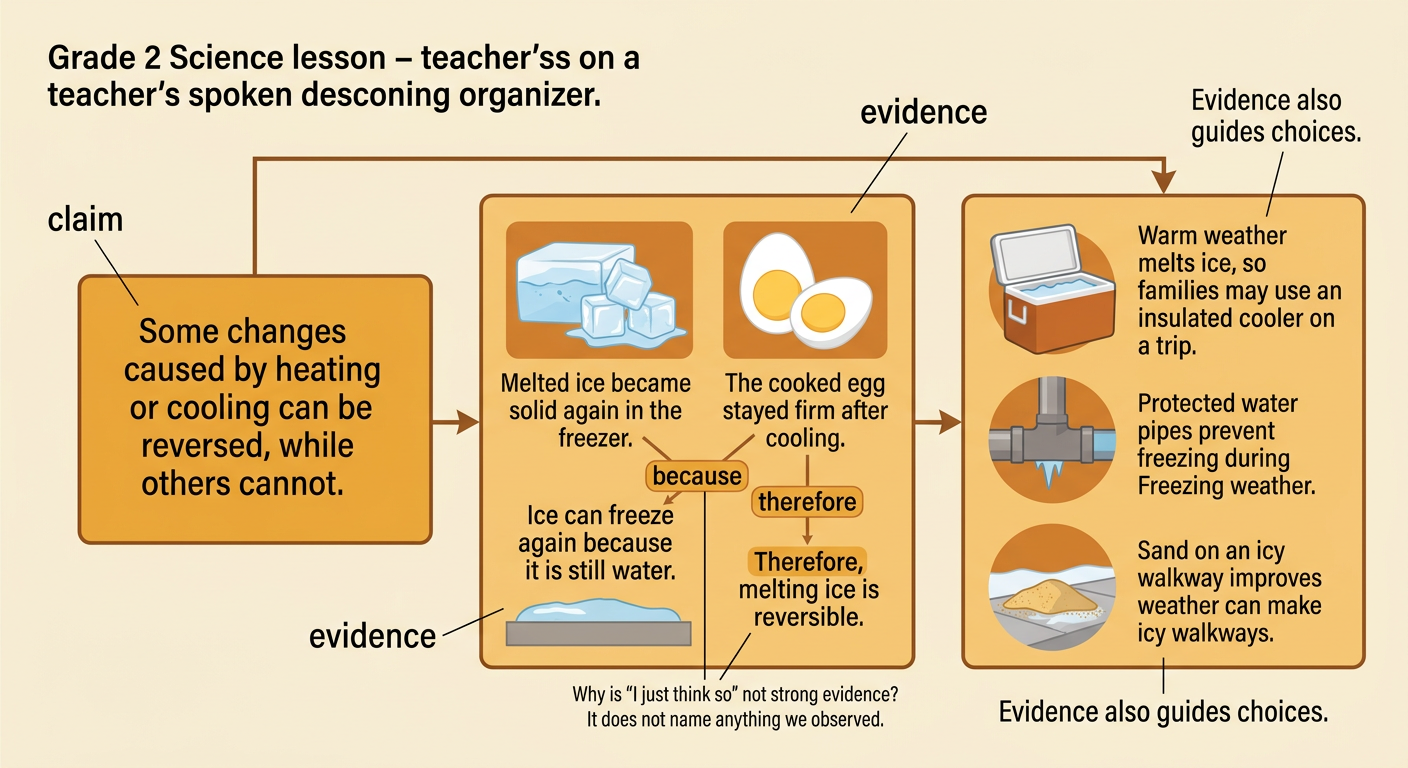
Melt, Freeze, or Change Forever?
Students observe how heating and cooling change materials and use evidence to decide whether each change can be reversed.
Illustrations are auto-generated and may be placeholders. They can be refreshed to match the narration.
Notice Changes in Everyday Materials
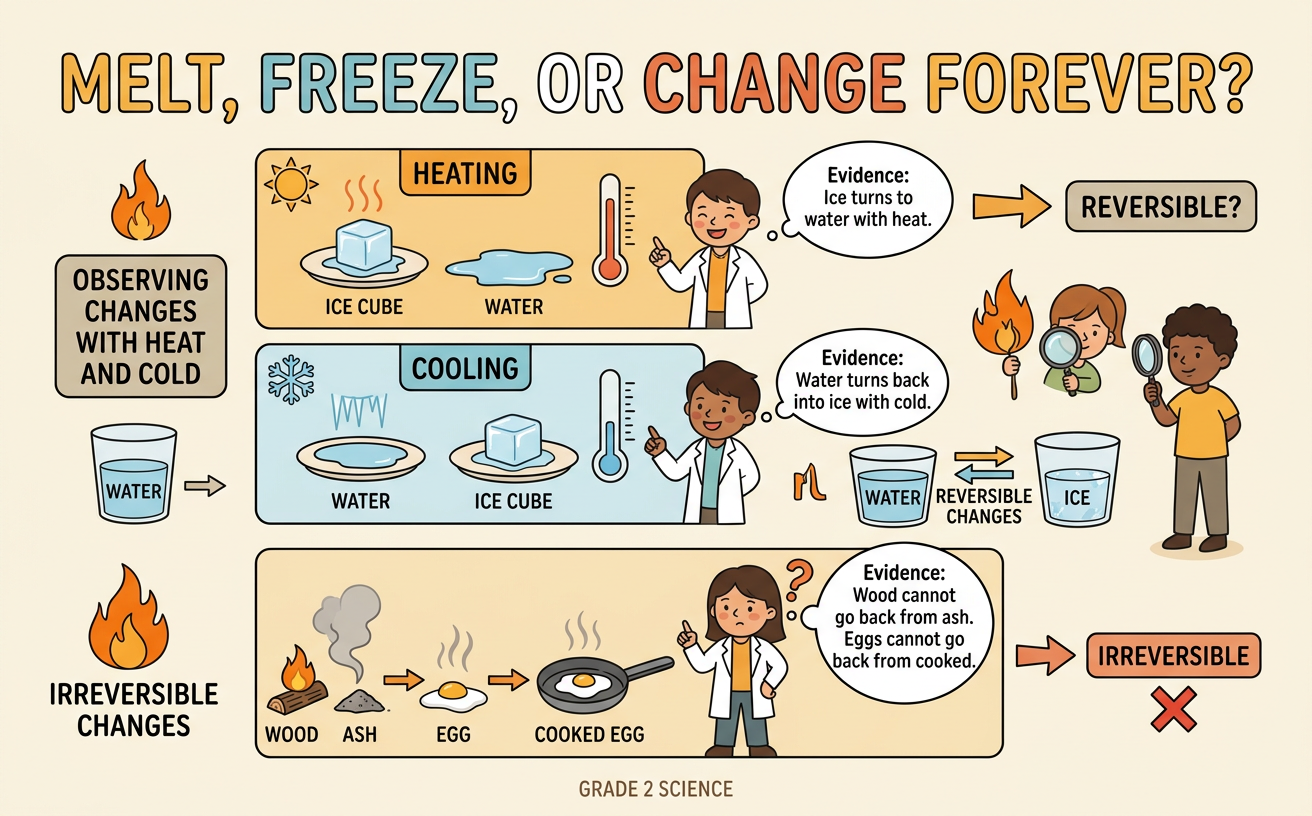
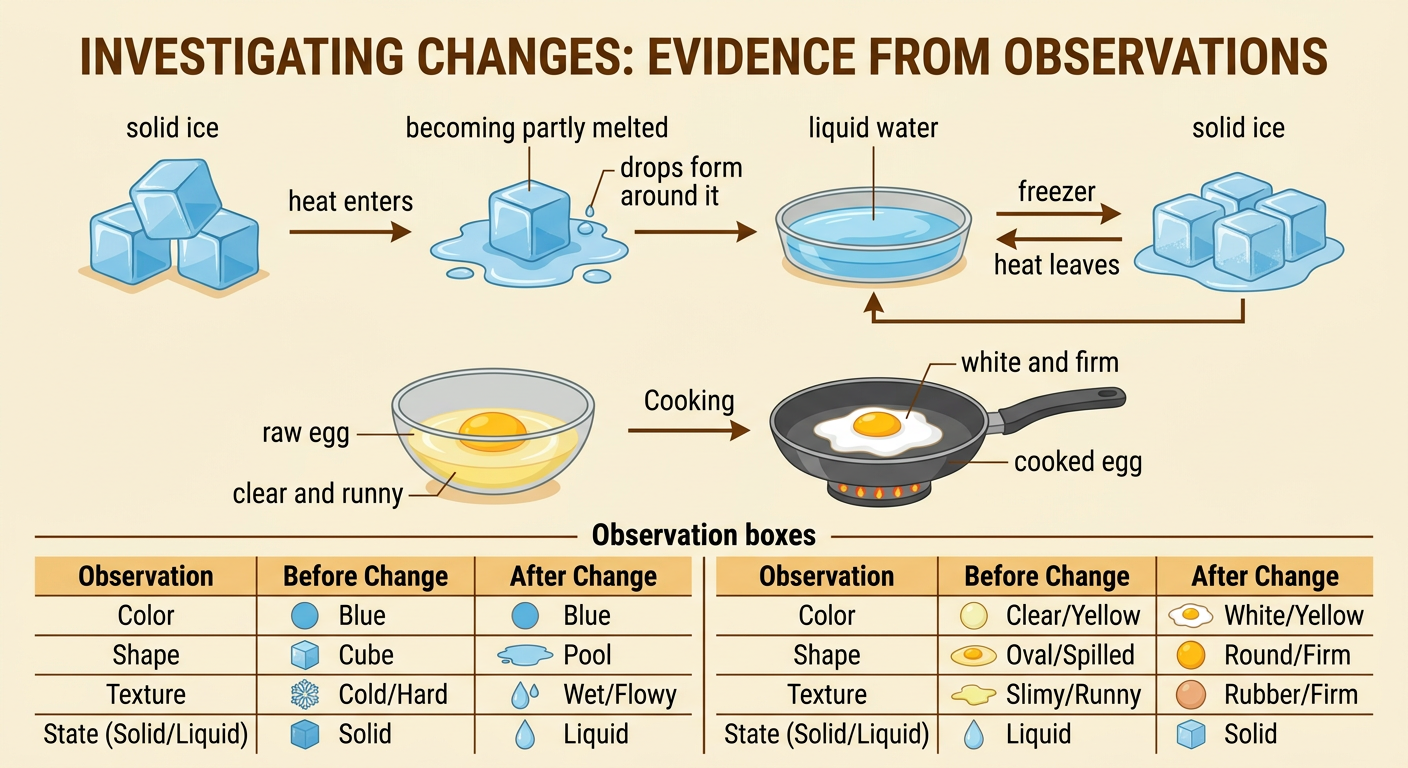
Materials can change when they are heated or cooled. Think about an ice cube left on a plate. Heat from the warmer air moves into the ice, so the solid ice melts into liquid water. If the water is placed in a freezer, it can become solid ice again. Some changes are different. When bread is heated in a toaster, it becomes brown and crisp. Cooling the toast does not turn it back into soft bread. People make choices based on these changes and their environment. On a hot day, people may keep food in a cooler so it stays cold and safe. In a cold place, people may heat homes and wear warm clothing. Careful observations help us describe what changed and decide whether the change can be reversed.
Predict What Heating or Cooling Will Do
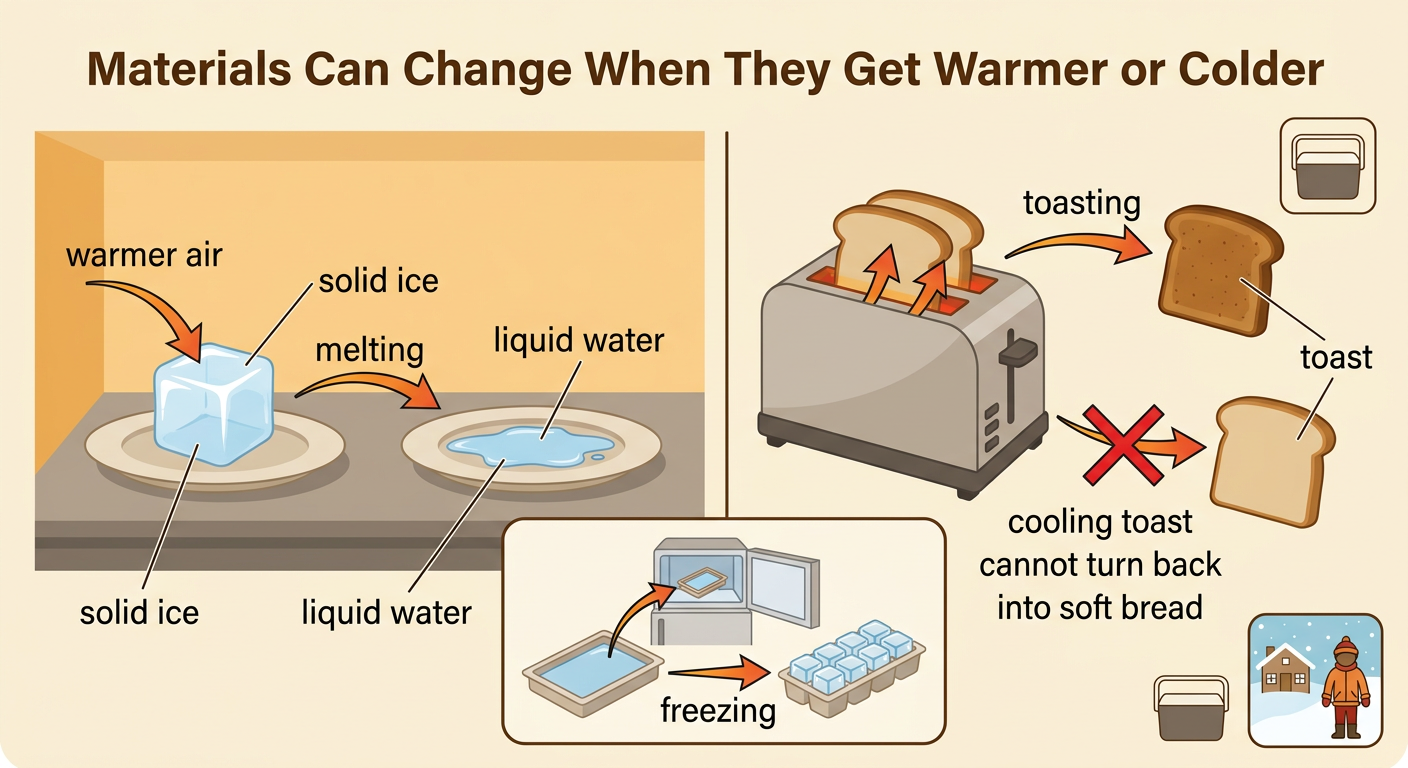
A prediction tells what you think will happen before a test. It should include a reason based on what you already know. Suppose you have an ice cube, a crayon, a cup of water, and a raw egg. You might predict that ice will melt when heated because you have seen ice melt on a warm day. You might predict that water will freeze when cooled in a freezer. A crayon may soften or melt with safe, gentle heating and become solid again when cooled. A raw egg becomes firm when cooked, but cooling it will not make it raw again. Record each prediction before observing the change. Use a sentence such as, “I predict the water will freeze because water becomes solid when it gets cold.” Adults must handle hot equipment during every investigation.
Observe Melting and Other Changes
During an investigation, observe with your eyes and record facts instead of guesses. Place an ice cube in a clear cup and watch it at regular times. At first, the ice is solid and keeps its shape. As it gains heat from the room, drops of liquid water form. After more time, the ice may melt completely. Then an adult can place the water in a freezer. When enough heat leaves the water, it freezes into solid ice. Compare this with an egg that an adult cooks. The clear and runny egg white becomes white and firm. Letting the cooked egg cool does not make it raw again. These observations are evidence. Record the material’s color, shape, texture, and state before and after heating or cooling. Never touch hot objects or taste investigation materials.
Sort Reversible and Irreversible Changes
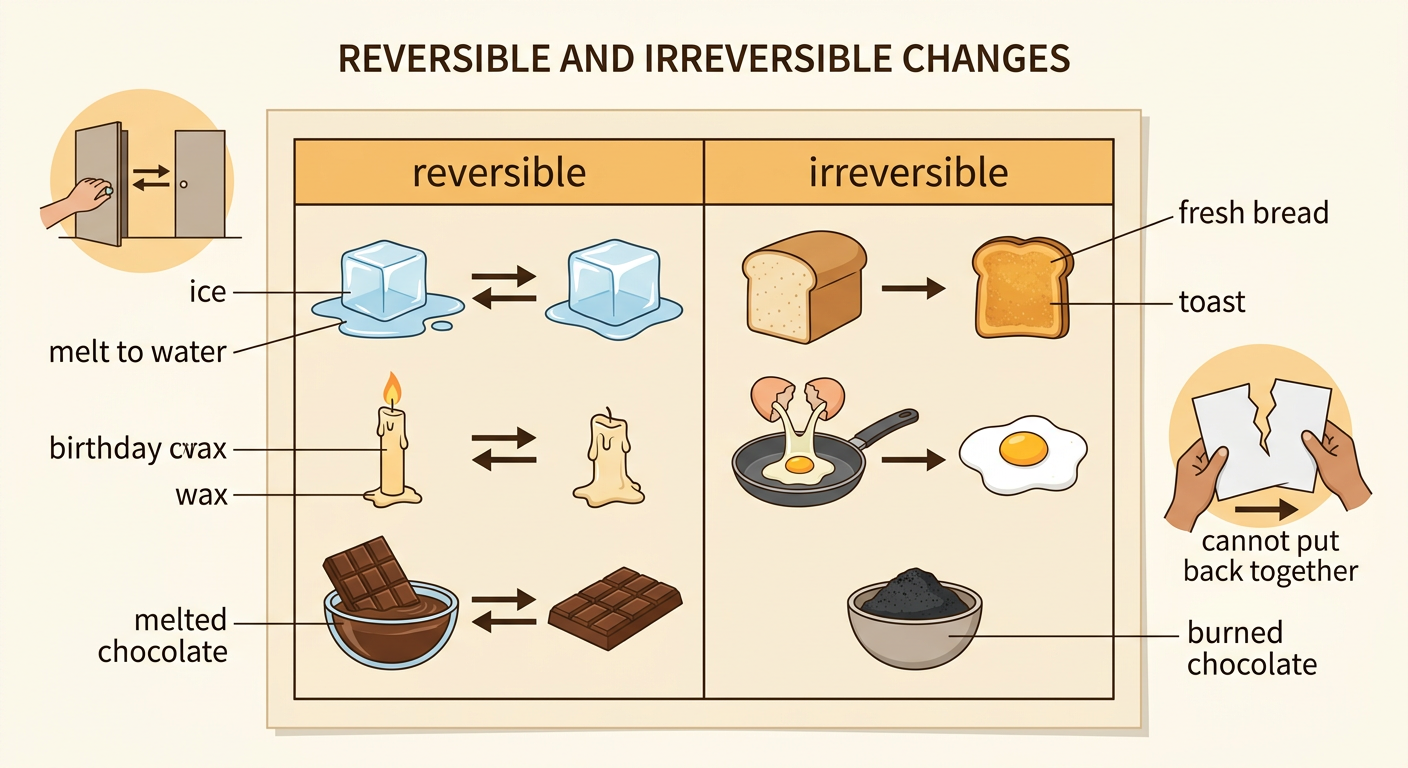
A reversible change can be undone so that the material returns to about the same form. Melting and freezing water are reversible changes. A melted ice pop can freeze again, although its shape may be different. Melted wax can also harden when it cools. An irreversible change cannot be undone by simply heating or cooling the material. Toast cannot become soft bread again, and a cooked egg cannot become raw. Sorting changes helps us find patterns. Make two groups labeled “reversible” and “irreversible.” Place each example in a group, then explain the evidence for your choice. Be careful with tricky examples. Melted chocolate can harden again when cooled, but burned chocolate has formed changed material and cannot be restored by cooling. The result depends on what happened, not only on whether heat was added.
Graph the Class Evidence
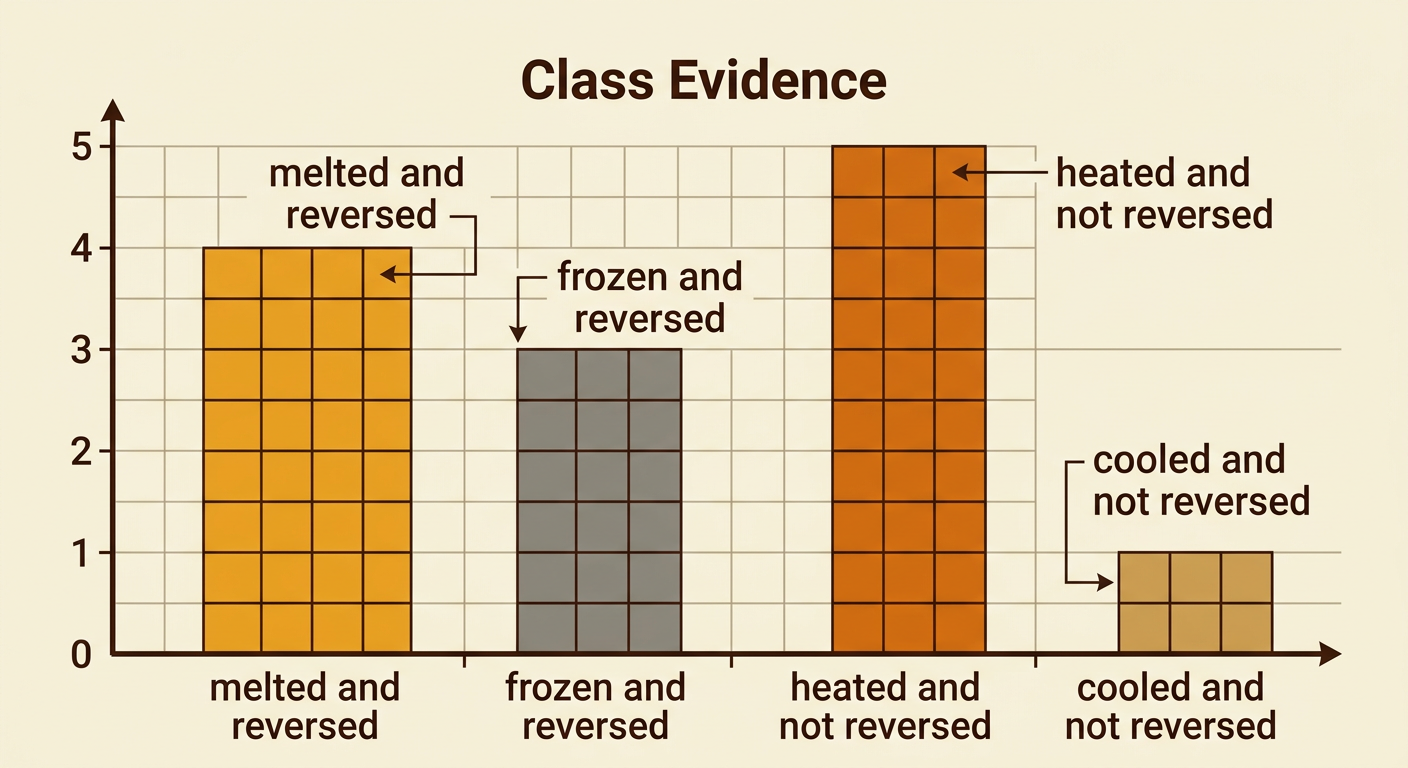
A graph helps the class compare evidence. First, test or discuss several examples and sort them into four categories: melted and reversed, frozen and reversed, heated and not reversed, and cooled and not reversed. Count the examples in each category. Then make a bar graph in which each square represents one example. If the class records four melted-and-reversed examples, color four squares above that category. Begin every bar at zero and use bars of equal width. Add a title and label both sides of the graph. After the graph is complete, ask questions about the data. Which category has the most examples? Which has the fewest? How many more heated-and-not-reversed examples are there than cooled-and-not-reversed examples? The graph displays observations, but students must use investigation notes to explain why each example belongs in its category.
Make an Evidence-Based Claim
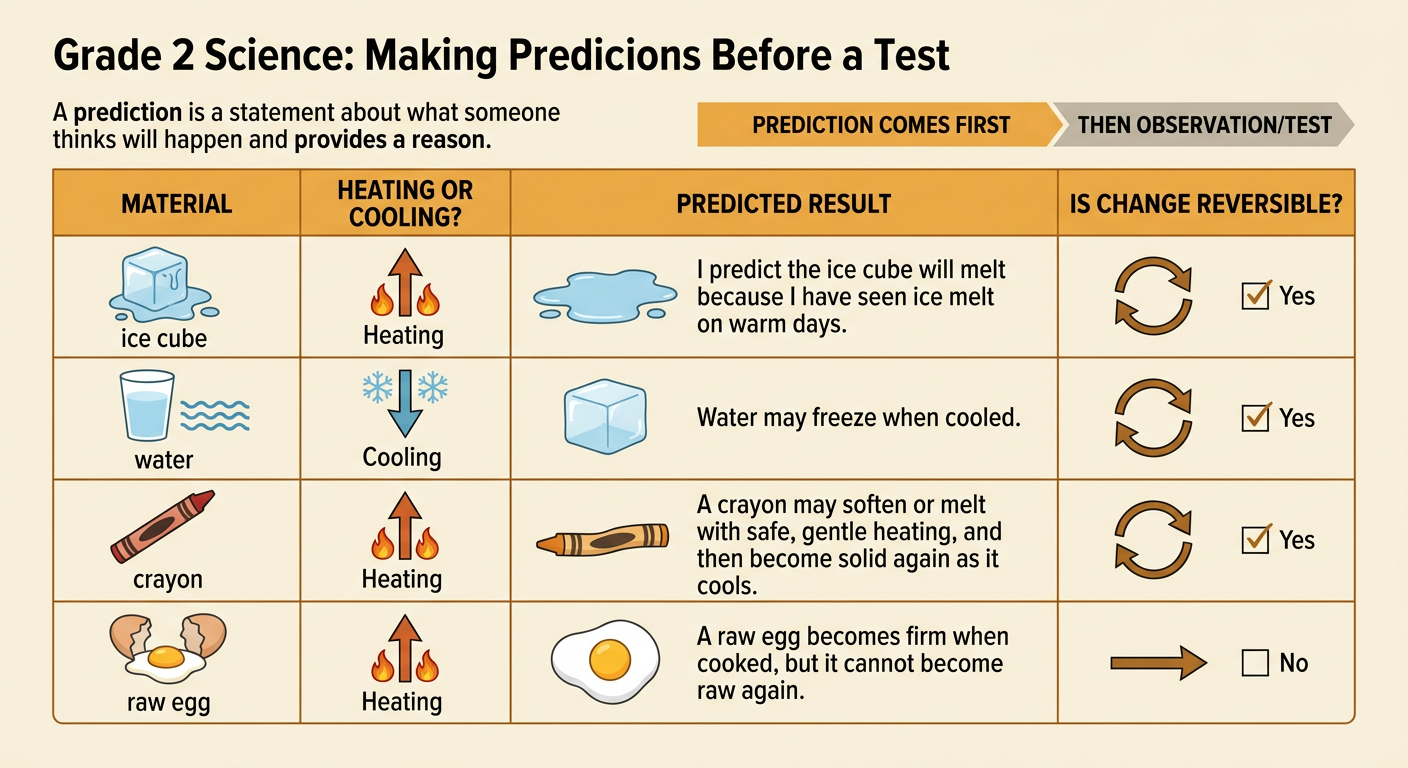
An evidence-based claim states what you think and supports it with observations. Begin with a clear opinion: “I think some changes caused by heating or cooling can be reversed, while others cannot.” Next, give reasons and evidence. You might write, “Melted ice became solid again in the freezer, so that change was reversible. The cooked egg stayed firm after it cooled, so that change was not reversible.” Use linking words such as because, also, and therefore. End with a concluding sentence that restates your opinion. You can also connect the evidence to people’s choices. Because warm weather melts ice, a family may use an insulated cooler to keep food cold during a trip. Because freezing weather can turn water into ice, people may protect water pipes and spread sand on icy walkways. Strong claims match the recorded observations and graph.