
Middle School Science Synthesis: Connecting Matter, Energy, and Systems
Students prepare for Grade 8 science by synthesizing prior knowledge of matter, forces, ecosystems, and Earth systems to explain how a change in one part of a system can affect the whole system.
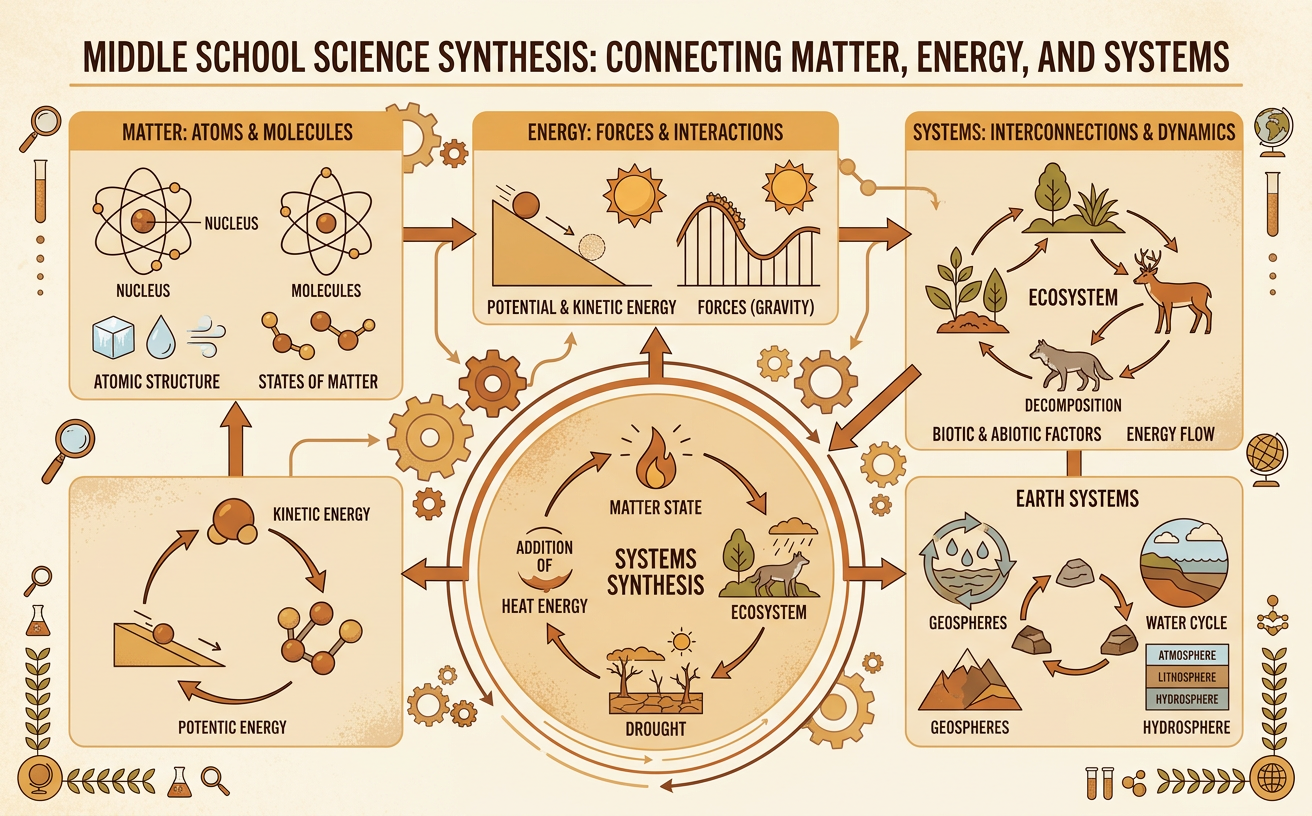
Illustrations are auto-generated and may be placeholders. They can be refreshed to match the narration.
Matter and Chemical Change
Matter is made of atoms, and its observable properties help scientists identify substances and detect chemical reactions. Evidence of chemical change may include gas production, formation of a solid, a lasting color change, or a temperature change that is not caused by external heating. For example, when baking soda and vinegar react in a sealed container, carbon dioxide gas forms and the temperature may decrease. The substances after the reaction have different properties from the starting substances. However, the total number of each type of atom remains the same because atoms are rearranged rather than created or destroyed. Comparing measurements and observations before and after a reaction helps distinguish chemical change from physical change, such as melting, in which the substance keeps its chemical identity.
Forces, Motion, and Energy Transfer
A force is a push or pull that can change an object's motion. When the forces on an object are unbalanced, the object accelerates by changing speed, direction, or both. Energy is transferred when a force acts through a distance. For example, a student pushing a cart transfers energy from chemical energy stored in the body to the cart's kinetic energy. A stronger push over the same distance generally transfers more energy. If the cart then collides with a foam block, some kinetic energy transfers to the block, while some becomes thermal energy and sound. Energy is not destroyed during these changes. A system model can track where energy enters, where it moves, and which objects store or release it.
Energy and Matter in Ecosystems
In ecosystems, matter cycles while energy flows in one main direction. Plants capture light energy and use it to make energy-rich sugars from carbon dioxide and water. Consumers obtain matter and energy by eating plants or other consumers. Decomposers break down wastes and dead organisms, returning nutrients to soil and water. At each transfer, organisms use some chemical energy for life processes, and much of that energy eventually transfers to the environment as thermal energy. For example, fertilizer runoff can add excess nitrogen to a pond. Algae may grow rapidly, and decomposers then use oxygen while breaking down dead algae. Low oxygen can harm fish. This chain of effects shows how changing one matter input can alter energy use, populations, and the stability of an ecosystem.
Interacting Earth Systems
Earth functions through interactions among the geosphere, hydrosphere, atmosphere, and biosphere. Energy from the Sun drives weather and the water cycle, while energy inside Earth drives processes such as plate movement and volcanism. Water, wind, ice, and organisms weather rock and move sediment. For example, heavy rain on a steep hillside can saturate soil and trigger a landslide. Removing vegetation for construction may increase the risk because roots no longer hold as much soil in place, and paved surfaces can concentrate runoff. The moving sediment may enter a stream, making the water cloudy and changing aquatic habitats downstream. Scientists use maps, rainfall records, slope measurements, and land-use information to explain how natural processes and human decisions influence connected Earth systems.
Cross-Disciplinary Systems Model
A systems model identifies components, boundaries, inputs, outputs, interactions, and feedbacks. It can combine evidence about matter, energy, organisms, Earth processes, and human choices. Consider a forest watershed after a wildfire. Fire rearranges matter through combustion and transfers stored chemical energy to thermal and light energy. Loss of vegetation reduces food and shelter, while exposed soil erodes more easily during rain. Ash and sediment can enter streams and affect water quality for wildlife and nearby communities. A quantitative model might compare rainfall, sediment concentration, and vegetation cover before and after the fire. A geographic map can show which slopes, habitats, roads, and neighborhoods are most exposed. No model includes every detail, so scientists state assumptions and revise the model when new evidence becomes available.
Grade 8 Synthesis Check
To explain a system change, begin with a clear claim, support it with evidence from multiple sources, and use scientific reasoning to connect the evidence. Suppose a town removes an old dam. Water may move faster through the former reservoir area, stored sediment may travel downstream, and fish may regain access to upstream habitat. A strong explanation could compare before-and-after water-speed measurements, sediment data, fish counts, and maps of nearby communities. It should track matter, such as water and sediment, and describe energy changes associated with moving water. It should also consider both benefits and risks, including habitat recovery and temporary increases in cloudy water. Check that the explanation names the system boundary, identifies cause-and-effect links, uses quantities correctly, and notes limits or uncertainty in the available evidence.