
Mixtures, Solutions, and Separation Methods
Students distinguish mixtures from pure substances, compare homogeneous and heterogeneous mixtures, describe dissolving and concentration, and select physical methods for separating mixture components.
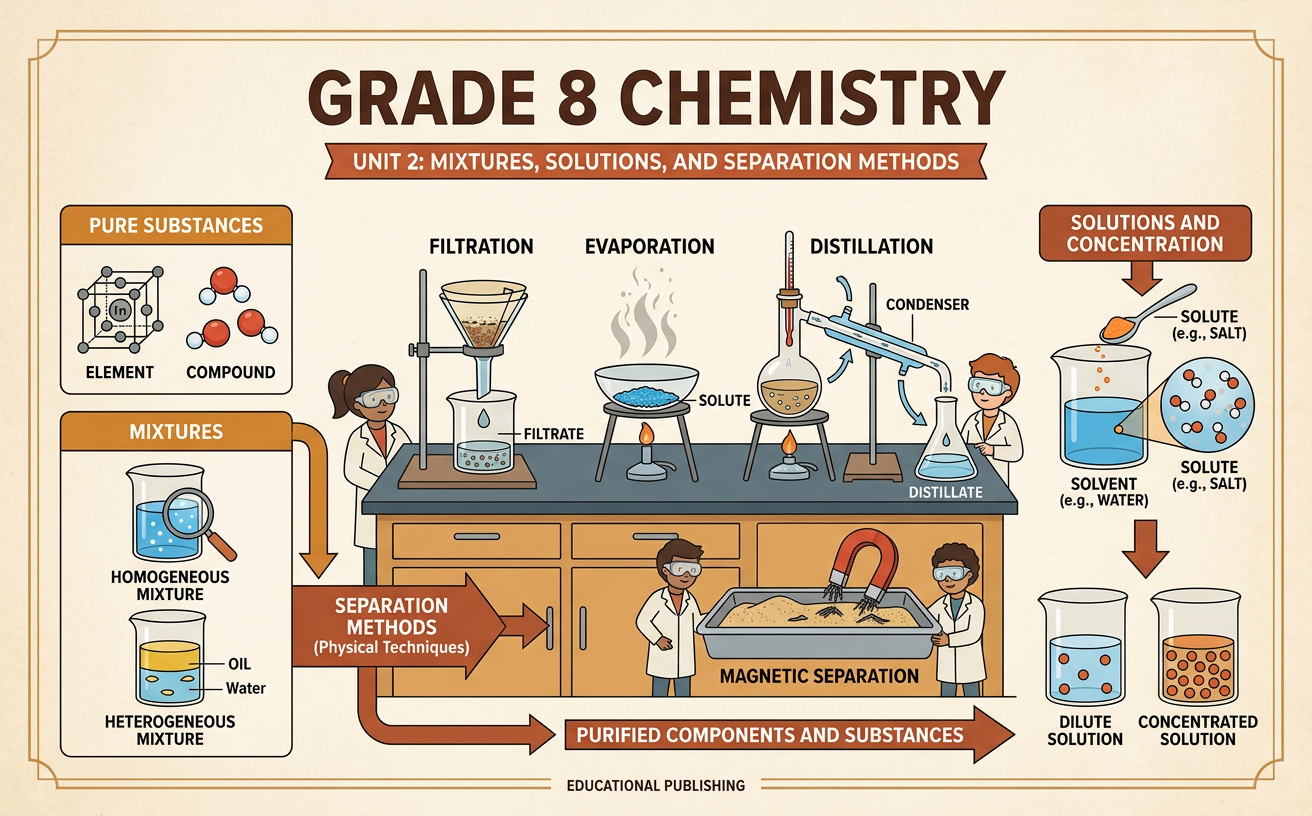
Illustrations are auto-generated and may be placeholders. They can be refreshed to match the narration.
Pure Substances and Mixtures
A pure substance contains only one element or one compound and has a consistent composition. A mixture contains two or more substances that are physically combined rather than chemically bonded. Each substance in a mixture keeps its own properties, so the components can often be separated by physical methods. For example, salt water is a mixture because the salt and water are not changed into a new substance. If the water evaporates, solid salt remains. In contrast, pure distilled water contains only water molecules. The proportions in a mixture can also vary. Lemonade may contain a little sugar or a great deal of sugar, but water always contains hydrogen and oxygen in the same fixed proportion.
Homogeneous and Heterogeneous Mixtures
A homogeneous mixture has an even composition throughout, so its different substances are not visibly separate. Solutions are homogeneous mixtures. Air, vinegar, and clear salt water are common examples. A heterogeneous mixture does not have the same composition in every part, and its components may be visible. Soil, vegetable soup, and oil mixed with water are heterogeneous mixtures. Particle size can help scientists classify mixtures. In a suspension, particles are large enough to settle over time, as muddy water does. In a colloid, smaller particles remain spread out and scatter light. Milk is a colloid because tiny droplets of fat are dispersed through water. Classifying a mixture helps determine which separation method will work best.
Dissolving and Solubility
In a solution, the solute is the substance being dissolved, and the solvent is the substance doing the dissolving. When sugar dissolves in water, sugar is the solute and water is the solvent. Dissolving spreads solute particles evenly among solvent particles, but it does not make the solute disappear or create a new substance. Solubility is the greatest amount of a solute that can dissolve in a certain amount of solvent at a particular temperature. A saturated solution cannot dissolve additional solute under those conditions. Temperature often affects solubility. More solid sugar can usually dissolve in hot water than in cold water. However, gases often become less soluble as temperature rises, which is why warm soda loses dissolved carbon dioxide more quickly.
Understanding Concentration
Concentration describes how much solute is present in a certain amount of solution. A concentrated solution contains relatively more solute, while a dilute solution contains relatively less. Concentration is not the same as saturation. A dilute solution can be saturated if the solute has very low solubility, and a concentrated solution can remain unsaturated if more solute could still dissolve. One simple way to compare concentration is to calculate solute mass divided by solution volume. For example, 10 grams of salt in 100 milliliters of solution has a concentration of 0.10 gram per milliliter. Adding water lowers the concentration without changing the amount of salt. Evaporating some water raises the concentration because the same salt remains in less solution.

Separating Mixtures
Mixtures can be separated by using differences in physical properties such as particle size, boiling point, density, solubility, or magnetism. Filtration separates an insoluble solid from a liquid, as when sand is removed from water with filter paper. Evaporation can recover dissolved salt from salt water. Distillation boils a liquid and then condenses its vapor, allowing substances with different boiling points to be separated. A magnet can remove iron filings from sand, while a separating funnel can divide liquids such as oil and water that do not mix. No single method works for every mixture. To separate iron filings, sand, and salt, a student could first use a magnet, dissolve the salt in water, filter out the sand, and finally evaporate the water.