
Model Addition and Subtraction
Students use objects, drawings, actions, and equations to represent joining and separating situations.

Illustrations are auto-generated and may be placeholders. They can be refreshed to match the narration.
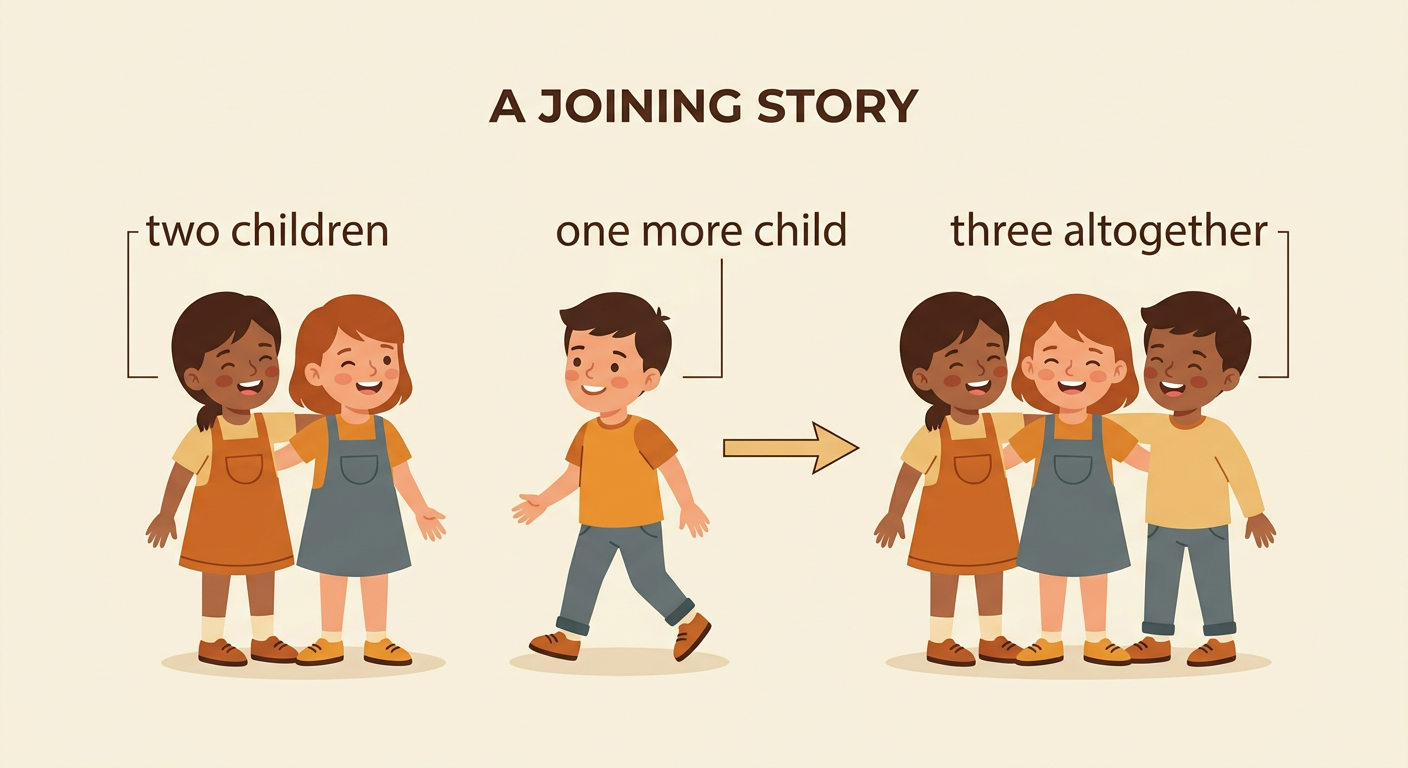
Act Out a Joining Story
A joining story tells about groups that come together. Listen for words such as comes, joins, or altogether. Act out this story: Two children are standing by a table. One more child joins them. How many children are at the table now? Ask two classmates to stand together. Then have one classmate walk over and join them. Count everyone in the new group: one, two, three. There are three children altogether. You can show the story with your fingers, too. Hold up two fingers on one hand and one finger on the other hand. Bring your hands together and count all the raised fingers. Acting out the story helps you see that joining groups is addition.
Model Addition
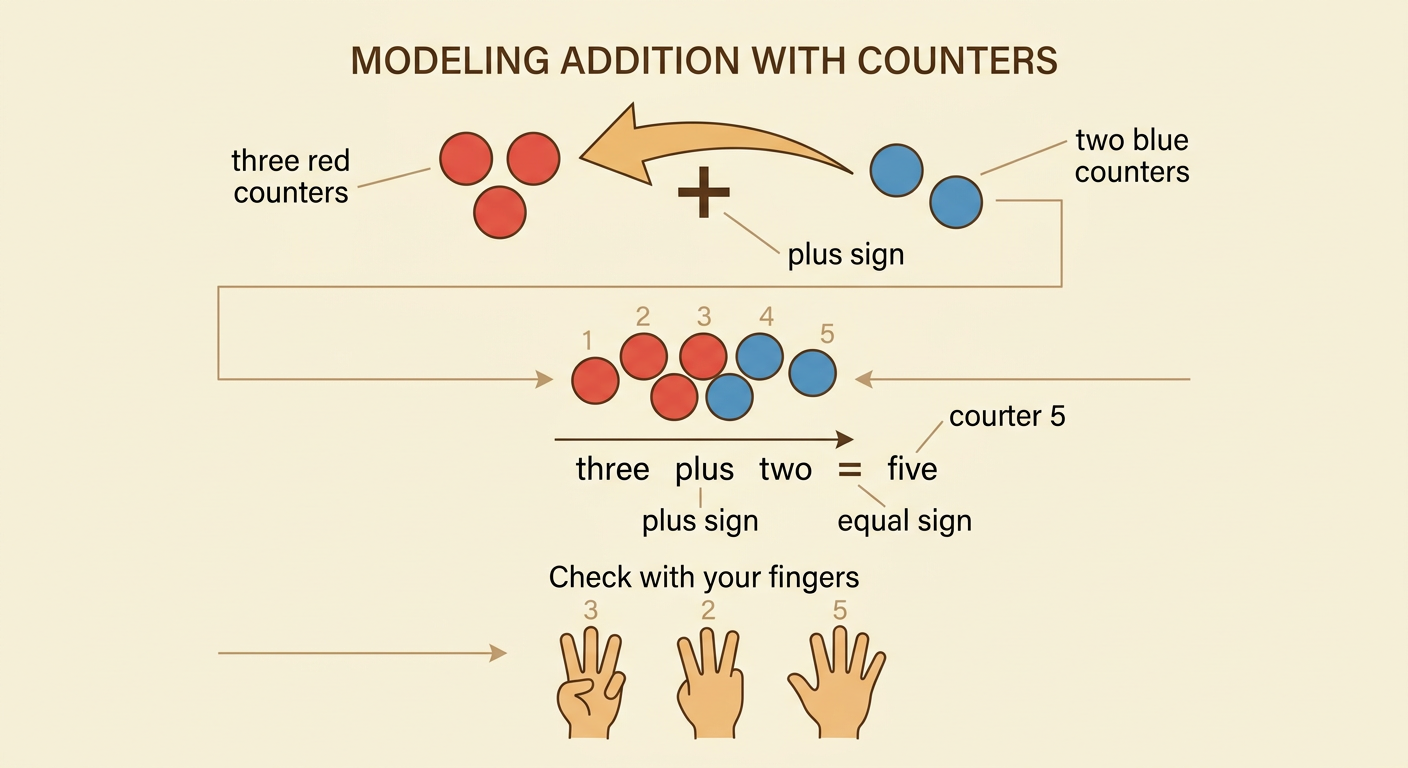
Addition can be modeled with small objects such as counters, cubes, or buttons. Make a group of three red counters. Next to it, make a group of two blue counters. Push the groups together because addition joins groups. Count all the counters: one, two, three, four, five. The model shows 3 + 2 = 5. The plus sign means to join or add. The equal sign means that both sides have the same value. Say the equation aloud: “Three plus two equals five.” You can also use five fingers to check your answer. Models make each part of an addition story easy to see: the first group, the group that joins, and the total number altogether.
Act Out a Separating Story
A separating story begins with a group and takes some away. Listen for words such as leaves, gives away, or takes away. Act out this story: Four children are playing in a line. One child leaves to get a book. How many children are still in the line? Ask four classmates to stand together. Have one classmate walk away. Count the children who remain: one, two, three. Three children are left. You can act it out with your fingers, too. Hold up four fingers, then put one finger down. Count the fingers that are still up. Separating one from four leaves three. Acting out the movement helps you understand that taking away is subtraction.
Model Subtraction
Subtraction can be modeled by starting with a group and removing part of it. Place five cubes in a row. Move two cubes away from the row. Count the cubes that remain: one, two, three. The model shows 5 − 2 = 3. The minus sign tells you to take away or subtract. The equal sign shows that the amount on the left has the same value as the number on the right. Say the equation aloud: “Five minus two equals three.” You can check with five fingers. Put down two fingers and count the three fingers still raised. A subtraction model shows the starting number, the part taken away, and the number left.
Draw and Explain
A drawing can show what happens in an addition or subtraction story. Try this story: Mia has two balloons. Her friend gives her three more balloons. Draw two circles for Mia’s balloons. Draw three more circles beside them. Count every circle: one, two, three, four, five. Write 2 + 3 = 5 under your drawing. Then explain your work: “I drew two balloons and three more balloons. I joined the groups and counted five balloons altogether.” For a separating story, you can draw the whole group and cross out the objects taken away. Your picture, equation, and words should tell the same story. Check that the number of objects in your drawing matches every number in your equation.