
Modeling Atoms, Elements, and Molecules
Students use particle models to distinguish atoms, elements, molecules, and compounds and to represent the atomic composition of simple substances.

Illustrations are auto-generated and may be placeholders. They can be refreshed to match the narration.
Matter at the Particle Scale
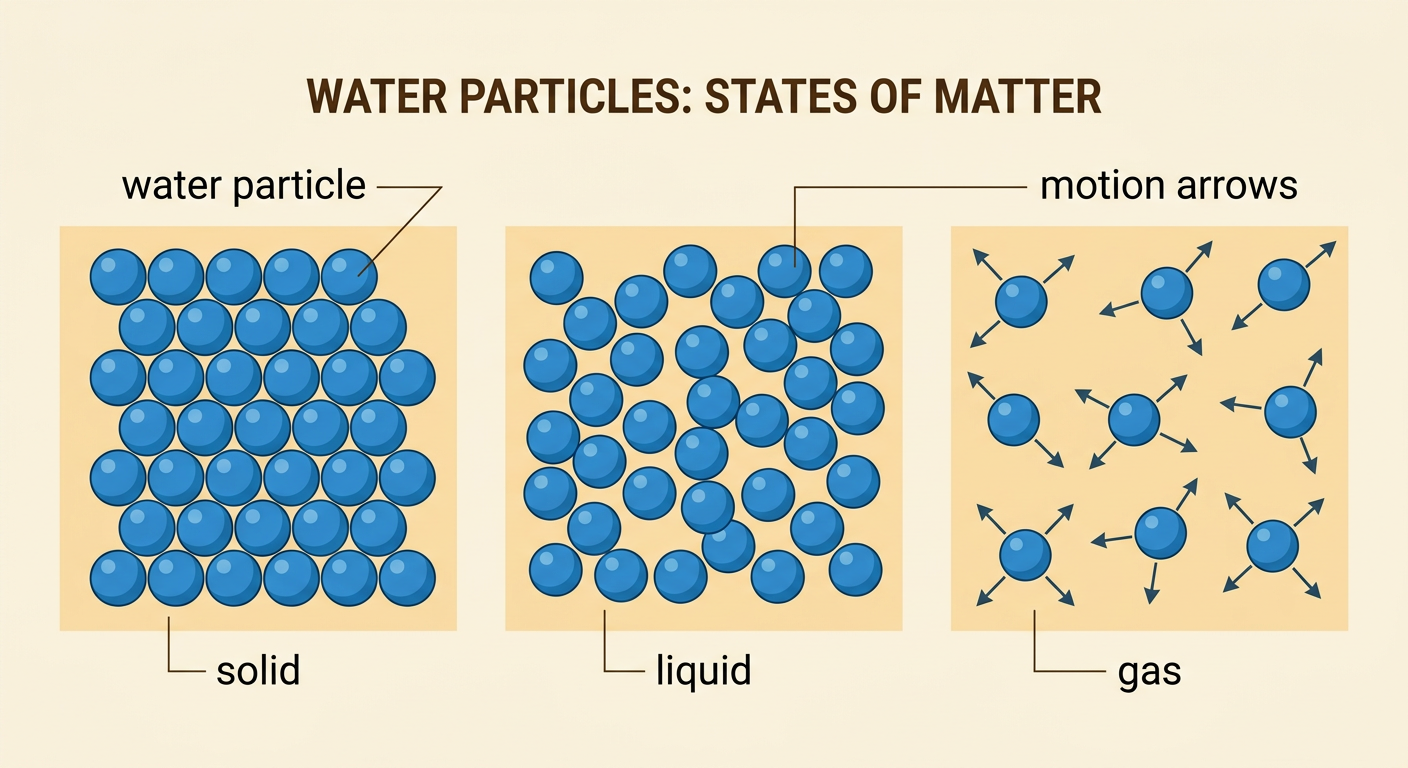
All matter is made of particles too small to see with ordinary microscopes. A particle model uses circles or spheres to represent these tiny pieces. The model is not a magnified photograph; it is a tool for explaining observations. In a solid, particles remain close together and vibrate around fixed positions. In a liquid, particles stay close but move past one another. In a gas, particles are much farther apart and move freely. For example, when liquid water becomes water vapor, the water particles do not disappear or turn into air. They spread out and move more freely. Scientific models of matter changed as new experiments provided evidence. Early thinkers described matter as continuous, but later measurements and discoveries supported atomic models. This history shows how new evidence can cause scientists to revise explanations while matter itself remains unchanged.
Atoms and Chemical Elements
An atom is the smallest unit of an element that keeps the chemical properties of that element. An element is a pure substance made of only one kind of atom. Each element has a name and a chemical symbol, such as H for hydrogen, O for oxygen, and C for carbon. The identity of an atom is determined by the number of protons in its nucleus. For example, every carbon atom has six protons, while every oxygen atom has eight. Particle models usually use a different color or label for each element, but atoms do not actually have those colors. The colors are a model convention that helps readers distinguish elements. John Dalton’s early atomic model pictured atoms as solid spheres. Later evidence about electrons and nuclei caused scientists to develop more detailed models, demonstrating how scientific explanations change when discoveries provide new evidence.

Molecules and Compounds
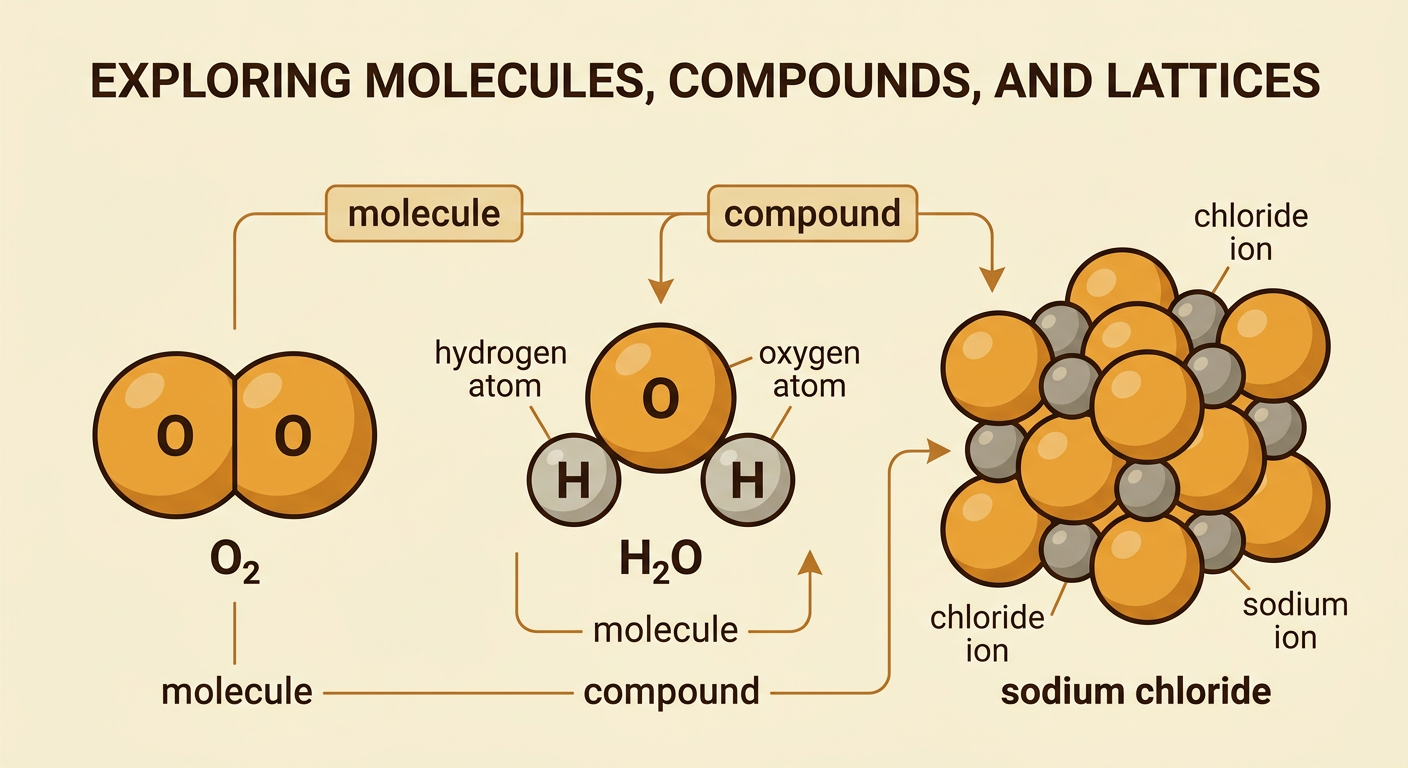
A molecule forms when two or more atoms are chemically bonded as a single group. The atoms may belong to the same element or to different elements. Oxygen gas, O2, consists of molecules containing two oxygen atoms, so it is a molecular element rather than a compound. A compound is a pure substance containing atoms of two or more different elements chemically combined in a fixed ratio. Water, H2O, is both a molecule and a compound because each water molecule contains two hydrogen atoms bonded to one oxygen atom. Carbon dioxide, CO2, contains one carbon atom and two oxygen atoms. Not all compounds exist as separate molecules. Sodium chloride forms an extended, repeating structure of sodium and chloride ions. Particle models should therefore show which atoms are bonded and whether the substance consists of separate groups or a repeating structure.
Building Particle Models
To build a particle model, begin by choosing a consistent symbol or color for each element. Use one sphere for each atom and connect spheres only when the atoms are chemically bonded. Then count the atoms and check their ratio. For a water molecule, use two identical hydrogen spheres and one oxygen sphere. Connect each hydrogen to the oxygen, producing one group with a 2-to-1 ratio. To model three water molecules, repeat that complete group three times rather than joining all nine atoms into one particle. Models can also represent extended structures. A model of solid sodium chloride should show an alternating, repeating arrangement instead of separate NaCl pairs. Include a key so readers can match each type of sphere to an element. Remember that sphere size, color, and spacing may be simplified unless the model specifically states that they represent actual relative features.

Reading Chemical Formulas
A chemical formula identifies the elements in a substance and shows their atom ratio. Element symbols begin with a capital letter, and a second letter, when present, is lowercase. A subscript applies only to the element symbol directly before it. In H2O, the 2 means that one water molecule has two hydrogen atoms; oxygen has no written subscript, so there is one oxygen atom. In CO2, there is one carbon atom and two oxygen atoms. A coefficient in front of a formula counts complete particles and multiplies every atom in the formula. For example, 3H2O represents three water molecules, containing six hydrogen atoms and three oxygen atoms in all. Subscripts and coefficients are not interchangeable. Changing H2O to H2O2 changes the substance from water to hydrogen peroxide, while placing a coefficient before H2O changes only the number of water molecules represented.

Check Your Model
A useful particle model must agree with both the written description and the chemical formula. First, use the key to identify every element. Next, count each type of atom and compare the counts with the formula. Check that bonded atoms are grouped correctly and that repeated molecules remain separate. Also decide whether the model shows an element, a molecular compound, or an extended structure. For example, a model labeled 2CO2 should contain two separate groups. Each group must have one carbon atom bonded to two oxygen atoms, giving a total of two carbon atoms and four oxygen atoms. A model showing two carbon atoms and only two oxygen atoms is incorrect because it does not match the subscripts and coefficient. Finally, state the model’s limits. Colors and sphere sizes may help identify atoms, but they may not represent actual colors, sizes, distances, or motion.
