Modeling Energy Flow and Matter Cycling in Ecosystems
Students interpret food webs and ecological pyramids to explain how matter cycles and energy moves through ecosystems, including how human activities can alter these patterns.

Illustrations are auto-generated and may be placeholders. They can be refreshed to match the narration.
Energy and Matter in Ecosystems
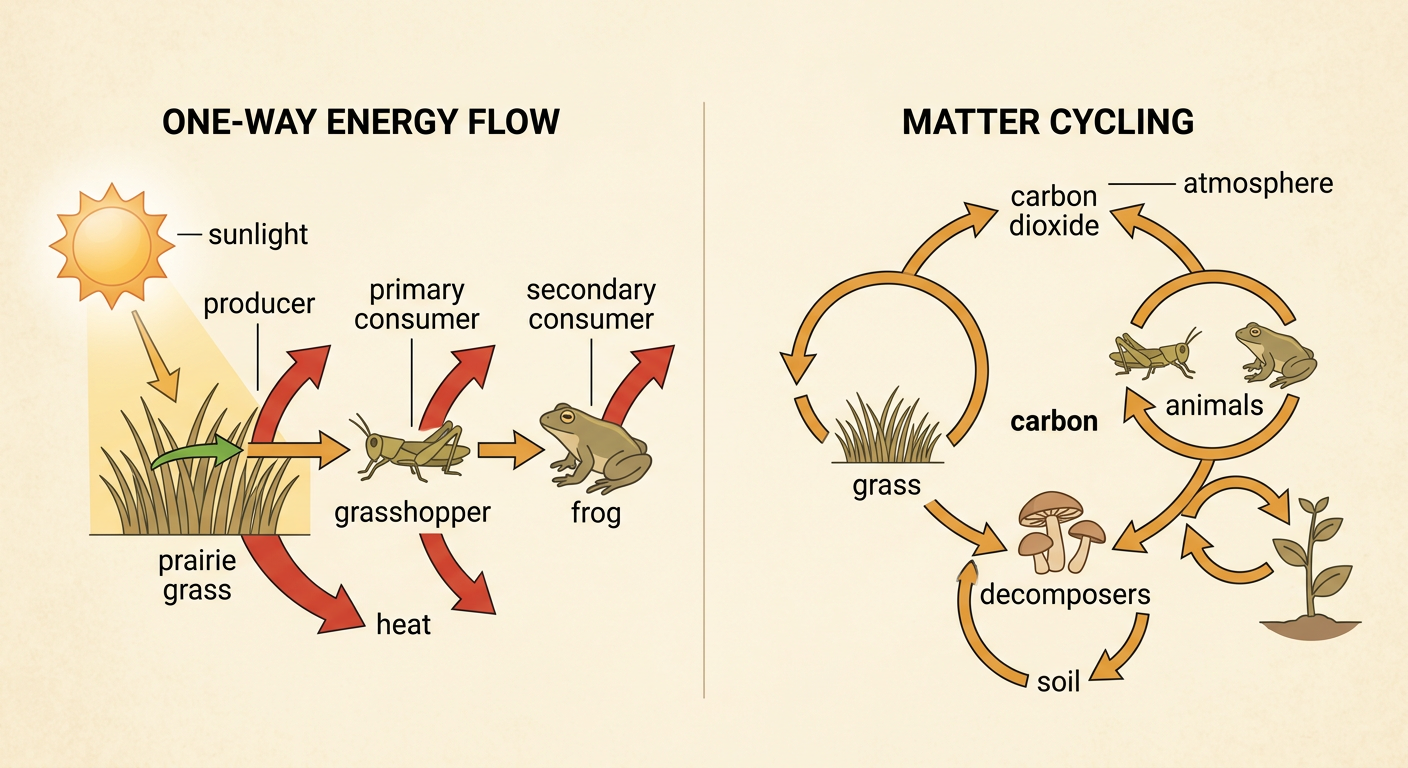
Ecosystems depend on both energy flow and matter cycling. Most ecosystem energy begins as sunlight. Producers, such as prairie grasses, capture light energy through photosynthesis and store some of it as chemical energy in sugars. A grasshopper obtains that energy by eating grass, and a frog may obtain some by eating the grasshopper. At each transfer, organisms use much of the energy for life processes, and some leaves the ecosystem as heat. Energy therefore moves mostly in one direction rather than cycling. Matter behaves differently. Water, carbon, nitrogen, and other materials move repeatedly between organisms and the nonliving environment. For example, carbon in grass can pass to a grasshopper, return to the atmosphere through cellular respiration, and later be absorbed by another plant.
Reading a Food Web
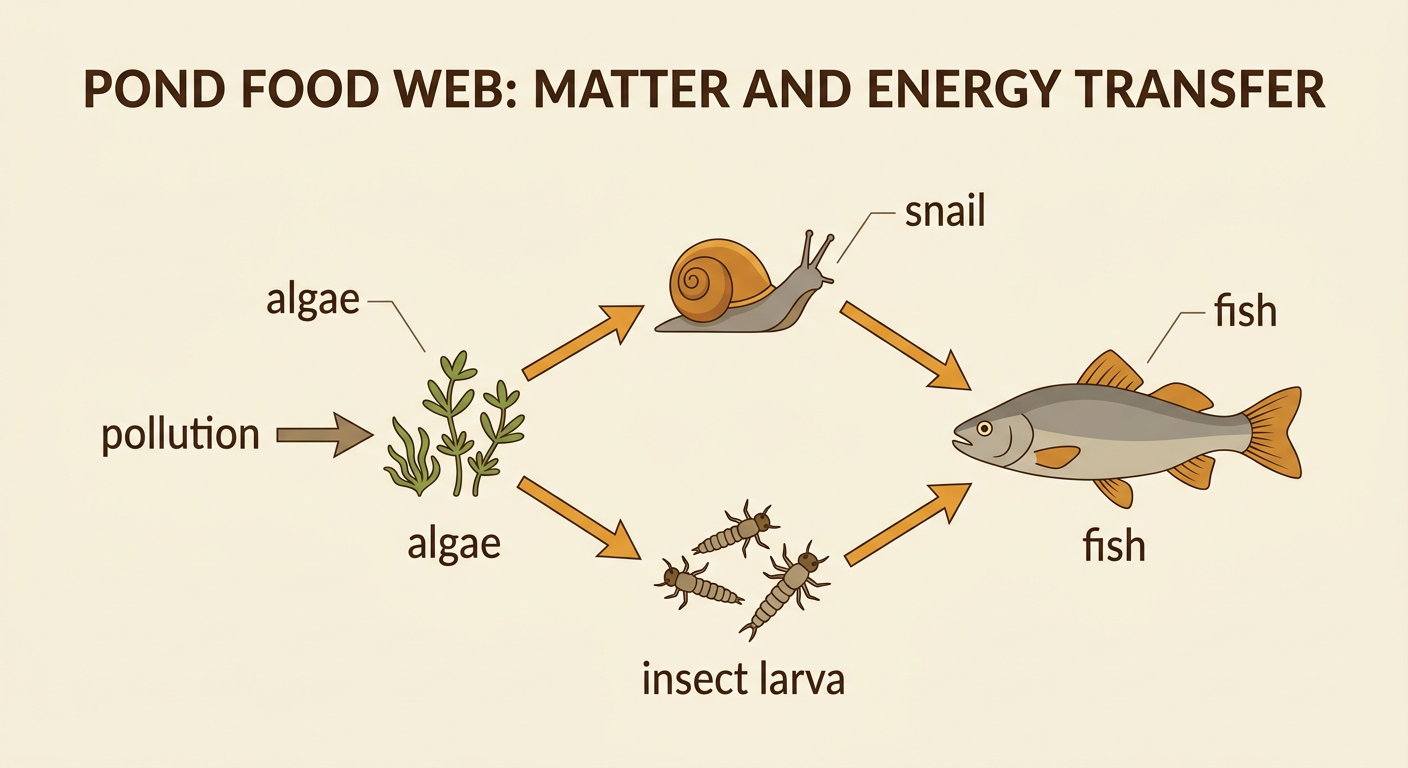
A food web represents multiple feeding relationships in an ecosystem. Each arrow points from the organism being eaten toward the organism that receives matter and energy. In a pond food web, an arrow from algae to a snail means that the snail eats the algae. If arrows lead from the snail and an insect larva to a fish, the fish has more than one food source. Organisms can also occupy different trophic levels depending on what they eat. A fish that eats algae acts as a primary consumer, but a fish that eats an insect larva acts as a secondary consumer. To predict the effect of change, trace connected arrows. If pollution reduces algae, snail populations may decline because they have less food. Fish that eat snails may then receive less energy, producing indirect effects across the web.
Calculating Energy Transfer
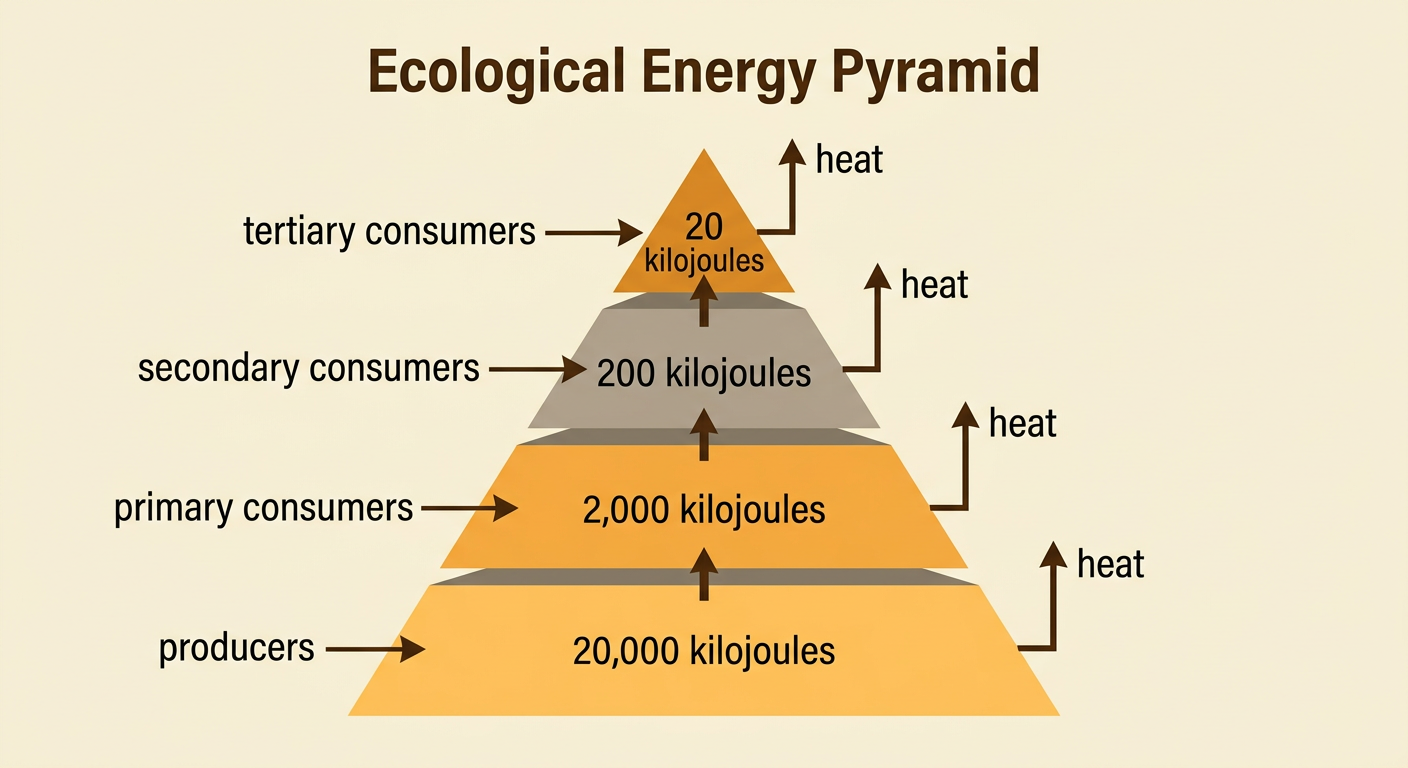
An ecological energy pyramid shows how much energy is available at each trophic level. Producers form the broad base because they contain the most stored energy. Only a fraction of that energy becomes biomass at the next level; a common model estimates about 10 percent transfer. Suppose prairie producers store 20,000 kilojoules of energy. Primary consumers would receive about 2,000 kilojoules: 20,000 multiplied by 0.10. Secondary consumers would receive about 200 kilojoules, and tertiary consumers about 20 kilojoules. The transfer percentage can be calculated as energy at the higher level divided by energy at the lower level, multiplied by 100. These values are estimates because transfer efficiency varies. The pyramid narrows upward because organisms use energy for movement, growth, reproduction, and cellular processes, while much is released as heat.
Explaining Matter Cycling
Matter is conserved, so atoms are rearranged and reused rather than destroyed as they move through an ecosystem. Consider carbon in a forest. Trees absorb carbon dioxide during photosynthesis and use the carbon to build sugars and other molecules. A deer obtains carbon by eating leaves. Both the tree and deer release some carbon dioxide through cellular respiration. When leaves fall or an organism dies, decomposers such as fungi and bacteria break down the remains. This process returns carbon dioxide to the atmosphere and nutrients to the soil. Plants absorb soil nutrients through their roots, beginning another pathway through the food web. A matter-cycle model should include organisms, air, water, and soil, with arrows showing transfers among them. Unlike matter, energy is not recycled; it must continually enter, usually as sunlight.

Evaluating Human Impacts
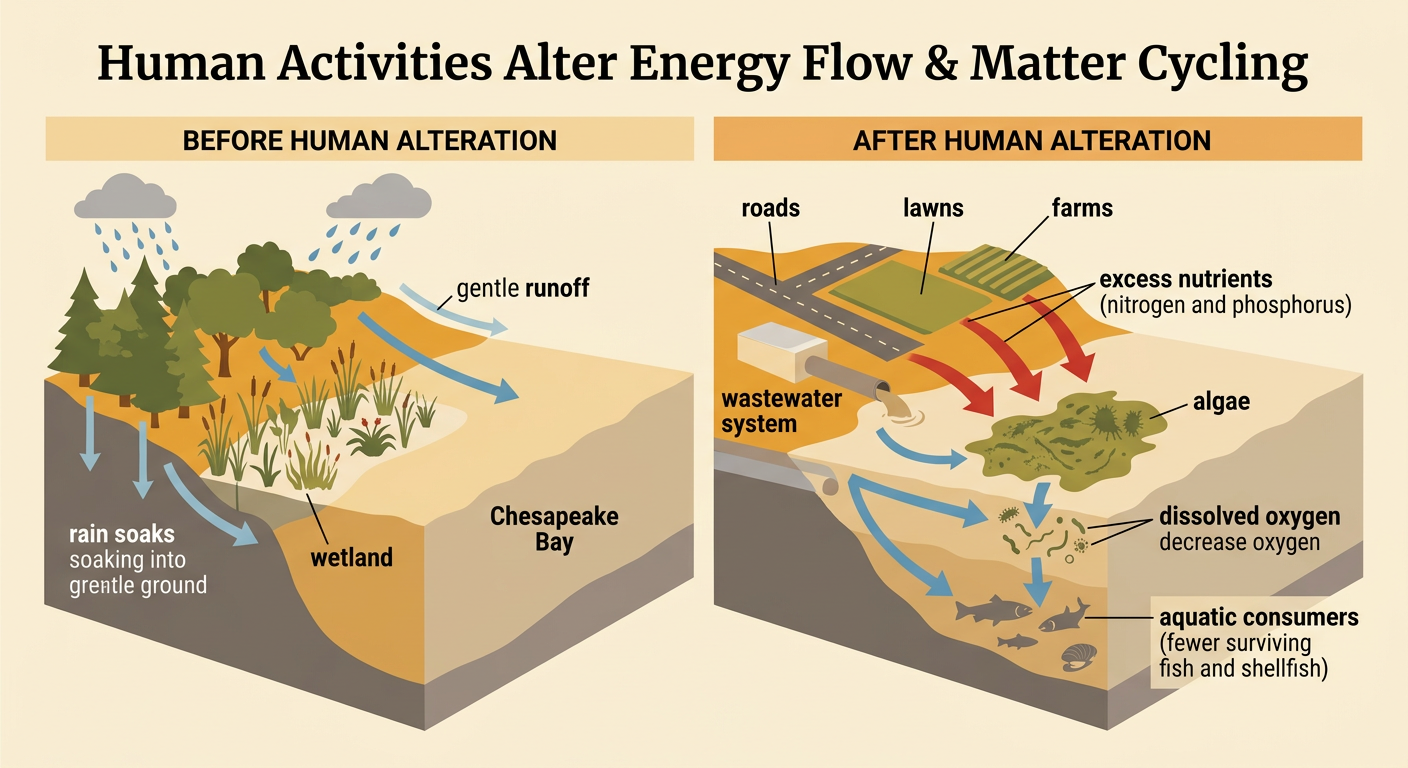
Human settlement can alter energy flow and matter cycling by changing land cover, water movement, and nutrient inputs. Around the Chesapeake Bay, expanding communities add roads, lawns, farms, and wastewater systems. Rain can carry excess nitrogen and phosphorus from fertilizers and sewage into streams and the bay. These nutrients may cause rapid algal growth. When algae die, decomposers consume them and use dissolved oxygen during cellular respiration. Low-oxygen water can kill fish and shellfish, reducing energy transfer to larger predators and affecting fishing livelihoods and regional traditions. A before-and-after model can support an evaluation: the altered system has larger nutrient inputs, more algae, less oxygen, and fewer aquatic consumers. Possible responses include restoring wetlands, improving wastewater treatment, planting streamside vegetation, and reducing fertilizer use. Effective solutions limit runoff while considering housing, food production, employment, and community needs.