
Modeling Wave Properties
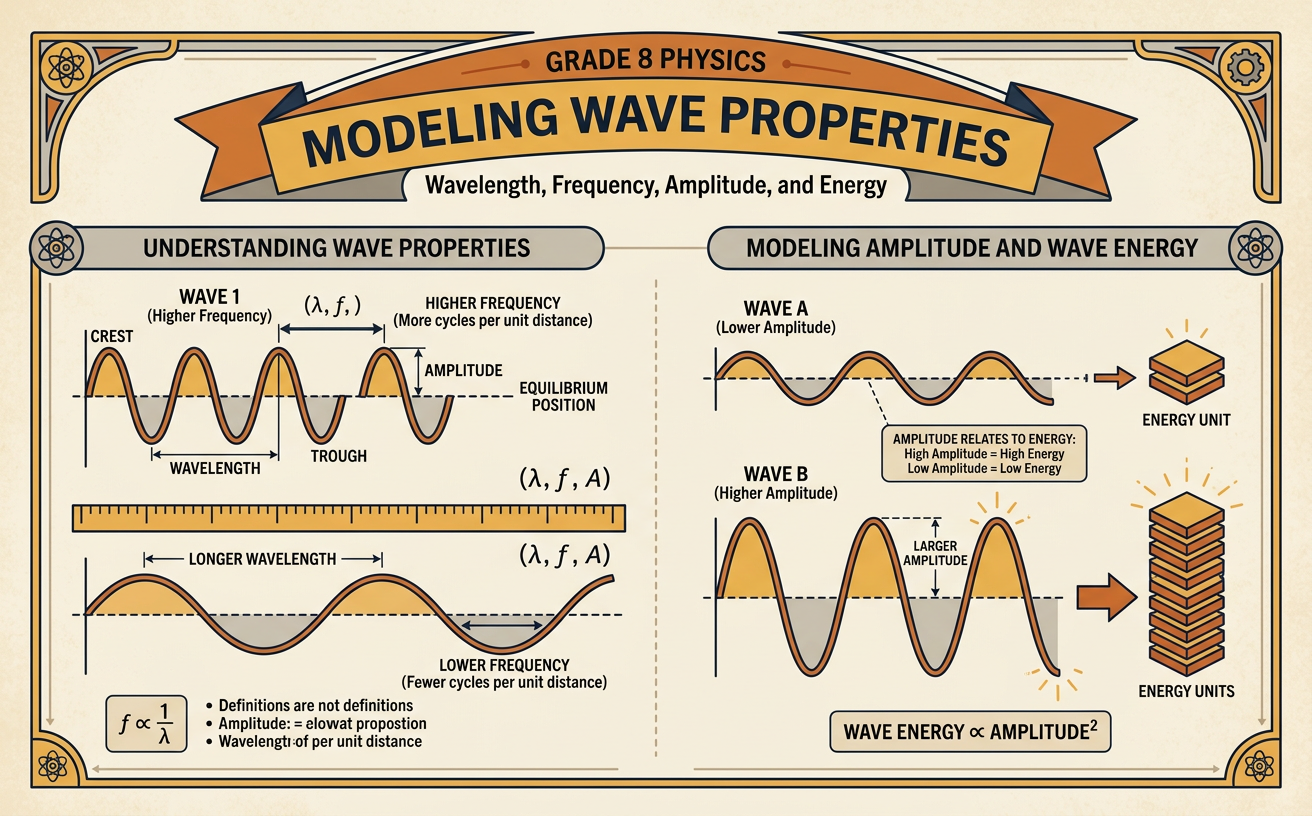
Students use diagrams and simple mathematical representations to explain how wavelength, frequency, and amplitude describe waves and how amplitude relates to wave energy.
Illustrations are auto-generated and may be placeholders. They can be refreshed to match the narration.
What Is a Wave?
A wave is a repeating or single disturbance that transfers energy from one place to another. The material through which a mechanical wave travels is called a medium. The particles of the medium usually vibrate around their resting positions rather than traveling with the wave. For example, when one end of a rope is shaken, a pulse moves along the rope. Each small part of the rope moves up and down, but the rope itself does not move from one end of the room to the other. Water waves and sound waves are also mechanical waves because they need matter to travel through. A useful wave model shows a repeating pattern around an equilibrium, or rest, position. The model helps describe measurable properties such as wavelength, frequency, and amplitude.

Identifying Crests and Troughs
A wave diagram often uses a curved line to represent how a medium is displaced from its rest position. The highest point above the rest position is called a crest. The lowest point below the rest position is called a trough. Crests and troughs repeat in a regular pattern when a wave is periodic. Imagine moving one end of a jump rope steadily up and down. Each upward motion can produce a crest, and each downward motion can produce a trough. The horizontal centerline in the diagram represents equilibrium, where the rope would rest if it were not disturbed. A crest is not a piece of matter traveling separately from the rope. It is a location in the moving pattern. Correctly identifying crests, troughs, and the rest position makes it easier to measure the wave’s other properties.

Measuring Wavelength and Amplitude
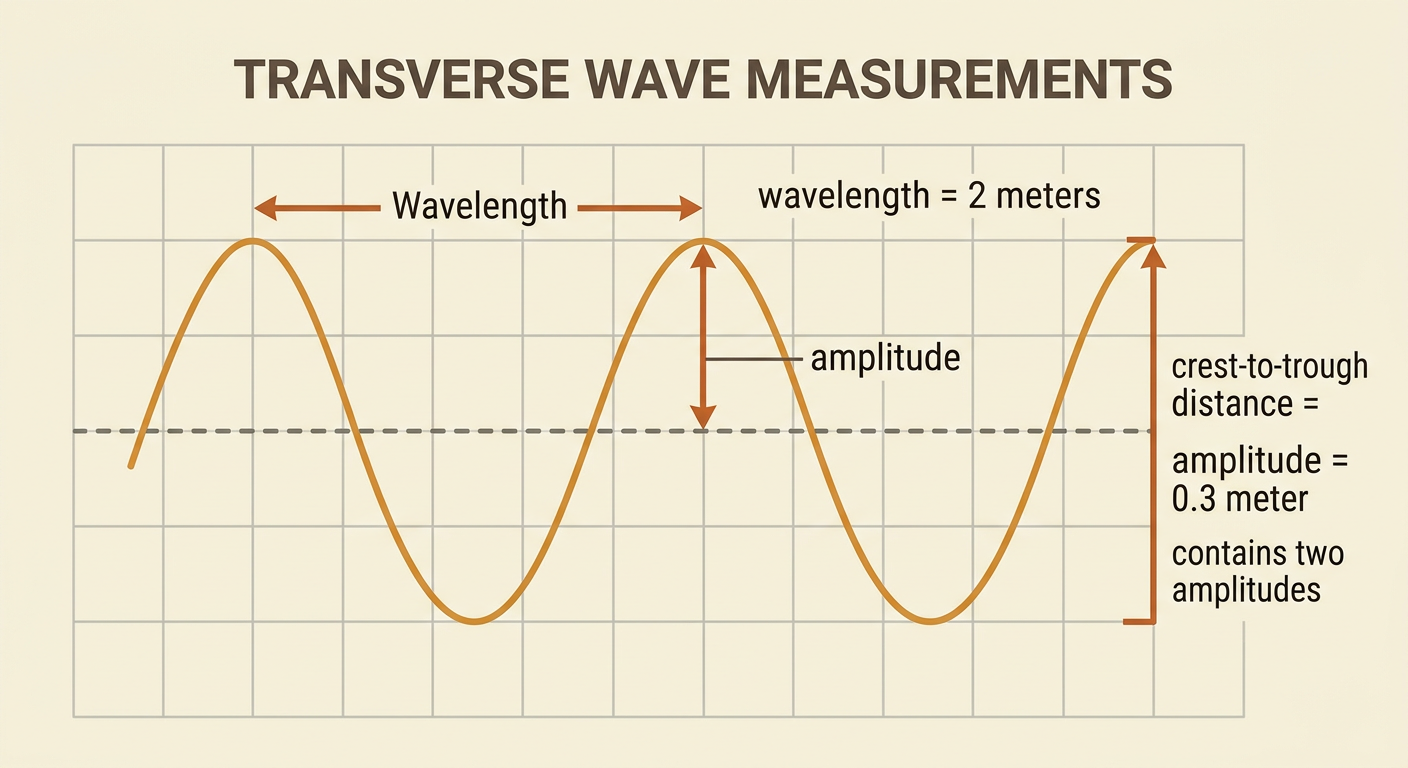
Wavelength and amplitude measure different parts of a wave. Wavelength, represented by the Greek letter lambda, is the distance between matching points on consecutive cycles. It can be measured from one crest to the next crest or from one trough to the next trough. Amplitude is the maximum displacement from the equilibrium line. For a transverse wave, measure amplitude vertically from the equilibrium line to a crest or to a trough, not from crest to trough. For example, if consecutive crests are 2 meters apart, the wavelength is 2 meters. If a crest is 0.3 meter above equilibrium, the amplitude is 0.3 meter. The total vertical distance from that crest to the matching trough is 0.6 meter, which equals two amplitudes. Distance measurements must include units such as meters or centimeters.
Comparing Frequency and Wavelength
Frequency is the number of complete wave cycles that pass a point each second. It is measured in hertz, where 1 hertz means 1 cycle per second. Wave speed, frequency, and wavelength are related by the equation v = fλ. In this equation, v is wave speed, f is frequency, and λ is wavelength. When waves travel at the same speed, increasing frequency decreases wavelength. For example, suppose waves move along a rope at 6 meters per second. A frequency of 2 hertz gives a wavelength of 3 meters because 6 = 2 × 3. If the frequency increases to 3 hertz while the speed stays 6 meters per second, the wavelength becomes 2 meters. Frequency and wavelength are therefore inversely related only when wave speed remains constant. Amplitude can change without changing either frequency or wavelength.

Connecting Amplitude and Energy
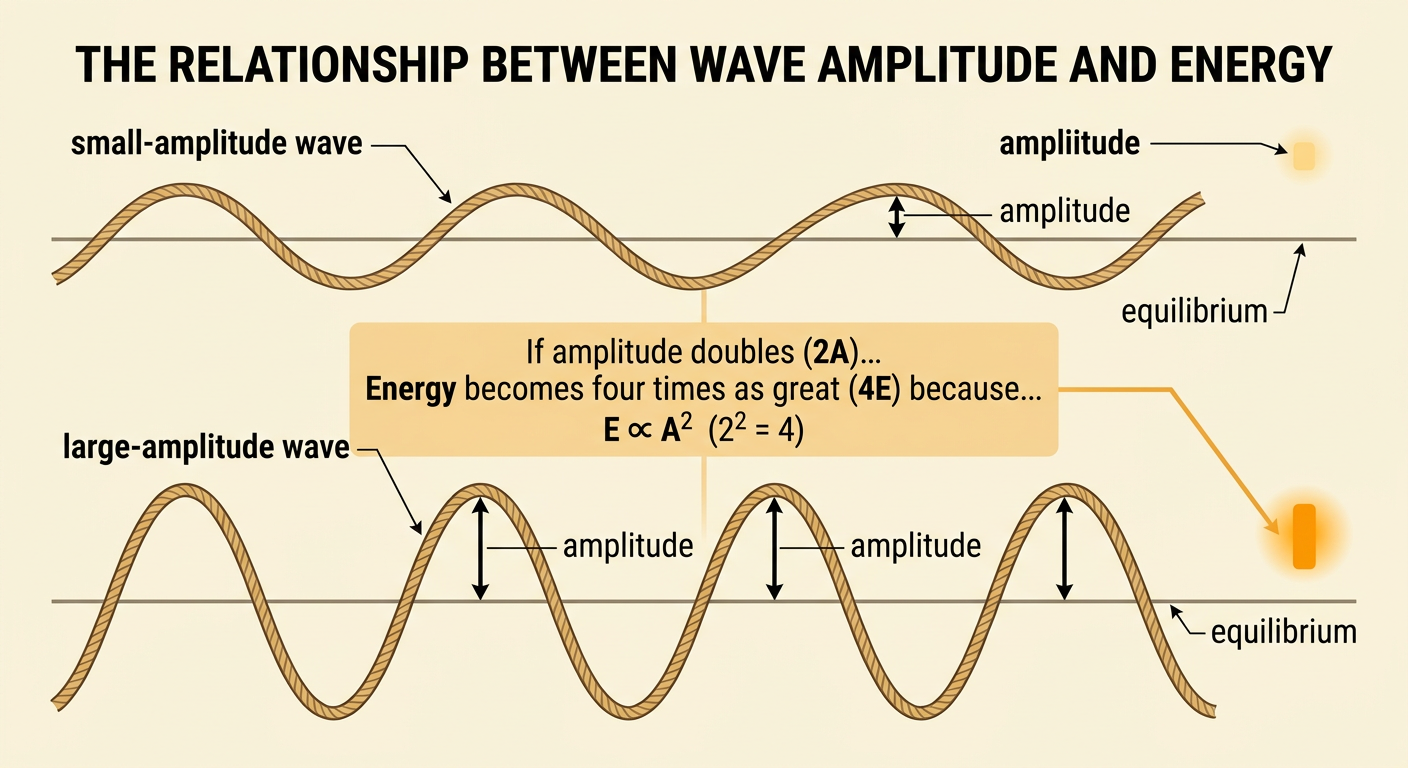
Amplitude describes the size of a wave’s maximum displacement from equilibrium. A larger amplitude means that the vibrating parts of the medium move farther from their rest positions. Creating that motion requires more energy, so a larger-amplitude wave carries more energy than a smaller-amplitude wave of the same type. In a common simple wave model, energy is proportional to the square of amplitude: E ∝ A². If amplitude doubles, the model predicts four times as much energy because 2² = 4. If amplitude triples, it predicts nine times as much energy. For example, shaking a rope gently creates small-amplitude waves, while shaking it more strongly creates larger-amplitude waves that carry more energy. Amplitude does not tell how many waves pass each second; that property is frequency. Compare energy only after clearly identifying which wave features are changing.
Quick Wave-Model Check
Use the diagram and equations to check each wave property separately. Suppose a wave model shows crests 4 meters apart, an amplitude of 0.5 meter, and a frequency of 2 hertz. The wavelength is 4 meters because wavelength is the distance from one crest to the next. The wave speed is v = fλ = 2 × 4, or 8 meters per second. Now imagine a second wave in the same model with the same frequency and wavelength but an amplitude of 1 meter. Its amplitude is twice as large. Using E ∝ A², its energy is four times as great. A complete explanation should name the measured feature, include units, use the correct equation, and state what stays constant. Remember that crest-to-trough height is twice the amplitude, so it would be 2 meters for the second wave.
