
Modern Government and Citizenship in Europe and the Americas
Students compare democratic systems, levels of government, protections for rights, and ways citizens participate in public life.
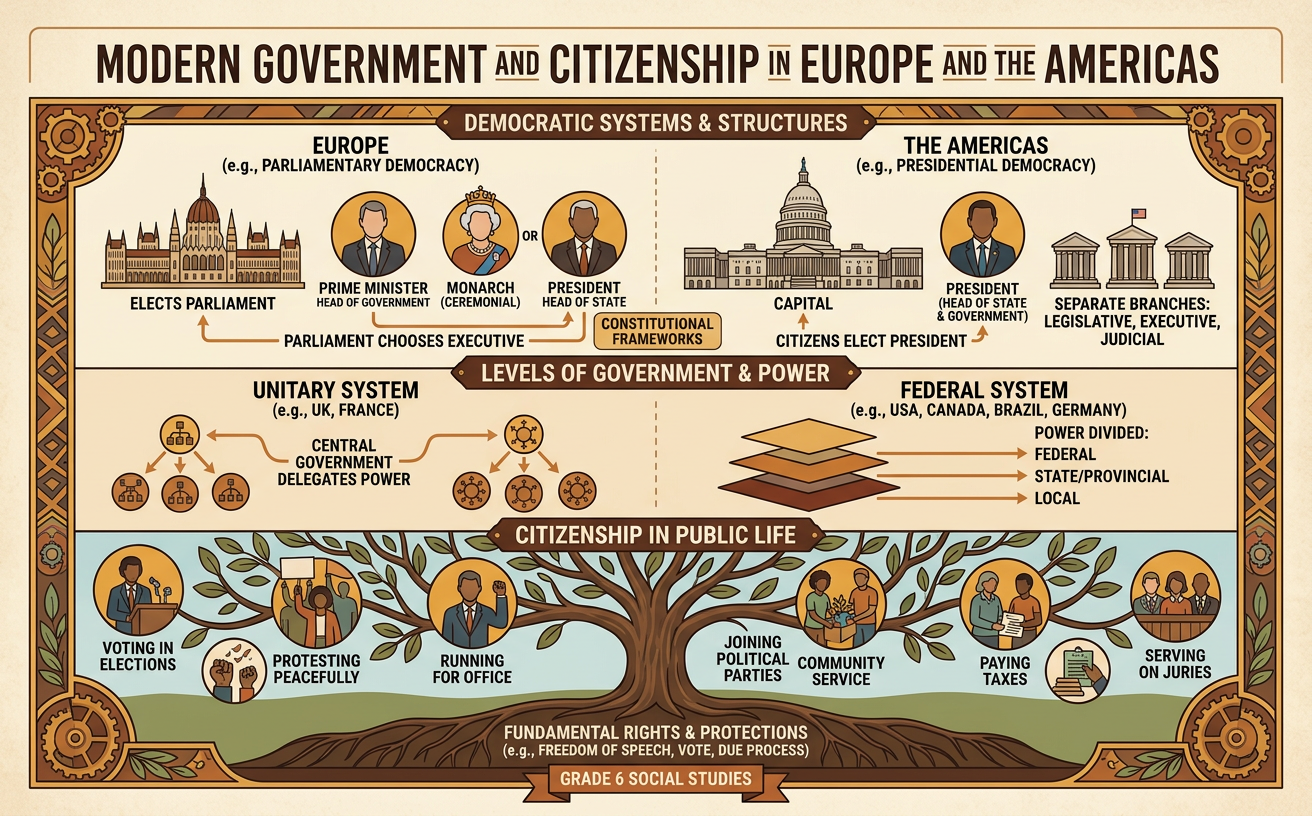
Illustrations are auto-generated and may be placeholders. They can be refreshed to match the narration.
Democracy, Authoritarianism, and Limited Government
Governments create laws, provide services, protect territory, and make decisions for society. In a democracy, citizens influence government through elections and other forms of participation. A limited government must follow a constitution or established laws that restrict its power. In an authoritarian system, one leader or a small group holds most political power, and citizens have fewer opportunities to challenge decisions. Countries may call themselves democracies, but elections alone do not guarantee democratic government. Free expression, competitive political parties, independent courts, and fair vote counting are also important. For example, an election is not fully democratic if opposition candidates are arrested or news organizations cannot criticize current leaders. Comparing governments therefore requires examining both formal institutions and the way political power operates in practice.
Presidential and Parliamentary Systems
Democratic countries organize executive and legislative power in different ways. In a presidential system, voters elect a president separately from the legislature. The United States and many Latin American countries use this model. In a parliamentary system, voters choose members of parliament, and the majority party or coalition selects a prime minister to lead the government. The United Kingdom and Canada use parliamentary systems, although each also has a monarch with limited constitutional duties. Parliamentary governments may hold new elections when a governing coalition loses support. Presidential systems usually have fixed election schedules and a clearer separation between executive and legislative branches. For example, a United States president may belong to one political party while Congress is controlled by another, requiring negotiation before a law can pass.
Federal and Unitary Governments
Government power can also be divided geographically. In a federal system, a national government shares constitutional authority with states, provinces, or other regional units. The United States, Canada, Mexico, Brazil, and Germany are federal countries. Their regional governments may control areas such as education, transportation, or local law enforcement. In a unitary system, the national government holds primary authority and may grant powers to local governments. France is an example of a unitary state. Unitary does not mean undemocratic; it describes where legal authority is located. For example, an education policy in a federal country might vary among states or provinces, while a unitary country may establish more uniform national rules. Each structure attempts to balance consistent national policies with the needs of local communities.
Rights, Responsibilities, and Participation
Democratic citizenship includes rights as well as responsibilities. Common rights include freedom of expression, religious liberty, peaceful assembly, due process, and equal treatment under law. Responsibilities may include obeying laws, paying taxes, serving on juries where required, and staying informed about public issues. Citizens can participate by voting, contacting officials, attending meetings, joining civic groups, volunteering, or peacefully protesting. Young people who cannot yet vote can still research issues and contribute to community projects. For example, students concerned about traffic near a school could collect observations, survey families, and present a proposed crosswalk location to local officials. Responsible participation also requires evaluating evidence, listening to different viewpoints, and distinguishing disagreement from personal attack. These habits help democratic institutions solve problems peacefully.