Modular Arithmetic
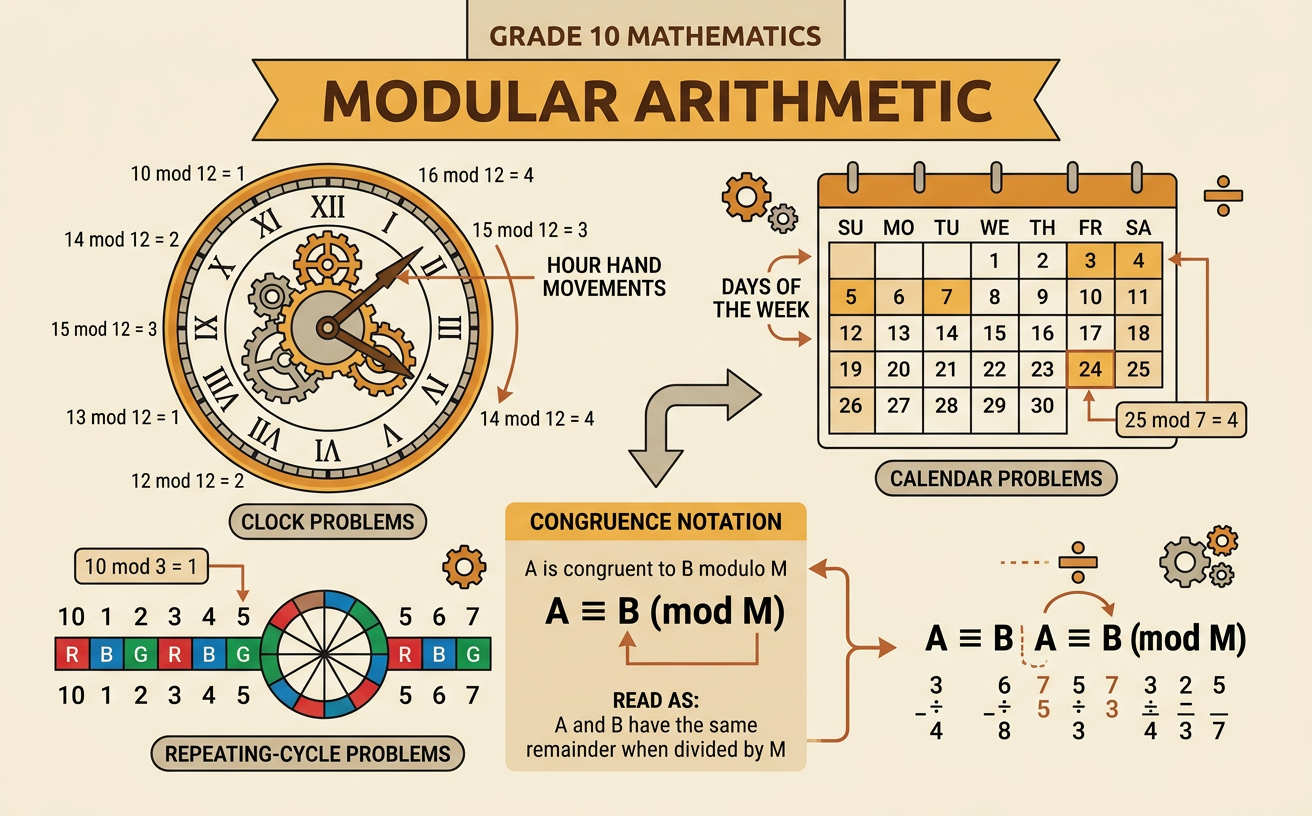
Students use remainders and congruence notation to solve clock, calendar, and repeating-cycle problems.
Illustrations are auto-generated and may be placeholders. They can be refreshed to match the narration.
Meaning of a Modulus
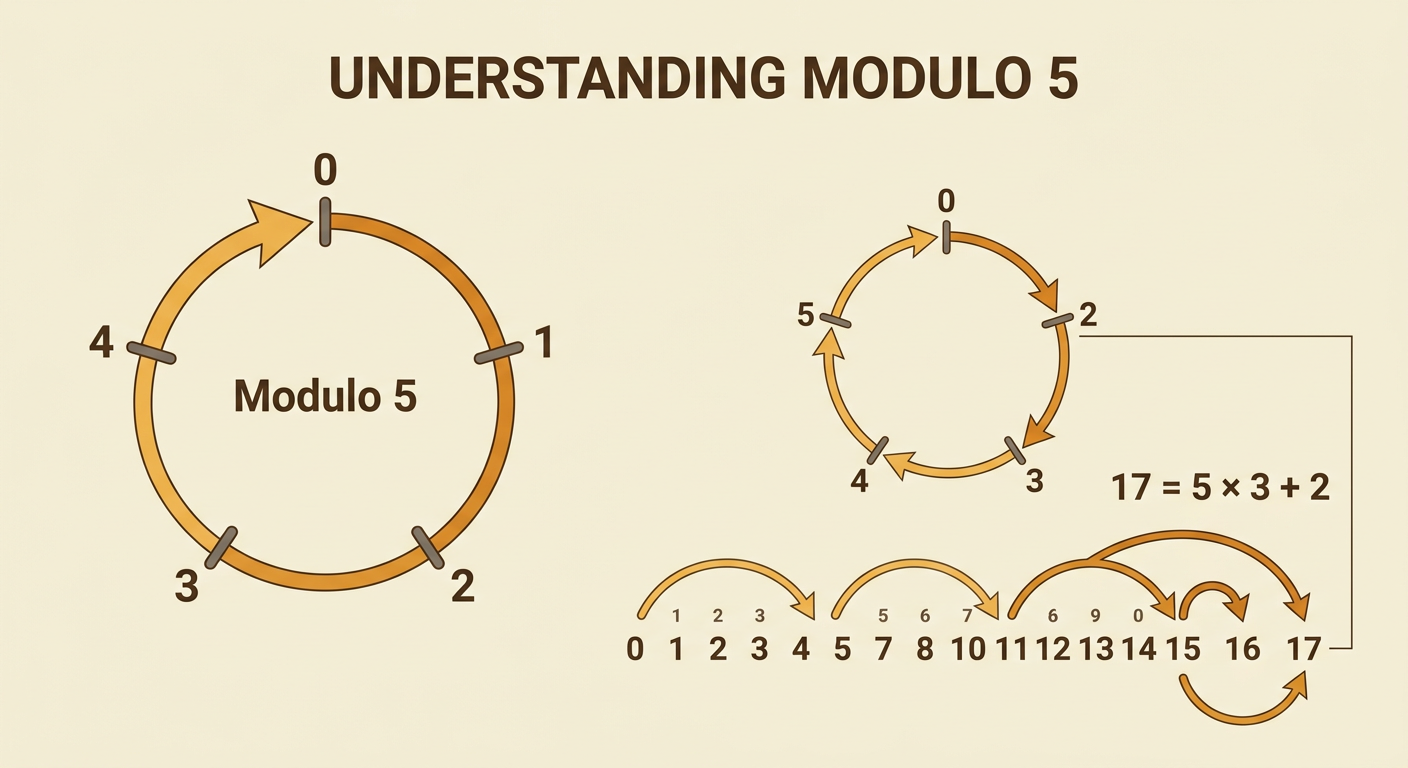
A modulus is a positive integer that determines when counting starts again in a repeating cycle. In arithmetic modulo n, numbers are grouped according to their remainders after division by n. For example, consider arithmetic modulo 5. The possible remainders are 0, 1, 2, 3, and 4. After 4, the count returns to 0. To find 17 modulo 5, divide 17 by 5. Since 17 = 5 × 3 + 2, the remainder is 2, so 17 mod 5 = 2. A modulus can be represented by points arranged in a circle. Moving forward one point at a time shows how values repeat. Modulo 5, the integers 2, 7, 12, and 17 all reach the same point because each leaves remainder 2 when divided by 5.
Remainders and Congruence
Two integers are congruent modulo n when they have the same remainder after division by n. The notation a ≡ b (mod n) means that a and b are congruent modulo n. It also means that a − b is a multiple of n. For example, 29 and 5 both leave remainder 5 when divided by 12. Therefore, 29 ≡ 5 (mod 12). This can also be checked by subtraction: 29 − 5 = 24, and 24 is a multiple of 12. Negative integers can be included. Since −7 differs from 5 by −12, −7 ≡ 5 (mod 12). Congruence does not mean that the integers are equal. It means they belong to the same remainder class for the chosen modulus. Always state the modulus because the same pair may not be congruent under a different modulus.
Addition and Subtraction
Congruent numbers can be added or subtracted before or after their remainders are found. This makes calculations with large integers easier. For addition modulo n, add the numbers and reduce the result to a remainder from 0 to n − 1. For example, 38 + 47 = 85. Modulo 9, 38 ≡ 2 and 47 ≡ 2, so 38 + 47 ≡ 2 + 2 ≡ 4 (mod 9). Subtraction works in the same way. To calculate 14 − 20 modulo 7, first subtract to obtain −6. Add 7 until the result is in the standard remainder range: −6 + 7 = 1. Therefore, 14 − 20 ≡ 1 (mod 7). Adding or subtracting any multiple of the modulus does not change the congruence class.
Multiplication Modulo n
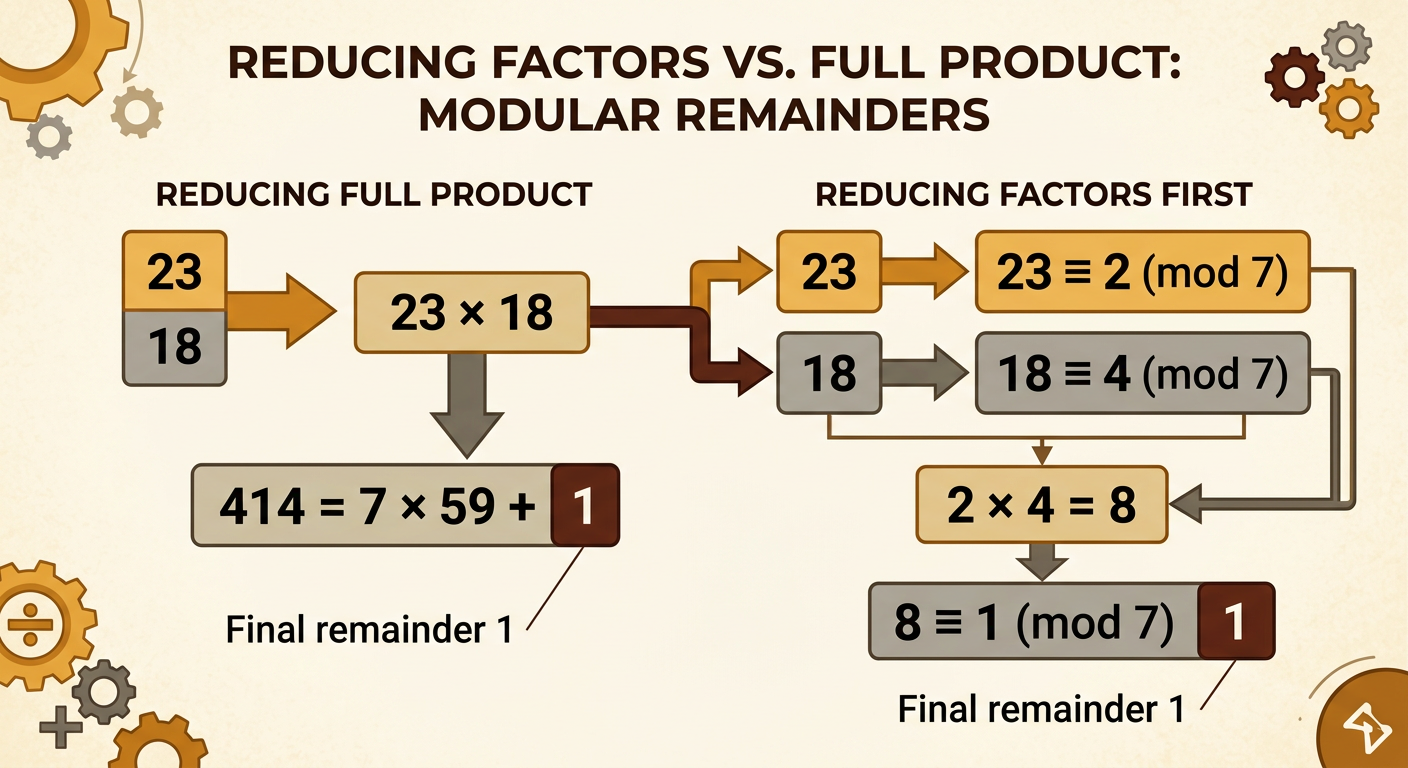
To multiply modulo n, multiply the integers and then find the remainder, or reduce each factor first and multiply the smaller remainders. For example, calculate 23 × 18 modulo 7. Direct multiplication gives 414, and 414 = 7 × 59 + 1, so the remainder is 1. Using smaller values is quicker: 23 ≡ 2 (mod 7) and 18 ≡ 4 (mod 7). Therefore, 23 × 18 ≡ 2 × 4 ≡ 8 ≡ 1 (mod 7). This method is especially useful for large numbers and powers. For example, 122 modulo 5 can be simplified using 12 ≡ 2 (mod 5). Thus, 122 ≡ 22 ≡ 4 (mod 5). Reducing intermediate results keeps calculations manageable without changing the final remainder.
Clock and Calendar Problems
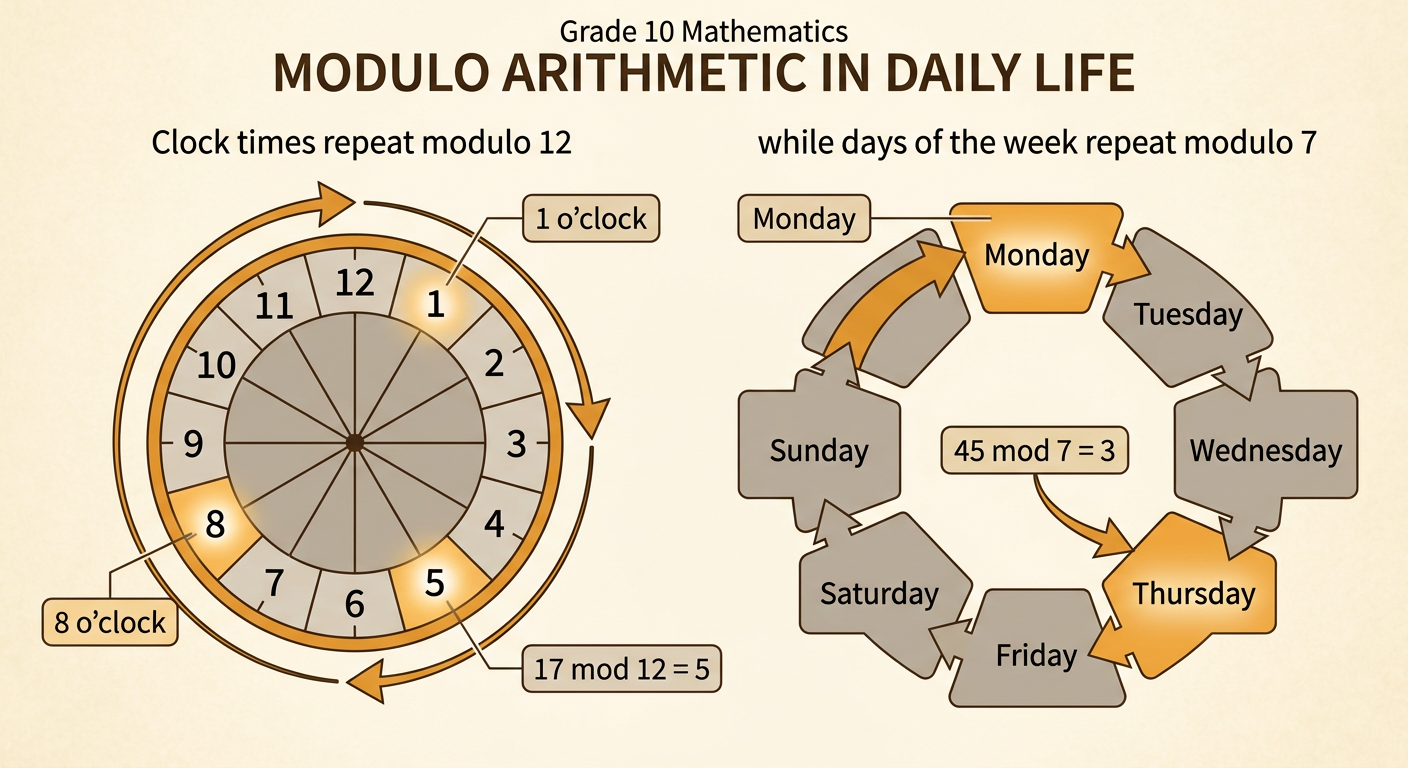
Clocks and calendars are practical modular systems because their values repeat. A 12-hour clock uses modulo 12, with remainder 0 represented by 12. Suppose the time is 8 o’clock and 17 hours pass. Since 17 ≡ 5 (mod 12), move forward 5 hours from 8 to reach 1 o’clock. Algebraically, 8 + 17 = 25 and 25 ≡ 1 (mod 12). A week uses modulo 7 because the seven days repeat. Suppose today is Monday and an event occurs 45 days later. Since 45 = 7 × 6 + 3, move forward three days from Monday: Tuesday is one day later, Wednesday is two days later, and Thursday is three days later. Therefore, the event occurs on Thursday. Clearly identify the starting point and whether the question asks for a time or day before or after it.