
Momentum and Collisions
Students calculate momentum and use conservation of momentum to analyze interactions and collisions in closed systems.
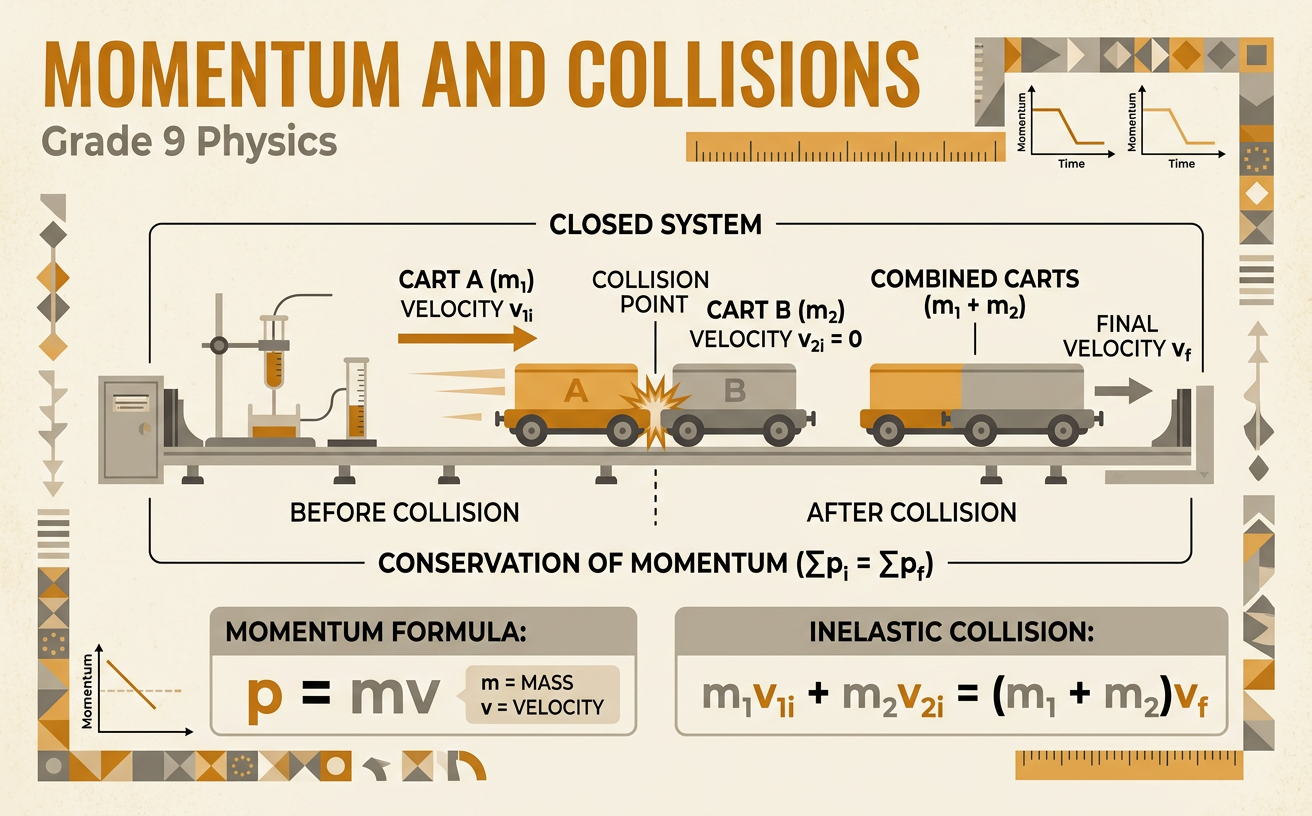
Illustrations are auto-generated and may be placeholders. They can be refreshed to match the narration.
Defining Momentum
Momentum describes how difficult it is to stop or change the motion of an object. It is calculated by multiplying mass by velocity: p = mv. Momentum is a vector, so it has both magnitude and direction. Its SI unit is kilogram-meter per second, written kg·m/s. A 2 kg cart moving east at 3 m/s has a momentum of 6 kg·m/s east. If the same cart moves west at 3 m/s, its momentum is 6 kg·m/s west, or −6 kg·m/s when east is defined as positive. Increasing either mass or speed increases the magnitude of momentum. Thus, a slowly moving truck can have more momentum than a quickly moving bicycle because the truck has much greater mass.
Impulse and Force
Impulse is the change in an object's momentum. It equals the net force multiplied by the time interval during which the force acts: J = FnetΔt = Δp. The SI unit of impulse is the newton-second, which is equivalent to kg·m/s. For example, suppose a 0.15 kg baseball initially at rest is struck with an average force of 120 N for 0.01 s. The impulse is 1.2 N·s, so the ball gains 1.2 kg·m/s of momentum in the force's direction. A larger force or a longer interaction time produces a greater momentum change. Safety devices such as airbags increase stopping time. For the same momentum change, increasing the stopping time reduces the average force on a passenger.
Closed Systems
A system is the group of objects chosen for analysis. A closed system exchanges no matter with its surroundings and experiences no net external force during the interaction being studied. Forces that objects inside the system exert on one another are internal forces. These forces can change each object's momentum, but they cannot change the system's total momentum because they occur in equal and opposite pairs. Consider two carts colliding on a nearly frictionless track. If both carts are included in the system, their collision forces are internal. Gravity and the track's normal force balance vertically, and friction is negligible, so the net external force is approximately zero. The two-cart system can therefore be treated as closed during the brief collision, even though each cart's individual momentum changes.
Conservation of Momentum
The law of conservation of momentum states that a system's total momentum remains constant when the net external force on the system is zero. Mathematically, total momentum before an interaction equals total momentum after it: Σpbefore = Σpafter. For two objects moving along one line, m1v1i + m2v2i = m1v1f + m2v2f. Velocity signs must represent direction. Suppose a 2 kg cart moving right at 4 m/s collides with a stationary 2 kg cart, and afterward the first cart stops. The initial total momentum is 8 kg·m/s right. To preserve that total, the second cart must have 8 kg·m/s right, giving it a final velocity of 4 m/s. Momentum is redistributed between the carts, but the system total does not change.
Collision Examples
Momentum is conserved in both elastic and inelastic collisions when no net external force acts. In an elastic collision, total kinetic energy is also conserved. In an inelastic collision, some kinetic energy changes into sound, thermal energy, or deformation. If objects stick together, the collision is perfectly inelastic. For example, a 1 kg cart moving right at 6 m/s strikes a stationary 2 kg cart, and the carts stick. Their initial total momentum is 6 kg·m/s right. Their combined mass is 3 kg, so 6 kg·m/s = (3 kg)vf. The final velocity is 2 m/s right. Momentum is conserved, but kinetic energy decreases from 18 J before the collision to 6 J afterward. The missing kinetic energy has changed into other forms; it has not disappeared.