Momentum Conservation in Collisions
Students analyze one-dimensional collisions to determine how the total momentum of an isolated system remains constant before and after a collision.

Illustrations are auto-generated and may be placeholders. They can be refreshed to match the narration.
Defining Momentum
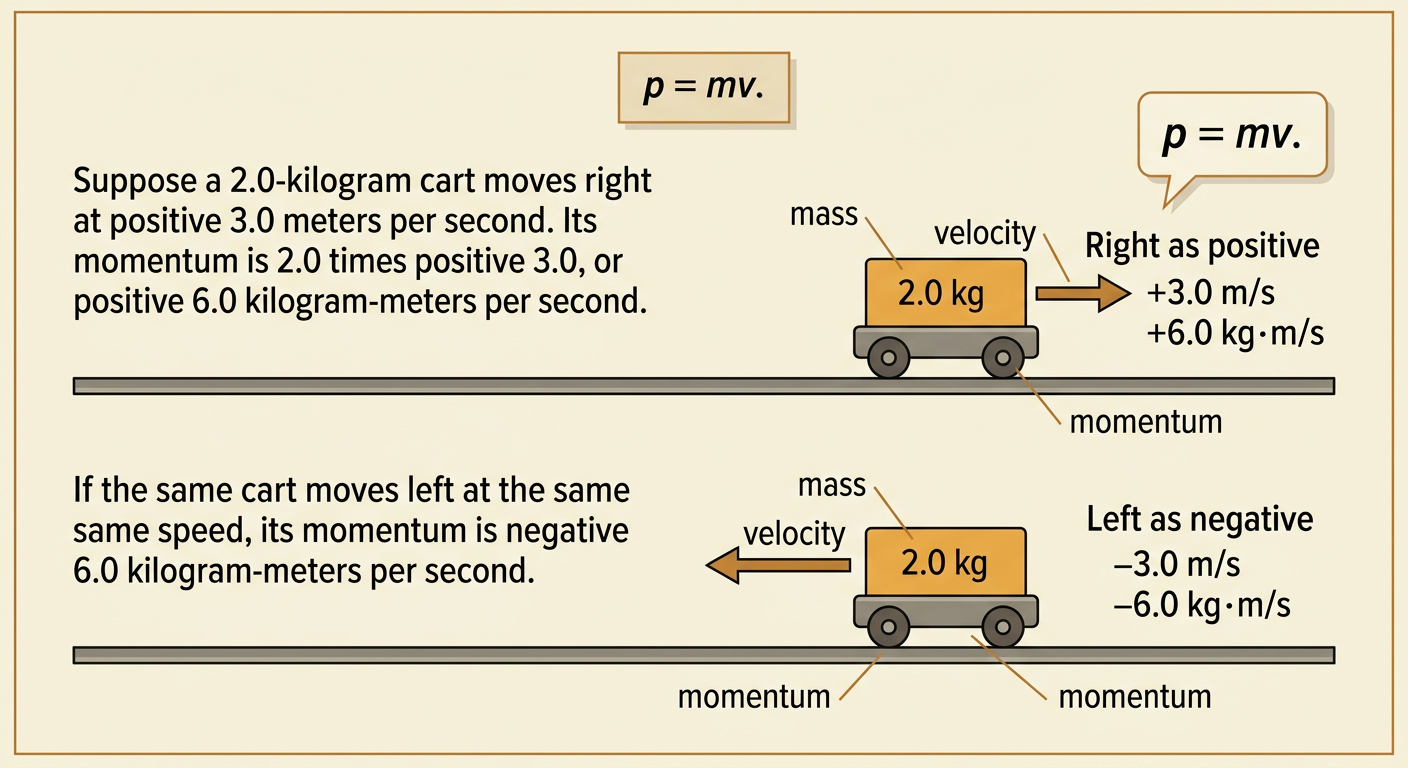
Momentum describes the motion of an object and how difficult that motion is to change. It is calculated with the equation p = mv, where p is momentum, m is mass, and v is velocity. Momentum has both size and direction because velocity has direction. In one-dimensional problems, a positive sign can represent motion to the right, while a negative sign represents motion to the left. For example, a 2.0-kilogram cart moving right at 3.0 meters per second has a momentum of +6.0 kilogram-meters per second. If the same cart moves left at the same speed, its momentum is -6.0 kilogram-meters per second. A more massive or faster-moving object has a greater momentum magnitude.
System Boundaries and External Forces
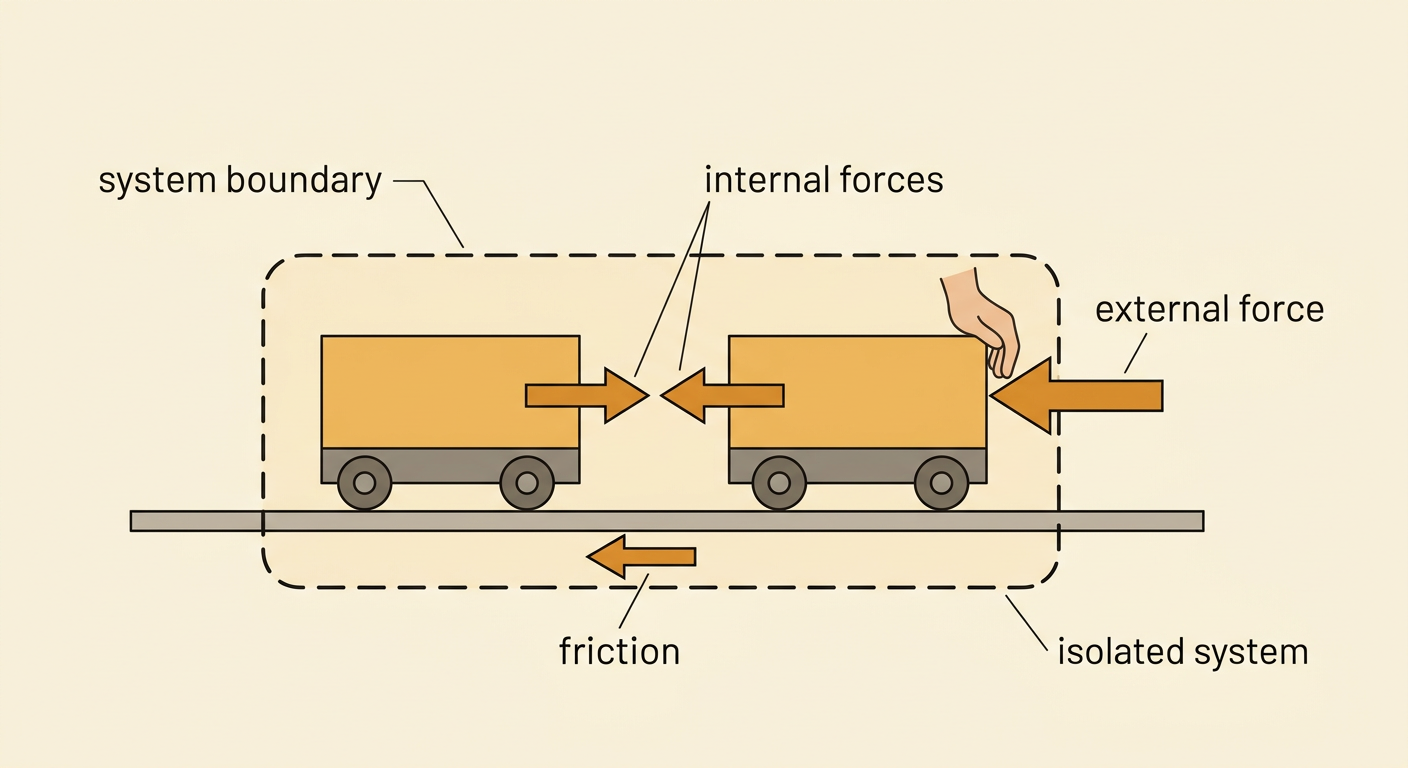
Momentum conservation applies to a chosen system, so the system boundary must be identified. If two colliding carts are inside the boundary, the forces they exert on each other are internal forces. These forces change each cart’s momentum, but they do not change the total momentum of the two-cart system. An external force comes from outside the boundary, such as friction from the track or a push from a person. During a brief collision on a nearly frictionless track, the net external force is approximately zero, so the system can be treated as isolated. For example, if a hand continues pushing one cart during the collision, the hand provides an external force, and the carts’ total momentum may change. The hand must then be included in a larger system or accounted for separately.
Observing a One-Dimensional Collision
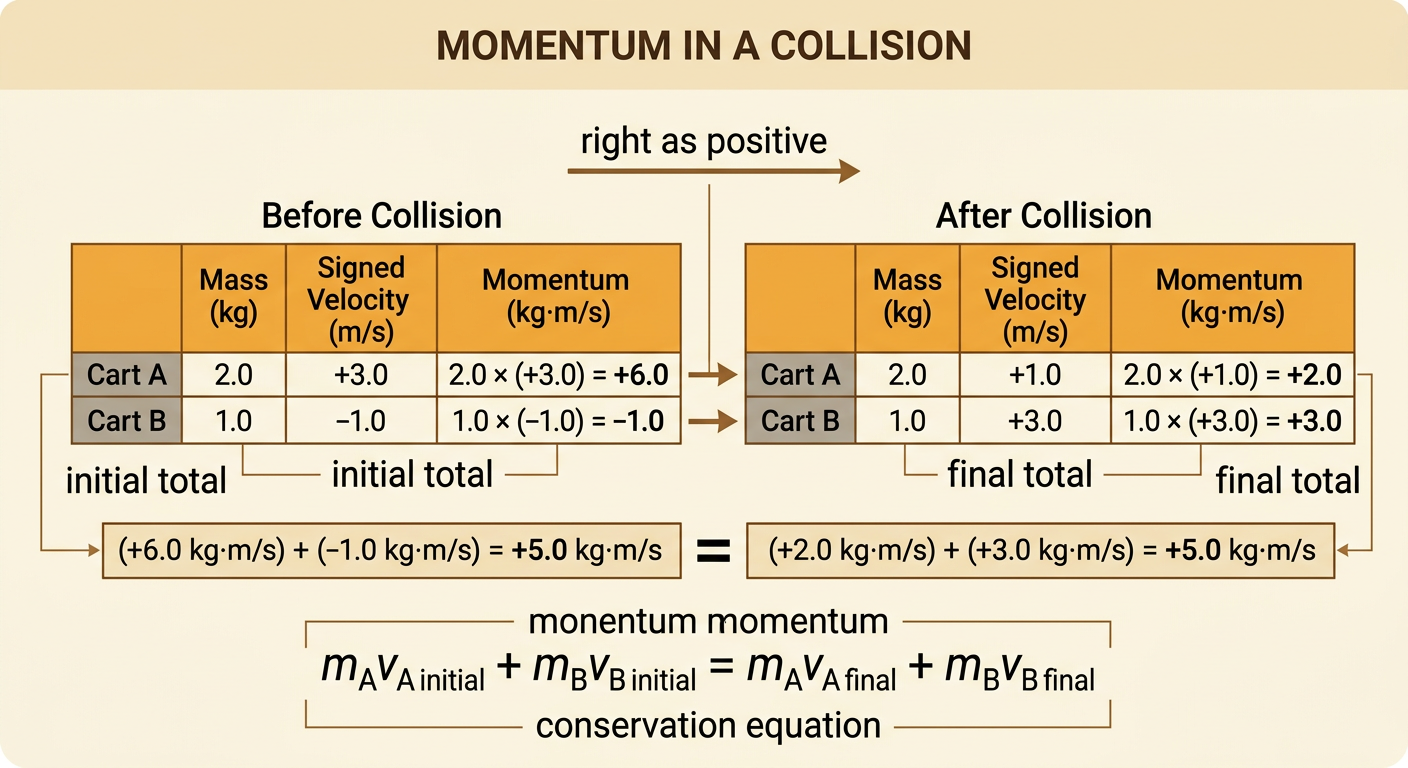
In a one-dimensional collision, all motion occurs along one straight line. Record each object’s mass, velocity, and direction immediately before and immediately after contact. Consider cart A, with a mass of 2.0 kilograms, moving right at +3.0 meters per second. Cart B, with a mass of 1.0 kilogram, moves left at -1.0 meter per second. After they collide, cart A moves right at +1.0 meter per second, and cart B moves right at +3.0 meters per second. The velocity arrows show that cart A slows down while cart B reverses direction and speeds up. A motion diagram or sequence of snapshots helps translate the observed movement into signed velocity values. Those values can then be used to compare the system’s momentum before and after the collision.

Calculating Momentum Before and After
To calculate a collision, choose right as positive and include the sign of every velocity. Before the collision, cart A has pAi = (2.0)(+3.0) = +6.0 kilogram-meters per second. Cart B has pBi = (1.0)(-1.0) = -1.0 kilogram-meters per second. The initial total is therefore +5.0 kilogram-meters per second. Afterward, cart A has pAf = (2.0)(+1.0) = +2.0, and cart B has pBf = (1.0)(+3.0) = +3.0 kilogram-meters per second. The final total is also +5.0 kilogram-meters per second. If one final velocity is unknown, rearrange mAvAi + mBvBi = mAvAf + mBvBf to get vBf = (mAvAi + mBvBi - mAvAf) divided by mB. Total momentum is conserved even though each cart’s momentum changes.
Using Evidence to Defend Conservation
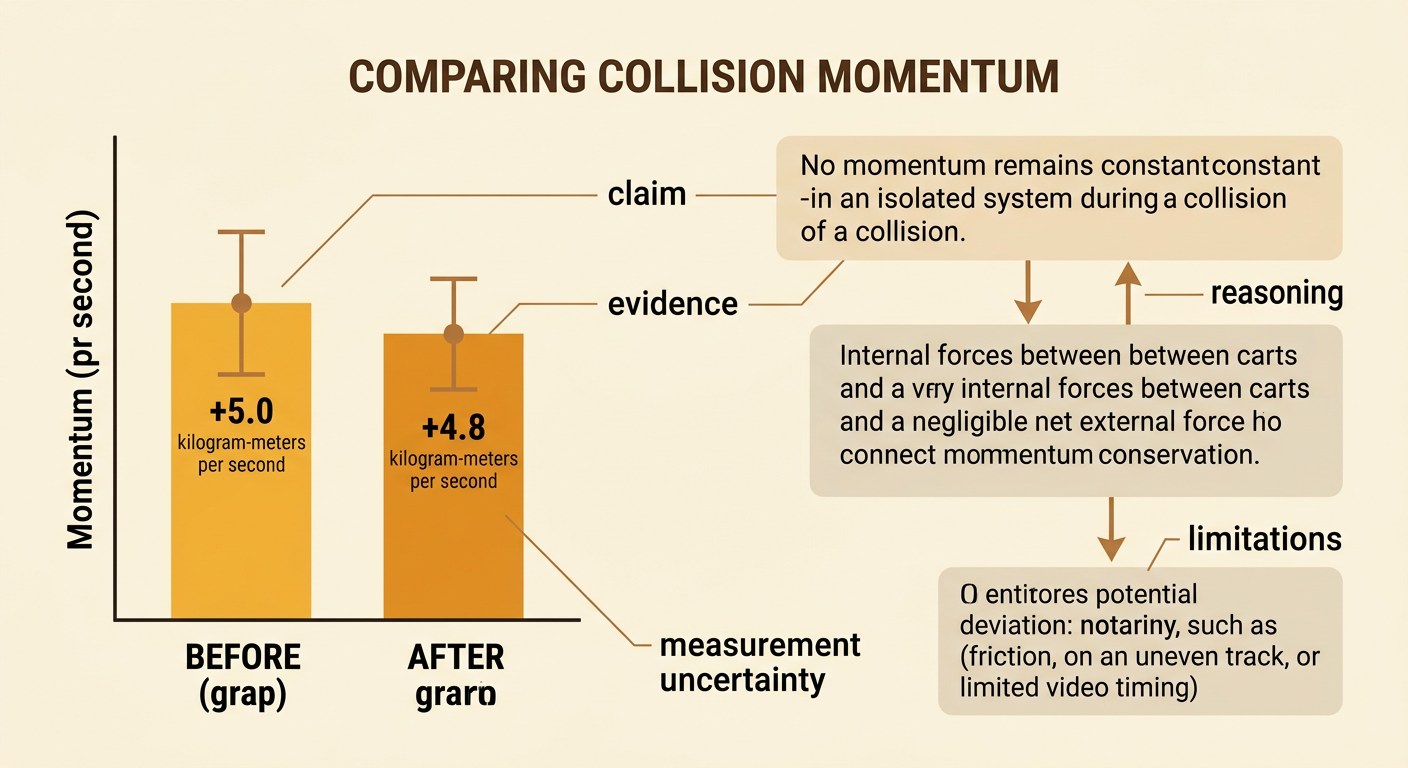
A scientific argument should include a claim, evidence, reasoning, and an honest evaluation of limitations. The claim is that the total momentum of an isolated two-cart system remains constant during a collision. In the example, the calculated total is +5.0 kilogram-meters per second both before and after, which supports the claim. The reasoning is that the carts exert internal forces on each other, while the net external force is negligible. A counterclaim might state that measured totals are not exactly equal. For example, a classroom trial might produce +5.0 before and +4.8 kilogram-meters per second after. This small difference could result from friction, an uneven track, video timing limits, or velocity measurement uncertainty. The evidence supports conservation most strongly when the difference is within the experiment’s uncertainty and external forces are minimized.