
Momentum, Impulse, and Collision Analysis
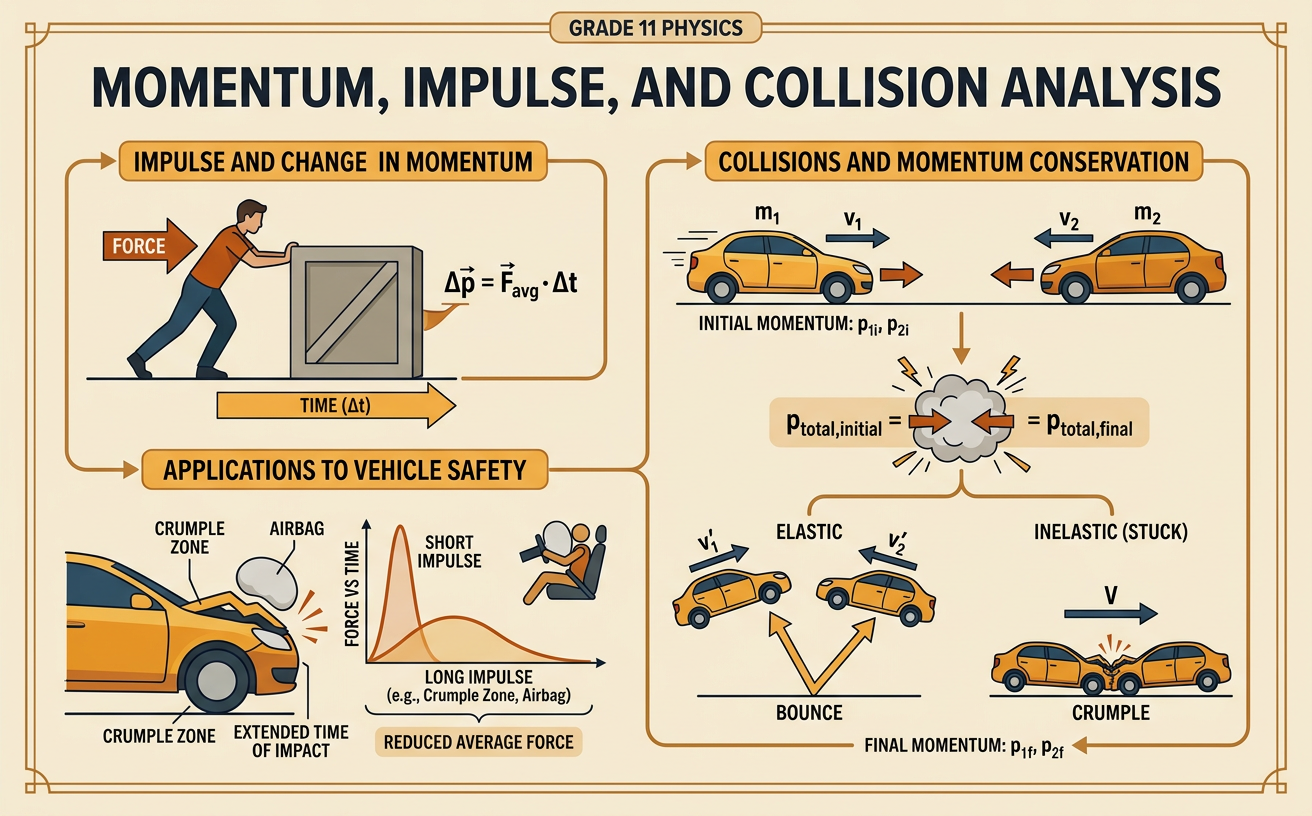
Students use momentum and impulse relationships to predict and explain changes in motion during collisions, including applications to vehicle safety.
Illustrations are auto-generated and may be placeholders. They can be refreshed to match the narration.
Defining Momentum
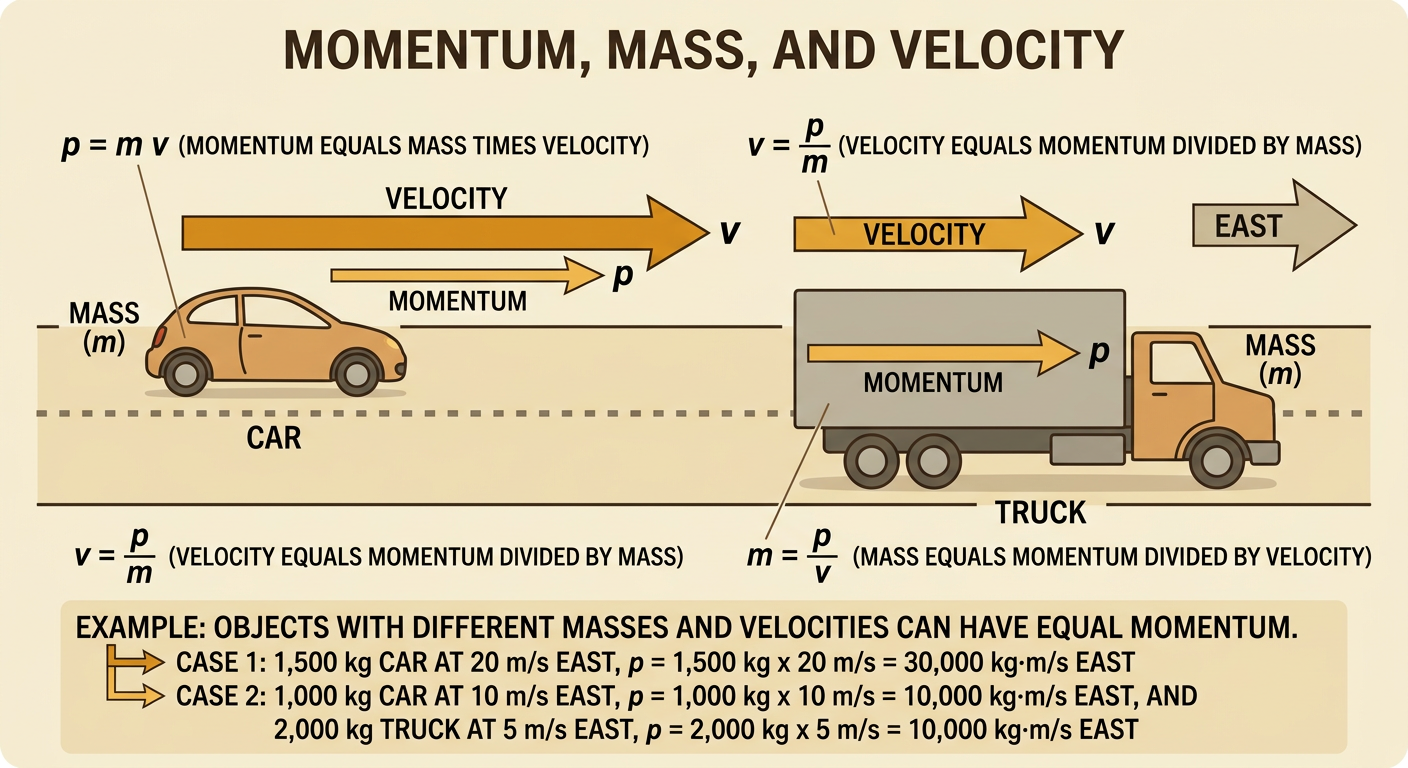
Momentum measures how difficult it is to stop or redirect a moving object. It is defined by p = mv, where p is momentum, m is mass, and v is velocity. Because velocity includes direction, momentum is a vector and also has direction. Its SI unit is kilogram-meter per second. A 1,500-kilogram car traveling east at 20 meters per second has a momentum of 30,000 kilogram-meters per second east. Solving the formula for velocity gives v = p/m, while solving for mass gives m = p/v. These rearrangements highlight different quantities of interest. Two objects can have equal momentum even if their masses and velocities differ. For example, a 1,000-kilogram car moving at 10 meters per second and a 2,000-kilogram truck moving at 5 meters per second have the same eastward momentum.
Impulse and Change in Momentum
Impulse is the effect of a force acting over a time interval. It is calculated with J = F average times change in time and equals the change in momentum: J = change in p = mv final minus mv initial. Impulse has units of newton-seconds, which are equivalent to kilogram-meters per second. On a force-versus-time graph, impulse is the signed area between the force curve and the time axis. Suppose a 0.15-kilogram baseball initially moves toward a bat at 20 meters per second and leaves in the opposite direction at 30 meters per second. Choosing the outgoing direction as positive, its momentum changes from negative 3 to positive 4.5 kilogram-meters per second. The bat therefore gives the ball an impulse of positive 7.5 newton-seconds. A larger force or a longer contact time can produce a larger momentum change.

Conservation in Isolated Systems
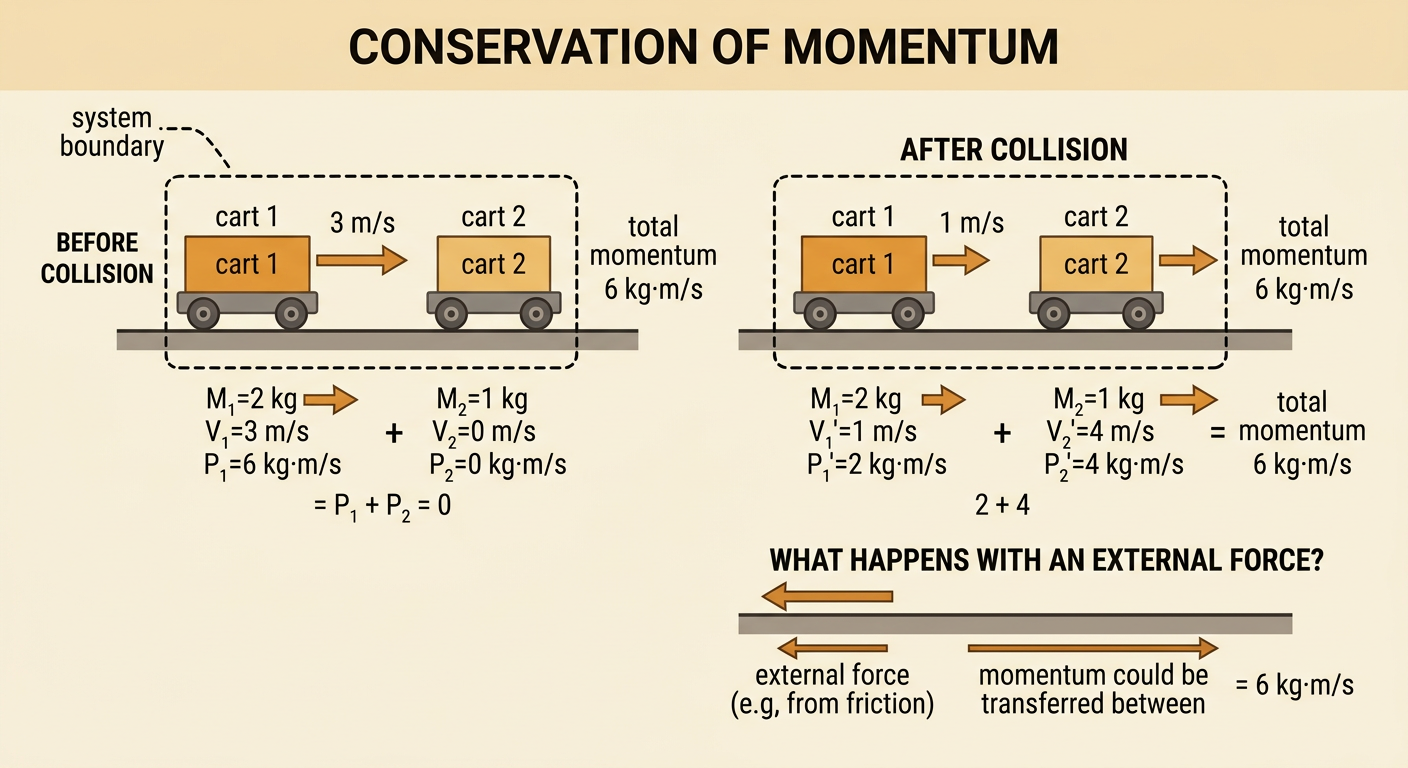
A system's total momentum remains constant when no net external force acts on it. Internal forces, such as the forces two colliding carts exert on each other, can change each object's momentum but not the system's total momentum. Mathematically, total momentum before equals total momentum after. Consider a 2-kilogram cart moving right at 3 meters per second toward a stationary 1-kilogram cart. The initial system momentum is 6 kilogram-meters per second to the right. If the first cart moves right at 1 meter per second after the collision, it has 2 kilogram-meters per second of momentum. The second cart must therefore have 4 kilogram-meters per second of momentum to the right, so its velocity is v = p/m = 4 meters per second. Friction or another external force would transfer momentum between the carts and their surroundings, so the chosen system must be identified clearly.
Elastic and Inelastic Collisions
Momentum is conserved in every isolated collision, but kinetic energy is conserved only in an elastic collision. In an elastic collision, objects rebound without a net loss of the system's kinetic energy. For example, when one identical low-friction cart strikes another identical stationary cart elastically, the first cart can stop while the second moves away at nearly the first cart's original speed. In an inelastic collision, some kinetic energy changes into thermal energy, sound, or deformation. In a perfectly inelastic collision, the objects stick together. Suppose a 1-kilogram cart moving right at 4 meters per second sticks to a stationary 1-kilogram cart. Their initial momentum is 4 kilogram-meters per second. Using 4 = (1 + 1)v, their shared final velocity is 2 meters per second right. Their kinetic energy decreases from 8 joules to 4 joules, although total energy is still conserved in other forms.

Vehicle Safety Application
Vehicle safety systems use the impulse-momentum relationship to reduce injury. During a crash, a passenger's momentum must change from mv to zero. For a fixed momentum change, J = F average times change in time shows that increasing the stopping time decreases the average force. For example, a 75-kilogram passenger moving at 20 meters per second has 1,500 kilogram-meters per second of momentum. If the passenger stops in 0.05 second, the average force magnitude is 30,000 newtons. If a seat belt, airbag, and crumple zone increase the stopping time to 0.20 second, the average force falls to 7,500 newtons. The impulse is the same in both cases, but the longer stopping time reduces the force. Seat belts also spread force across stronger parts of the body, airbags cushion contact, and crumple zones deform to extend the collision while the passenger compartment is designed to resist intrusion.
