
Momentum, Impulse, and Collisions
Students use momentum conservation and impulse to analyze collisions and evaluate safety features that reduce impact forces.
Illustrations are auto-generated and may be placeholders. They can be refreshed to match the narration.
Momentum and Its Units
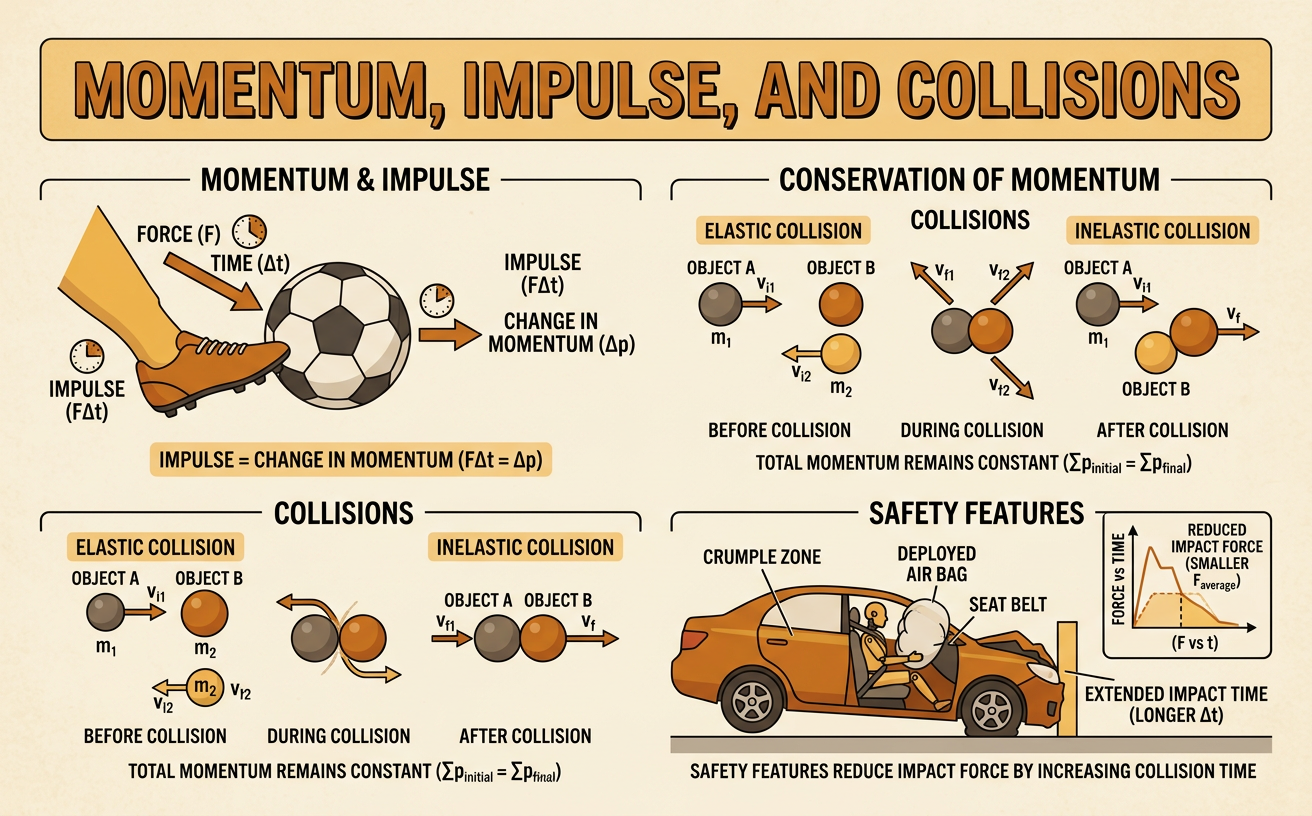
Momentum describes the motion of an object by combining its mass and velocity. It is calculated with the equation p = mv, where p is momentum, m is mass in kilograms, and v is velocity in meters per second. The SI unit of momentum is kilogram-meter per second, written kg·m/s. Momentum is a vector, so its direction matters. A positive or negative sign can represent opposite directions along a chosen axis. For example, a 1,200 kg car traveling east at 15 m/s has a momentum of 18,000 kg·m/s east. A 2,400 kg truck moving east at the same speed has twice that momentum. An object at rest has zero momentum because its velocity is zero, even though it may have a large mass.
Impulse-Momentum Theorem
Impulse is the effect of a force acting over a time interval. For a constant force, impulse is calculated as J = FΔt, where F is force and Δt is elapsed time. The impulse-momentum theorem states that J = Δp = mvf − mvi. Therefore, the same change in momentum can result from a large force acting briefly or a smaller force acting longer. Suppose a 0.15 kg baseball changes velocity from 0 m/s to 40 m/s. Its momentum changes by 6.0 kg·m/s, so the impulse is 6.0 N·s. If contact lasts 0.010 s, the average force is 600 N. If a padded surface extends contact to 0.030 s while producing the same impulse, the average force decreases to 200 N.
Conservation of Momentum
In an isolated system, total momentum remains constant. This means the vector sum of momentum before an interaction equals the vector sum afterward: Σpbefore = Σpafter. External forces such as friction can change a system’s momentum, so collision models often assume those forces are negligible during the short impact. Consider a 2 kg cart moving right at 3 m/s that collides with a stationary 1 kg cart. If the carts stick together, their initial total momentum is 6 kg·m/s to the right. Their combined mass is 3 kg, so 6 = 3vf and vf = 2 m/s to the right. Momentum is conserved even though each cart’s individual momentum changes. Defining the carts as one system makes the internal collision forces cancel in equal and opposite pairs.
Elastic and Inelastic Collisions
Momentum is conserved in both elastic and inelastic collisions when the system is isolated. Kinetic energy distinguishes the collision types. In an elastic collision, total kinetic energy and total momentum are conserved. For example, when one identical billiard ball strikes another head-on, the first ball may stop while the second moves away at nearly the first ball’s original speed. In an inelastic collision, momentum is conserved, but some kinetic energy is transformed into sound, thermal energy, or deformation. A perfectly inelastic collision occurs when objects stick together. For instance, a lump of clay striking a stationary cart may remain attached, and the combined objects then move at one shared velocity. The missing kinetic energy has not disappeared; it has changed form. Real vehicle collisions are usually inelastic because vehicle structures bend, crumple, heat, and produce sound.
Engineering for Collision Safety
Collision-safety systems reduce injury by increasing stopping time, spreading force over a larger area, or controlling deformation. Seat belts stretch slightly, airbags compress, helmets contain crushable foam, and vehicle crumple zones deform. Each feature increases the time over which a person’s momentum changes, reducing average force according to Favg = Δp/Δt. For example, if a passenger undergoes a 3,000 N·s impulse, stopping in 0.050 s would produce an average force of 60,000 N. Extending the stop to 0.150 s lowers it to 20,000 N. Engineers compare test data, cost, reliability, and unintended risks when choosing designs. Students can use this evidence to argue for an effective safety solution. Governments also establish seat-belt laws, helmet rules, crash-test standards, and airbag requirements. Evaluating these policies involves comparing reduced injuries and deaths with costs, enforcement concerns, and individual responsibilities.